


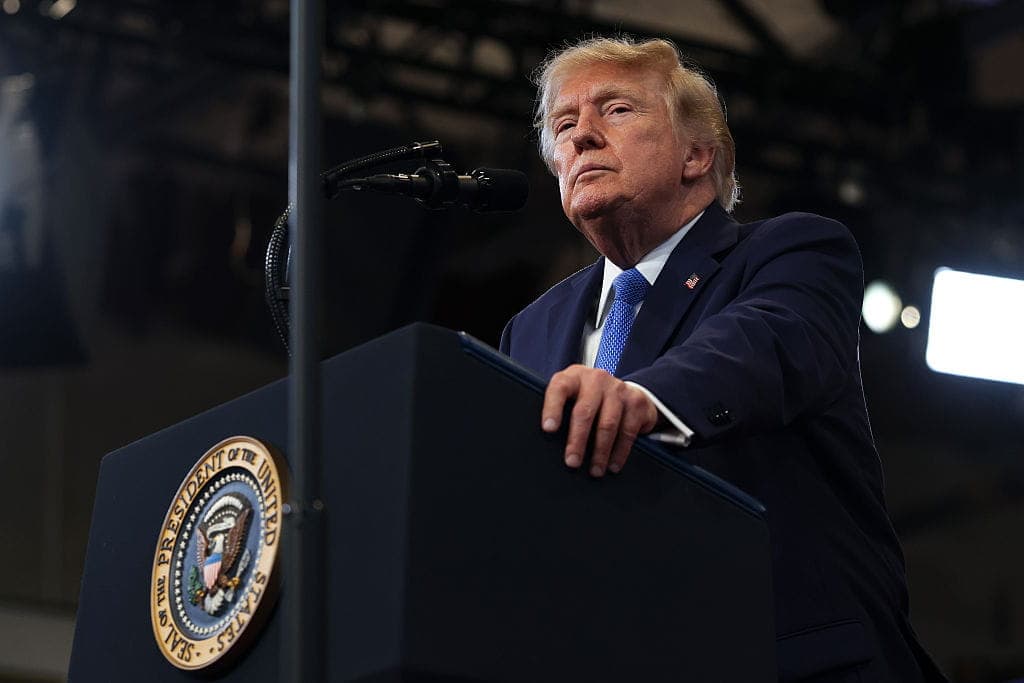

When you first look at President Donald Trump’s endorsement to win ratio, the record is impressive. Aggregators like Ballotpedia’s Trump endorsement Tracker often show a success rate over 90%. But a closer look under the hood reveals a few cracks in that façade – and it’s usually his less conventional (from a MAGA perspective, anyway) endorsements that seem to miss the mark. So, is Donald Trump the kingmaker so many seem to think he is? Two Republican primary runoffs this week will certainly put that to the test.
A Tale of Two Runoffs
Tuesday, August 25, will decide the fate of four Republican candidates in two states and determine which ones go on to represent the GOP in November. One is a standard sort of endorsement you’d expect to see from the president, and it seems as likely as not to feed right back into the president’s high success rate. The other, however, is certainly a less conventional choice – and it’s one the MAGA base might not stand behind.
Oklahoma Governor Kevin Stitt (R) has reached his term limit and can’t run again. The ensuing nine-way, very expensive Republican primary came down to two: Gentner Drummond, currently serving as Oklahoma attorney general, came in first with 25.9% of the vote. Former state Senator Mike Mazzei came in a close second, though, with 25.5%.
Free with the Daily Briefing
85EssaysUnravel the Constitution
Hamilton, Madison & Jay’s complete case for America, free and searchable in the Publius Reader.
Free with the Daily Briefing. Unsubscribe anytime.
Drummond narrowly beat Mazzei in the primary, despite President Trump’s endorsement for the latter. But that was a razor-thin win, and it triggered a runoff. With the president and the state’s current governor backing him, and with the other seven competitors eliminated, Mazzei actually has a solid chance of coming out on top. The most recent polls show the two deadlocked at 44% each, leaving the remaining 12% of undecided Republicans holding all the power.
Still, this is the sort of endorsement anyone would expect from Trump. Mazzei won presidential backing after publicly supporting a major smelting project also backed by Trump and bringing long-time Trump ally Roger Stone on as a campaign consultant. Drummond, on the other hand, has proven a bit more independent and has sparred at times with Governor Stitt’s administration.
The South Carolina endorsement, however, is perhaps a bit less conventional. Darline Graham was appointed by Republican Governor Henry McMaster to fill her late brother’s seat in the US Senate, and now she’s hoping to keep it. She beat Rep. Ralph Norman 32.7% to 24.6%, and she did so with Trump’s endorsement.
Now, Darline is the sister of the late senator, who was also Trump’s staunch ally, yes. But Ralph Norman is an experienced legislator and a prominent member of the House Freedom Caucus. He has a long voting record of backing the America First agenda and pushing for deregulation. He’s a proven electoral winner, MAGA conservative, and seems like the natural recipient of the movement’s grassroots support.
Norman has wondered aloud recently about the oddity of the president’s choice – though he has walked a fine line by openly questioning the political logic without attacking Trump personally. In an interview with the Associated Press, Norman called it a “head scratcher.”
Putting Trump to the Test
History shows that an endorsement from Donald Trump isn’t an automatic win – and a few cases highlight that in relevant ways. First, the president’s record isn’t nearly as good when he’s betting against an incumbent. In 2022, Trump famously backed Rep. Jody Hice against Secretary of State Brad Raffensperger and even recruited former Senator David Perdue to run against Governor Brian Kemp in Georgia’s Republican primary. Both incumbents went on to crush their primary challengers by wide margins.

Maybe that means the power of incumbency is simply stronger than that of a Trump endorsement. Maybe not. Kemp had a solid record of delivering conservative policy wins on guns, taxes, and abortion while maintaining a good connection with the state’s business and grassroots networks. Voters were handed a choice between a proven, popular governor and a mandate from Trump, and their choice might have had just as much to do with Kemp’s record as his incumbency. And, after all, incumbency didn’t help Sen. Bill Cassidy (R-LA), who not only lost his primary to a Trump-backed challenger but came in third.
Then there’s the ideological and grassroots mismatch. Back in 2017, Trump backed establishment-appointed Senator Luther Strange in Alabama’s special Senate primary runoff. The base wasn’t having it, though. They chose the much more controversial Roy Moore. In 2022, the president endorsed agribusiness exec Charles Herbster in Nebraska’s gubernatorial race. But the people followed their outgoing governor’s lead and chose Jim Pillen instead.
So, does Trump really carry the clout he appears to have in down-ballot elections? Perhaps and perhaps not. Either way, Tuesday’s runoffs may put it to the test.

.jpg&w=1920&q=75)