


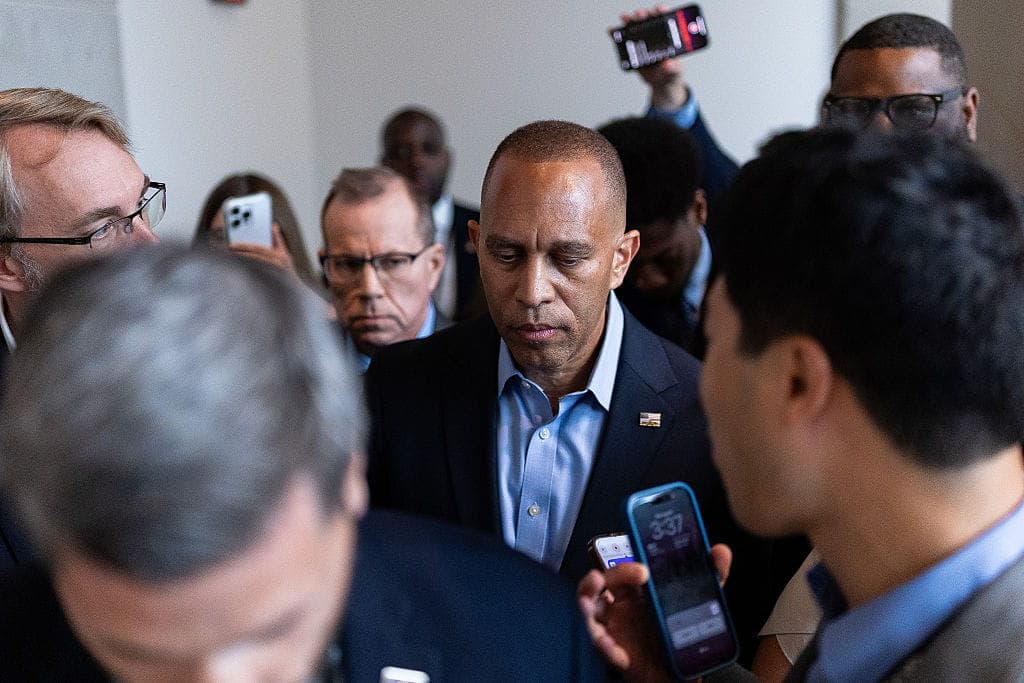

As is standard when Congress passes a piece of legislation, the losing team takes pains to deride and castigate the victors, often denouncing the measure as nigh on apocalyptic. But what happens when stalwart members of your own party break ranks and join the other side? That’s precisely the dilemma House Minority Leader Hakeem Jeffries (D-NY) now faces. More importantly, his reaction to two of his own bucking the party line provides insight into how a potential Democrat House will operate if the midterms go as predicted.
Democrat Action?
On Tuesday, Sept. 1, Reps. Jared Golden of Maine and Marie Gluesenkamp Perez of Washington State voted alongside most of the GOP caucus on a procedural measure to set the rules for the floor agenda. The final tally came in at 210 to 208, meaning if it weren’t for the Democratic duo, the Republican legislative agenda would remain stalled.
Jeffries was less than pleased, writing alongside the party whip and caucus chair that:
“The decision by two of our colleagues to blindside the entire House Democratic Caucus and join with the Republican majority to pass a procedural rule on the brink of failing represents a significant breach of trust. It is an action that necessitates a serious response, and we have asked the Committee on Caucus Rules to take this up in short order.”
Former House Speaker Nancy Pelosi (D-CA) expressed her own disbelief and perhaps twisted the knife a little when she said, “I, as speaker, never … we didn’t even consider that anybody would do that.” Concluding, she added, “We never had that problem, so I’m disappointed that they did that.”
The tone of the two party leaders is certainly strident, but what can the Caucus Rules committee really do?
Warning Shots Only
Golden is arguably not going to feel much pain regardless of the ultimate outcome. He is not running for re-election, so the usual punishments – such as stripping committee assignments, being banished from the leadership circle, or even losing campaign support – are pointless. He could theoretically face party censure or reprimand, but what would be the point?
As Golden explained after the ballot, he voted to advance his own piece of legislation, which would directly impact his Maine constituents:
“I think any member of Congress who introduces a bill for their constituents would be insane to turn around and sink a rule that contains that bill … So I think that’s pretty straightforward, right? Like, you came here to represent some people, you got to stand by them when it counts.”
Golden will leave the House in January, heralded by his fellow Pine Tree staters as someone who put constituents before party. Jeffries cannot do much to harm that perception.
As for the other Democrat rebel, she has what might fairly be termed “insurance.”
Use It or Lose It
Gluesenkamp Perez won a heavy Republican district in southwest Washington State in 2022. It was a rare pickup in MAGA country, and her victory was touted as the “model” for winning back blue-collar voters. A centrist who generally eschews partisanship, she has navigated the culture wars with care.


Free with the Daily Briefing
85EssaysUnravel the Constitution
Hamilton, Madison & Jay’s complete case for America, free and searchable in the Publius Reader.
Free with the Daily Briefing. Unsubscribe anytime.
Naturally, she is a thorn in the side of the more progressive elements in her state, and she advanced through Washington’s all-party primary to secure a spot on the ballot while fending off a serious challenge from her left. She will face Republican state Sen. John Braun in November, and retaining that seat is key for Democrats to reclaim the House.
It’s unclear how hard Jeffries and the Caucus Rules committee will come down on her, making it difficult to estimate the fallout if they do. Either way, it will upset whatever electoral math has thus far been calculated. She’ll need the party’s full backing to win, and any censure or lack of support could derail her bid.
Which brings us to the vision of the future.
It’s Fractured, Deal With It
Going against the party whip to vote for rules is rare – not unheard of – but it is generally not done by those who want to remain in leadership's favor. The November midterms could well give Jeffries the top spot in the House. However, it will be alongside a distinctly split caucus, in which Democratic Socialists of America members and uber-progressives hold a significant chunk of power – as in they could block not only his speakership but also almost any vote he wants passed.

Just how much reprimanding will he have to do to corral the factions soon to descend on the people’s House? As Liberty Nation News’ Tim Donner explained in a recent episode of Liberty Nation Radio, President Trump might be happier if his party does not control the lower chamber. After all, the GOP will likely still hold the Senate when the dust settles, so any legislative actions Democrats try to take can be stymied. But also, having a two-year track record of achieving nothing as they head into the 2028 presidential election bodes well for whoever becomes the Republican nominee.
A third factor to include, and one exemplified by Jeffries’ reaction to the pair of wayward lawmakers, is that a Democrat House in 2027 will likely be a chaotic affair filled with backbiting and division. If he can’t command compliance or punish those he relies on for any hope of building an agenda, it’s going to be a tough two years for Jeffries and the country.