


“If an American corporation needs workers, it should hire and train Americans.” That was an X post by Vice President JD Vance, a message that started a maelstrom across social media and beyond. He was referencing H-1B visas, saying employers should seek out American workers before turning to nationals from other countries. Ankit Gupta, a partner at Y Combinator, a venture capital firm, sniped back: “In a win for the woke left[,] DEI is back.” Has it really come to this: Hiring American citizens is part of the diversity, equity, and inclusion movement?
DEI Gets the America First Treatment
Not everyone approved of Gupta’s post. “No, Ankit,” Labor Department Inspector General Anthony D’Esposito wrote. “It’s called putting your own citizens first.” He also argued that companies should prioritize American jobs and workers – as Vance and Gupta wrote, just without the DEI association.
Federal Trade Commission Chairman Andrew Ferguson shot back at Gupta, saying:
“Y Combinator is a supposed champion of 'Little Tech' but perhaps they’re nothing more than a front for the far left. I’m deeply uncomfortable with wealthy investors attacking American workers like this. I’m afraid it’s increasingly obvious to many people that individuals such as this guy do not have the best interests of America and her citizens in mind. The purpose of the American economy is to promote the general welfare of American workers, not provide jobs for the rest of the world."
Nalin Haley, the son of former UN Ambassador Nikki Haley, also had strong words for Gupta:
"It’s now DEI to train and hire Americans? Plenty of data to show that Americans are more than qualified, but corporate greed refuses to pay them respectable wages. You can have a meritocracy in AMERICA but it has to apply to AMERICANS. Otherwise we’re just a globalist entity and not even a country anymore. Ban the H-1B Visa now!"
It appears most people believe Americans should come first, but not everyone agrees that citizens should be categorized as DEI.
The H-1B Visa Controversy
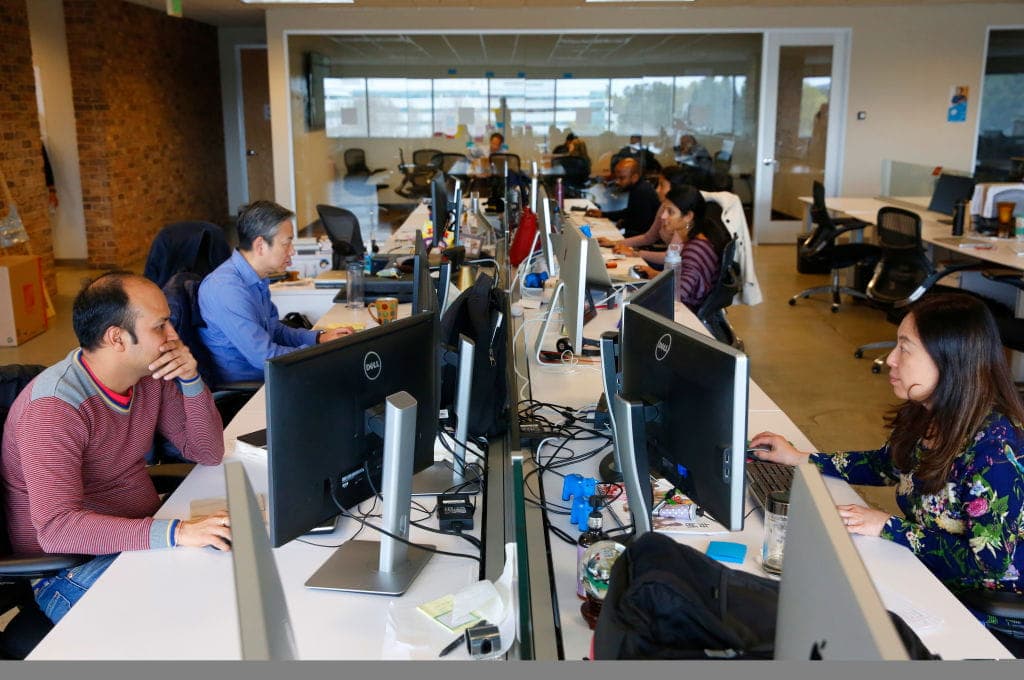
The H-1B visa program allows US employers to hire foreign professionals in specialty occupations on a temporary basis. The candidates are required to have at least a bachelor’s degree, usually in engineering, technology, or healthcare. Currently, the largest number of applicants are from India, followed by China, two countries with which America has strained relationships.

Critics argue the H-1B program has undercut American wages and displaced US workers, especially in tech jobs. Supporters, though, claim it fills skill gaps and stimulates economic growth. They argue this is especially true in California, the epicenter of the tech industry.
The Golden State had the highest number of approved H-1B petitions in fiscal year 2025. California Globe said it accounted for around 30% or more of the applications and petitions in “recent periods, with tens of thousands of certified filings annually"; the average offered wages often exceeded $160,000. Furthermore, “Historical data show California peaking near or above 100,000 H-1B-related employees in prior years.”
In addition, the Globe reported earlier this year:
“Two-thirds of Silicon Valley’s nearly 400,000 tech jobs are held by foreign-born workers. India-born employees account for 23 percent and China-born for 18 percent – together outnumbering U.S.-born workers at just 34 percent, according to a 2025 Joint Venture Silicon Valley report.
“This transformation extends to the C-suites. Major companies are now led by foreign-born executives: Microsoft’s Satya Nadella, Alphabet’s Sundar Pichai, Adobe’s Shantanu Narayen, IBM’s Arvind Krishna, Intel’s Lip-Bu Tan (Malaysian-born), YouTube’s Neal Mohan, and T-Mobile US’s Srinivas Gopalan — many from India. Silicon Valley, pioneered in American garages by Jobs, Hewlett, Packard, Noyce, and Moore, has gone global at the expense of domestic workers.”
According to a 2025 National Foundation for American Policy analysis, approximately 700,000 people on H-1B status live and work in the United States.
In 2025, Sens. Charles E. Grassley (R-IA) and Richard Durbin (D-IL) sent a letter to Microsoft expressing concerns about the unemployment rate in the tech industry and the hiring of foreign nationals. According to their missive, the tech sector’s unemployment rate was “well above” the overall jobless rate. Additionally, the Federal Reserve found that recent American graduates with STEM majors now face higher unemployment rates than the general population.
They mentioned mass layoffs, adding:
“At the same time you have been laying off thousands of American employees, you have been filing H-1B visa petitions for thousands of foreign workers. In fiscal year 2025, you applied for and received approval to hire 5,189 H-1B employees, making Microsoft the third-largest employer of newly approved H-1B beneficiaries in the nation. With all of the homegrown American talent relegated to the sidelines, we find it hard to believe that Microsoft cannot find qualified American tech workers to fill these positions.”
The Trump administration wants to make it more expensive for companies to bring in new H-1B workers. Under the proposal, employers would have to pay a new $103,265 fee on top of what they already pay. The Department of Homeland Security estimates it would apply to about 85,000 petitions each year and could bring in roughly $8.8 billion annually. This is separate from Trump’s earlier $100,000 H-1B payment, which became tied up in a federal court battle.
But the changes aren’t just about collecting more money. The administration also wants to raise the wages companies must pay H-1B workers, making it harder for businesses to use the program simply to find cheaper labor. The goal is to give American workers a better shot at those jobs and remove the financial advantage of hiring someone from overseas. Critics argue the changes could make it harder for companies to recruit highly skilled foreign workers when they can’t find Americans with the expertise they need.