

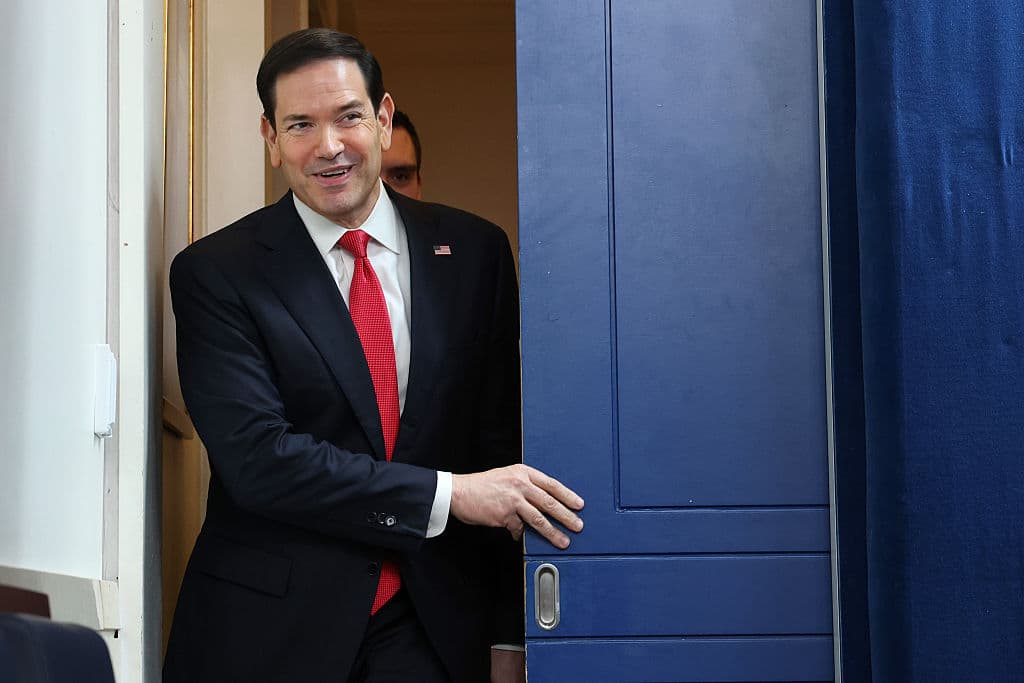

If you have been paying attention to the news since Donald Trump returned to the Oval Office, and, particularly these days, you may have noticed that one top administration official not named Trump has enjoyed repeated maximum public exposure. It is no secret that Secretary of State Marco Rubio has been a central figure in shaping and executing Trump's "maximum pressure" campaigns and military operations, particularly regarding Iran and Venezuela. The president’s confidence in his former rival appears to be almost limitless. And after Rubio's masterful performance in a press conference at the White House discussing the war with Iran on Tuesday, it is it easy to see why..
While Vice President JD Vance remains the frontrunner to represent the Republican Party on the 2028 presidential ticket, support for Rubio has grown considerably. It is now easy to envision a robust, perhaps even nasty, debate between backers of the two most major political figures in the GOP outside of the 47th president.
JD Vance Is No Slam Dunk
So how did we get to the point where the vice president is no longer considered a slam dunk for 2028? Upon Trump’s election to a second term and based on his own solid performance during the presidential campaign, Vance was widely considered the de facto frontrunner for 2028, especially after Rubio announced publicly that if Vance runs, he will support him and stay out of the race. But over the years, ambition, the temptation of power, and the call to service have caused many a politician to reverse course.
While Vance has done little to damage his brand and continues to be arguably the most articulate spokesman for the Trump agenda, he has fallen victim, so to speak, to events out of his control. Specifically, an avalanche of major military and diplomatic actions has turned the spotlight from the VP to Rubio, who enjoys the rare distinction of serving as both Secretary of State and National Security Advisor. Only Henry Kissinger previously held both positions at the same time under President Richard Nixon. Thus, he is assured high visibility as both the country’s chief diplomat and a key war strategist.
When the president unleashed American Special Forces to capture Venezuelan dictator Nicolas Maduro in the dark of night, Rubio was central to the planning. When Trump sought to stabilize the country following that daring attack, he picked Rubio as his point man, and he has since been called in some circles the de facto “governor of Venezuela.” But the consequences of that mission were not limited to Venezuela. In essentially quarantining the country’s massive oil supply, the lifeline for impoverished Cuba was severed, leaving the Communist regime in Havana teetering as never before. So, whom did Trump pick to control subsequent negotiations with Cuba? Rubio, of course, in what is undoubtedly a particularly sweet assignment given his Cuban heritage.
You could not afford to pay for this level of visibility and perceived competence. In a federal government so bitterly divided, Rubio is one of the few Trump appointees who commands respect among his former colleagues on both sides of the aisle in the Senate, as evidenced by their 99-1 vote in favor of his confirmation. Like Treasury Secretary Scott Bessent in the financial realm, Rubio has been relatively immune from direct attacks by the media.
Rubio — High Ceiling, Low Floor
But there is a counter-argument to be made about the rise of Rubio. If things head south on the international front — if the war in Iran persists, chaos erupts in the Middle East, or future military adventures over the next two and a half years falter — it is Rubio more than Vance who will pay the price. Thus, the secretary has a high ceiling in victory and a low floor in defeat. The vice president, on the other hand, will neither be credited nor blamed for international policy outcomes to nearly the same degree as Rubio, whose exclusive portfolio is diplomacy and national security. On the other hand, if the economy is in trouble, Vance might absorb more of the blame.
At the same time, while Vance and Rubio are apparently close personally, that does not mean their followers are marching in lockstep. The VP is full-on MAGA, while Rubio cuts a broader swath across the right and among independent voters. Troubling to Vance’s most dedicated backers is that Rubio has, over his career, been defined as a neoconservative, which is anathema to Trumpists. During his time as a Florida senator, he was a staunch advocate for a muscular foreign policy, pushing for a stronger US presence in the Middle East and confrontation with China. While Trump voters have largely supported the president’s military strikes, including Operation Epic Fury in Iran, that could change quickly if the war escalates and the commander-in-chief decides to deploy ground forces.
But the most serious implication of a Rubio candidacy is the message it would send to disaffected Republicans. It would serve as an invitation for Trump-deranged neoconservatives such as Bill Kristol and the Lincoln Project crowd to return to the party they have scorned for a decade, undoubtedly bent on extinguishing the MAGA legacy and seizing control afresh. The ramifications of that possible scenario are explosive, far-reaching, and will be the subject of close examination on these pages as the months tick down between now and 2028.
The Conundrum
According to NBC News, Trump personally conducted a presidential straw poll among 25 donors at a Mar-a-Lago dinner recently. In the matchup between Vance and Rubio, one attendee told NBC that “it was almost unanimous for Marco.” Suppose President Trump continues his streak of impressive international accomplishments in both war and peace. That would clearly accrue to Rubio’s benefit. With three young children and a fourth on the way, is it possible that Vance, just 41 years old with a promising future ahead of him, might defer to Rubio this time around? It is not inconceivable.
Then there is the concept of a Vance-Rubio “dream ticket,” which would look good to Republican voters, but probably not to Rubio. For him, going from Secretary of State and National Security Advisor to vice president would amount to a step down for a man on the rise. All we know this early in the game is that Rubio’s popularity is increasing and that both men have substantial support among the GOP faithful. In the end, the appropriate question for voters may not be about what each has accomplished during the present administration, but rather, freed from the incomparably long shadow of Trump, how would they measure up on their own merits?