


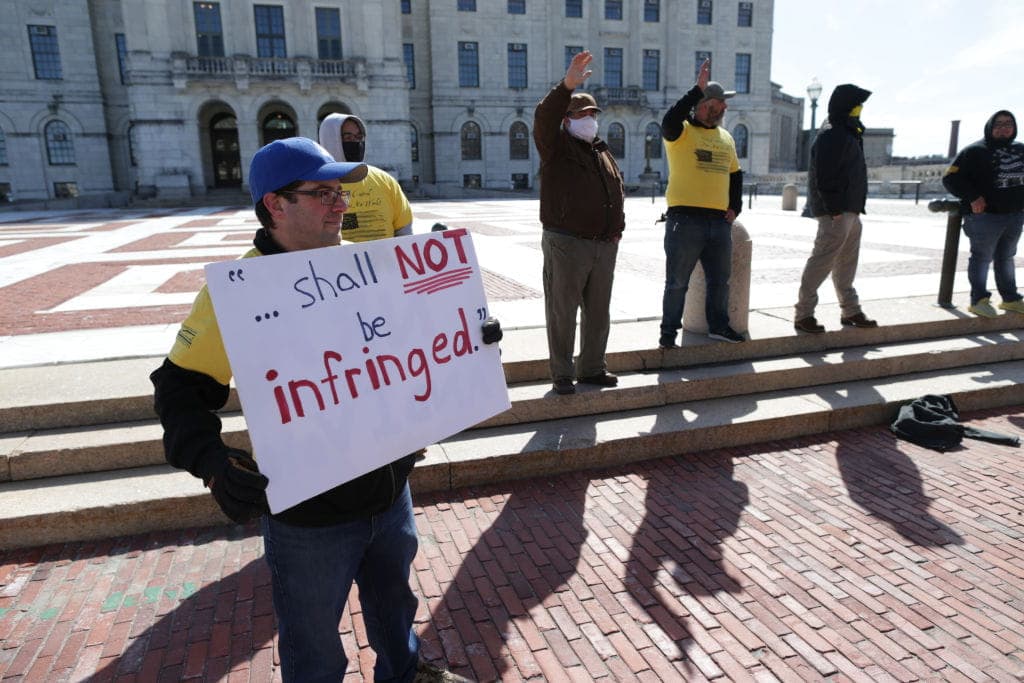

President Donald Trump’s second term is going to be remembered for several reasons. One of those will be the concerted efforts by Democrats at the state level to curtail gun rights. After several major wins at the Supreme Court for Second Amendment defenders in the past few years, Democrats have apparently determined that they will explore the very limits of their ability to disarm law-abiding Americans. The Commonwealth of Virginia became the most recent high-profile example. But in Rhode Island, lawmakers are taking the anti-gun philosophy to the extreme.
Legislators in Democrat-controlled Rhode Island have crafted legislation aimed at all but eliminating gun rights. Senate bill SB 2710 currently rests with the state Senate’s Judiciary Committee. It bans the manufacture, sale, purchase, transfer, and possession of a “prohibited firearm.”
What does the term “prohibited firearm” cover? Most common long guns. Thanks to a 2025 Rhode Island law, the list includes: semiautomatic rifles – essentially, all of them; semiautomatic rifles and pistols with a fixed (non-detachable) magazine capacity exceeding ten rounds; semiautomatic shotguns with a fixed magazine capacity exceeding six rounds; shotguns with revolving cylinders; and any semiautomatic firearm that accepts belt ammunition.
Dagger in the Heart of Gun Rights
The big problem in the proposed bill is the word “possess.” It’s a problem, of course, for gun rights advocates, but it’s also a pitfall for those who support the bill. When a legal challenge gets to the courts, as it inevitably will, there appears to be no possible way the proposed law would survive. It is, quite simply, a direct and very unambiguous violation of the Second Amendment.
Unlike many state-level bans on certain types of firearms, 2710 has no grandfather allowance. That means any Rhode Island resident who currently owns any of the semiautomatic rifles or shotguns in common use all over the country, or purchases one prior to July 1, 2026, will find themselves on the wrong side of the law. Those gun owners will have until the last day of the year to sell their weapon, or weapons, to a federally licensed firearms dealer or to a private citizen who lives outside the state.
Those licensed firearms dealers have the option to sell to out-of-state individuals, to law enforcement entities, or to other licensed dealers.
Of great concern for gun owners and gun rights advocates is the enforcement of this law, should it go into effect. The legislation does not specify how the law is to be enforced. Since it will be a crime to even “possess” these guns, having one in the house or in storage within the state would be a crime.
That raises the chilling specter of confiscation – even house-to-house inspections by law enforcement officers ordered to seize any weapons they find.
Rhode Island is going to war with the Second Amendment. Another piece of legislation being worked on would require gun owners to carry $1 million in liability insurance. Still another would require the completion of an eight-hour firearms safety course. Additional proposals include background checks for ammunition purchases, a limit of one gun purchase in a 30-day period, and legal liability for firearms manufacturers.
The Burden of Gun Control Laws
In an opinion piece for Fox News, the executive director of the National Rifle Association Institute for Legislative Action, John Commerford, points out the burdens this bill places on citizens. Forcing gun owners to sell their firearms within five months from the day the law would take effect will trigger a “rushed liquidation that will inevitably drive down prices.” That means owners will be selling their guns for a fraction of the purchase prices.
“In plain terms,” Commerford wrote, “the [Rhode Island] government would be engineering a fire sale of constitutional conduct, stripping citizens not only of their rights, but of their property value as well.”
It seems the anti-gun blue states have decided to test the limits of how far they can erode gun rights until they are forced to back off by the courts. And, perhaps, how much they can violate citizens’ Second Amendment rights without direct pushback from the gun owners themselves. Rhode Islanders who support gun rights would do well to remember that the Second Amendment supersedes all state-level gun restrictions, as other states have discovered.
Unfortunately, the Supreme Court has yet to underscore the inviolable nature of the Second Amendment as a whole. It rules often narrowly, based on the specific case. Since Rhode Island has decided to outlaw even the possession of weapons in common use and made it so that people who already own such weapons are now forced by law to get rid of them, this might be the case the Supreme Court needs to hear.
But even if this legislation becomes law and is then later struck down – as it almost certainly would be – there emerges an insidious pattern of anti-gun politicians constantly and deliberately making the exercise of Second Amendment rights increasingly expensive, inconvenient, and legally confusing. It may be that these politicians care not that their anti-gun bills get shot down. It has become a decades-long pattern of harassment of gun owners. Lawsuits cost money and time. No law-abiding citizen should be put in the position of having to expend that money and time to protect a right guaranteed by the Constitution.
This challenge is bigger than just gun rights, however. If a state can get away with gutting the Second Amendment, which other constitutionally protected rights might they decide are inconvenient or “dangerous”?


.jpg%20FISA&w=1920&q=75)
.jpg%20Starmer&w=1920&q=75)