

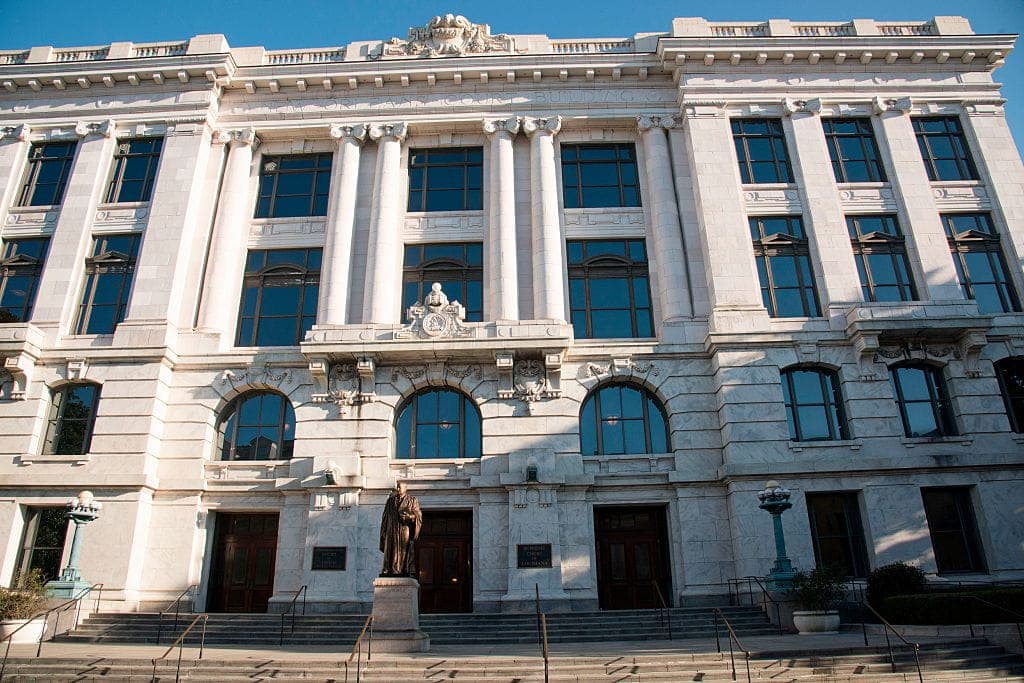

On April 29, the US Supreme Court ruled in Louisiana v. Callais that the state’s congressional voting districts constituted an unconstitutional racial gerrymander. Louisiana Gov. Jeff Landry promptly suspended congressional elections there, pending the creation of new districts. Redistricting without regard to race is expected to gain Republicans one to two House seats in a hotly contested midterm election season. On May 4, the Supreme Court granted a request that fueled rancor on the bench.
Issuing ‘Judgment Forthwith’
Under the rules, the certified judgment in Louisiana v. Callais would normally be issued 32 days following the release of the opinion unless the Court “shortens or extends the time.” On May 4, the Court indeed shortened it, issuing “judgment forthwith.” This essentially cleared the way for Louisiana to quickly redraw its districts, simultaneously undermining lawsuits seeking to preserve the pre-Callais voting districts.
Justice Ketanji Brown Jackson asserted that the majority’s decision to grant the application to issue the judgment forthwith served to interfere with the Louisiana election and expose the Court to accusations of political animus. Her dissent was sharp:
“To avoid the appearance of partiality here, we could, as per usual, opt to stay on the sidelines and take no position by applying our default procedures. But, today, the Court chooses the opposite. Not content to have decided the law, it now takes steps to influence its implementation. The Court’s decision to buck our usual practice under Rule 45.3 and issue the judgment forthwith is tantamount to an approval of Louisiana’s rush to pause the ongoing election in order to pass a new map.”
Sharp Judicial Swordplay
But Justice Samuel Alito’s concurring opinion dismissed such claims as “baseless and insulting,” emphasizing there was still time for Louisiana to change its map in time for the midterms. Otherwise, he wrote, “The dissent would require that the 2026 congressional elections in Louisiana be held under a map that has been held to be unconstitutional.”
But Justice Alito went further, rebuking Jackson while countering her claims of partiality:
“But the dissent does not explain why its insistence on unthinking compliance with Rule 45.3’s default rule does not create the appearance of partiality (by running out the clock) on behalf of those who may find it politically advantageous to have the election occur under the unconstitutional map. The dissent goes on to claim that our decision represents an unprincipled use of power … That is a groundless and utterly irresponsible charge … The dissent accuses the Court of ‘unshackl[ing]’ itself from ‘constraints’ … It is the dissent’s rhetoric that lacks restraint.”
Behind this juristic tension lies the modern American societal divide. It is not merely a possible pair of congressional seats in the balance, but as many as nine for the 2026 midterms and another 19 or more in 2028. Texas and Florida were redrawing their districts prior to the ruling. Alabama and Tennessee are doing so now. Callais is constitutionally seismic.
The Voting Rights Act has been used for decades to compel states and municipalities to employ race in drawing up voting districts. This has grown in impact, utilized by Democrats to craft favorable voting districts, and has become a sword of activist lawfare. Yet creating favorable circumstances for one racial group over another conflicts directly with the Equal Protection Clause of the US Constitution.
Louisiana Reclaims Constitutional Primacy
According to constitutional law, the Constitution is the highest law of the land (the Supremacy Clause), and any laws that conflict – including federal statutes – are subordinate. The Voting Rights Act is not on equal footing with the Equal Protection Clause: The Callais court ruled that Section 2 of the Voting Rights Act is limited to cases where there is strong evidence of intentional racial discrimination, and that race-conscious redistricting will be subjected to strict scrutiny in federal courts – the toughest of legal hurdles for review.
At core, then, the Callais decision has fully affirmed and held high the law of the land: that equality defeats equity; that government must ensure equality of opportunity, not of outcome; that cultural Marxism and racist critical race theory will not dominate America’s voting booths, tax structures, social programs, or public schools; and that Americans will be judged by the content of their character rather than the color of their skin.
Louisiana’s new congressional voting districts represent the front wave of a political and cultural return to colorblind America. The very fact that Democrats face the prospect of losing so many congressional seats once color-focused districting is eliminated demonstrates just how much they have used race to gain power. Now that the dice are no longer racially loaded, Republicans have gained a huge benefit in this pivotal voting year.
Justice Jackson wanted the Supreme Court to delay official certification of its Callais decision so that Louisiana could be compelled to preserve an unconstitutional status quo through the midterms. The Court’s latest decision makes far more sense, allowing the state to address the problem before the election. Preserving the Equal Protection Clause and universal equality should remain every citizen’s duty.
Dig Deeper Into the Themes Discussed in This Article!
Liberty Vault: The Constitution of the United States