


It started with one French high school’s complaints about crumbling classrooms. Six weeks later, protests have spread across at least seven European countries, police are firing tear gas from Paris to Tirana, and governments are scrambling to contain a wave of anger over everything from rents to pensions.
Protests Across Europe
France
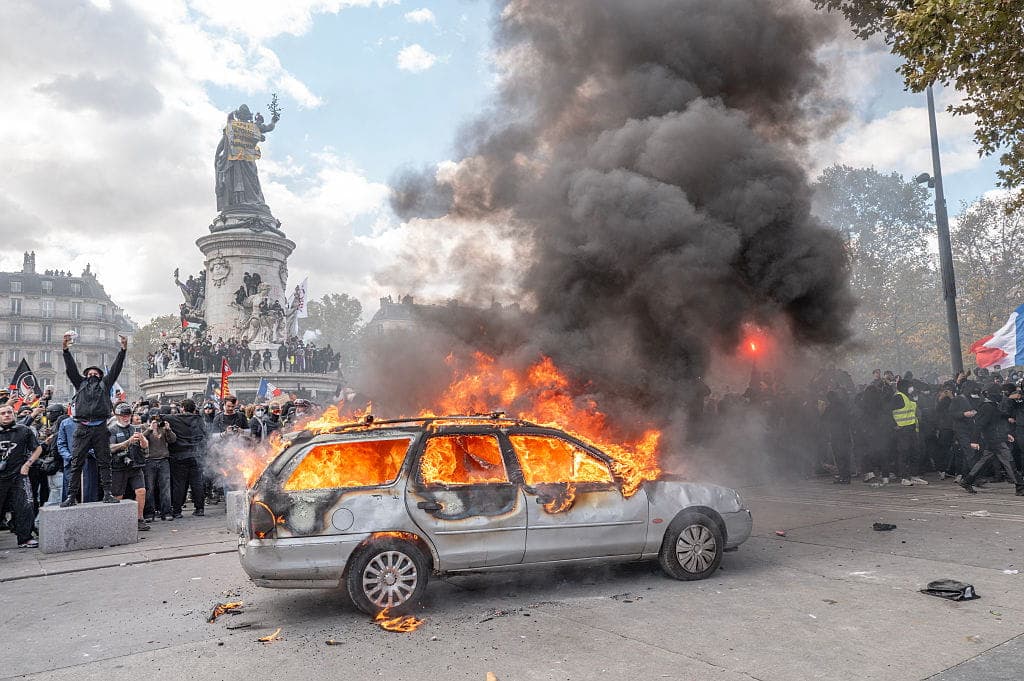
In September, students from one high school started to protest deteriorating conditions in their classrooms. They complained about teacher shortages, aging buildings, overcrowding, and diminished funding. Soon other schools, labor unions, and activists across France were demanding higher wages and better public services.
On Oct. 24, more than 400,000 people (800,000 according to the CGT labor union) were estimated to be demonstrating nationwide. Although the protests started out peacefully, some became violent, with masked protesters hurling objects and fireworks at police, who answered with tear gas, sound grenades, and water cannons.
Paris protester Louis Ledoux-Xatard told AP he was protesting because, he said, “Looking at countries like the United States, we don’t want to end up like them, where part of the population has everything and the others have nothing.”
This movement has become a major political challenge for French President Emmanuel Macron as demands rise to improve education and address inflation, economic inequality, and energy and housing costs. Some concessions were attempted, as Reuters explained, “The measures included a commitment to cap the size of some high school classes; €4 billion ($4.5 billion) of loans for renovating schools; and the replacement by 2028 of a university admissions system students see as socially unfair.”
The national debt is approaching 120% of GDP, and the chaos is boosting support for frontrunner Marine Le Pen for next year’s presidential election.
French authorities deployed 70,000 police officers across the country on Oct. 24, and Macron has vowed that demonstrators who destroy property or loot will be held accountable to pay for the damages.
Albania
In Albania, people are demanding education reform and an end to government corruption, calling for the resignation of the Socialist Prime Minister Edi Rama. Students joined an anti-government movement called Flamingo. “Ending corruption is a major demand of the movement, which was named for the natural habitat of flamingos in an area where Rama's government agreed to allow a major luxury tourism development linked to Jared Kushner, Trump's son-in-law. They also want protections for healthcare, education, and public pensions,” ABC News reported.
On Oct. 14, protesters attacked government buildings. Authorities said more than 300 protesters and police officers have been injured, and dozens of demonstrators have been detained since mid-month.
Belgium
Protests are demostrating against education reforms and government budget cuts. Some demonstrations turned violent, with protesters confronting police, damaging property, and blocking roads. Interior Minister Bernard Quintin accused far-left activists, including those allegedly connected to Antifa, of infiltrating the mayhem and encouraging young people to become violent.
Greece
Greece isn’t experiencing violent protests and the crowds are smaller, but protesters have many of the same concerns as the French. Demonstrators include students, teachers, and civil servants who have education concerns and object to the high cost of living.
Italy
“Italia in Piazza,” or Italy in the Streets, is one of the protests going on, with thousands of participants across the country. Inflation rose to 4.2% in September, and demonstrators demanded healthcare, education, higher wages, and access to housing.
There were not only peaceful marches but also fiery riots in Bologna, Milan, and Turin, where stores were looted and property was set ablaze. Prime Minister Giorgia Meloni condemned the violence and the “thugs,” who she said used the demonstrations to “sow chaos.”
Portugal
Portugal’s protests have focused on the housing crisis. Residents believe the high cost of rents and property are making it difficult for working people and younger adults to live in major cities.
Spain
Spain’s protests began in September and addressed several issues. The most pressing are housing affordability and retirement benefits. Young Europeans are experiencing “a strong sense of uncertainty and a lack of control,” María Silvestre, professor of sociology at the University of Deusto in Spain, said, according to ABC News. “And when specific situations come together, a spark suddenly ignites that is capable of channeling that discontent and driving people into the streets.”
Teachers began an “indefinite” strike in Madrid, demanding better working conditions and pay. Also, in the city’s Puerta del Sol plaza, more than 1,200 tents cover the area to protest the high cost of housing. Spain’s monthly minimum wage is 1,221 euros ($1,370) while the average rent for an apartment is around 1,130 euros ($1,270), ABC News explained.
The government approved affordable housing measures, but they didn’t get the support needed in Parliament.
On Oct. 24, protests continued in Madrid, with demonstrators demanding increased pensions tied to inflation, preventing public retirement benefits from privatization, and closing the pension gap between men and women.
Dissatisfaction Spreads
What began with one French high school’s complaints has spread across a continent in a matter of weeks. The grievances – rents that swallow paychecks, pensions that don’t keep pace, schools that are falling apart – are hardly unique to Europe. One Paris protester said he marched because he didn’t want France to end up like the United States. Americans might ask a different question: How long before we end up like France?