Five hundred and twenty-seven colleges and universities have accepted foreign gifts and contracts for a total of $62.4 billion – that we know about. China has given more than $4 billion to US universities, and it’s only the fourth highest on a list displayed on the Department of Education’s new online portal. It shows how much money American universities have received from foreign gifts and contracts, part of President Donald Trump’s effort to ensure these institutions are transparent about funds from outside the country. Getting universities to disclose information, however, is the easy part. China and Soft Power In April 2025, Trump signed an executive order directing the Department of Education to robustly enforce Section 117 of the Higher Education Act, which requires institutions to disclose significant sources of foreign funding. He aims to end “the secrecy surrounding foreign funds” and to protect “the marketplace of ideas from propaganda sponsored by foreign governments.” Trump made Section 117 a priority during his first term, too, launching more than a dozen investigations. But then “[t]he floodgates opened during the Biden era,” said Joel Finkelstein, co-founder of the Network Contagion Research Institute (NCRI), speaking to The Free Press in April 2025. “This isn’t just a financial issue—it’s a national security crisis. Hostile powers are buying influence on American campuses at an industrial scale.” NCRI shared an exclusive report with The Free Press last year, showing totals that were nearly half of what the Education Department’s new portal revealed. These donations can help countries with interests antithetical to ours gain access to US campuses and steal sensitive research and technology while promoting “soft power” agendas. “Universities are repositories of a significant amount of commercial and national security information,” explained The Heritage Foundation in a 2024 report, “some of which is produced under contract with the government and U.S. companies.” Countries can also leverage financial investments to shape academic programs and establish language and cultural programs, such as China’s Confucius Institutes, which can potentially allow spies to view sensitive information and research. “Some Chinese spies enroll in graduate programs and work under leading researchers, even gaining access to labs working on pre-classified technologies.” In 2020, around 118 Confucius Institutes were scattered across the US, but by 2022, more than 100 had closed, according to the America First Policy Institute. But the National Association of Scholars reported in June 2022 that “many once-defunct Confucius Institutes have since reappeared in other forms.” China is the largest source of foreign donations to some of America’s most renowned universities, including Harvard, Columbia, and Stanford. Would it be too far of a leap to speculate whether a correlation might exist between China's influence in academia and the growing number of people who have a positive view of socialism? The Cato Institute discovered in a survey last year that 62% of young Americans have a favorable opinion of socialism. Ideologies are not difficult to spread, especially when a propagandee has access to young and malleable minds, primed by teachers who proselytize collectivist ideas. Overall, numerous Americans appear to have leaned further into collectivism over the last few years – so have China’s donations to American universities, at least on paper. A Springboard for Anti-Semitism The country with the highest total of donations to American institutions is Qatar, totaling $6.6 billion, nearly a third of which was contributed after 2020, as far as the public knows. Qatar is home to Education City, which hosts outposts of American universities, including Northwestern’s journalism school, Georgetown’s foreign policy school, and a Texas A&M engineering campus. Qatar may be a non-NATO ally of the US, but “the country is also known for harboring the leaders of Hamas and exporting political Islamism, including by supporting the Muslim Brotherhood, across the Middle East,” explained The Free Press. An official on the president’s antisemitism task force told The Free Press last year that the White House was investigating “alleged connections between foreign malign actors and student groups on campus.” Representatives from the Department of Education and Health and Human Services were reportedly “interviewing professors and students at universities about groups involved in campus protests and allegations of foreign ties.” An NCRI study published in 2025 found that the universities receiving foreign funding from authoritarian countries experienced a rise in antisemitic incidents. The institutions with rampant anti-Israel protests have the strongest relationships with countries whose interests conflict with those of the United States. The study also concluded that “providing massive financial support to campuses with ascendant illiberalism serves the interests of foreign actors hostile to the U.S. in particular or liberal democracy in general.” Knowing Is Half the Battle Now that we have a better picture of how much foreign cash is going to universities, what comes next? The Trump administration no doubt has its hands full, but transparency no longer appears to be the issue. We may never know the actual amount universities receive in foreign donations, but knowing the exact totals probably won’t do much to stop authoritarian governments from influencing Americans. It won’t help us understand to what extent these countries are propagandizing students and professors. China has been creeping into the US for years, buying land while Chinese nationals run criminal networks and dominate the illicit marijuana trade. Those threats are more physical and easier to identify. But the influence that these countries appear to have in universities is likely harder to determine and might prove impossible to undo. Propaganda grows roots, and by the time we know its full effects, it might be too late.
Politics Corey SmithJan 11, 2026
China and Qatar Give Billions to US Universities – What Do They Get?
When authoritarian governments have access to American campuses.
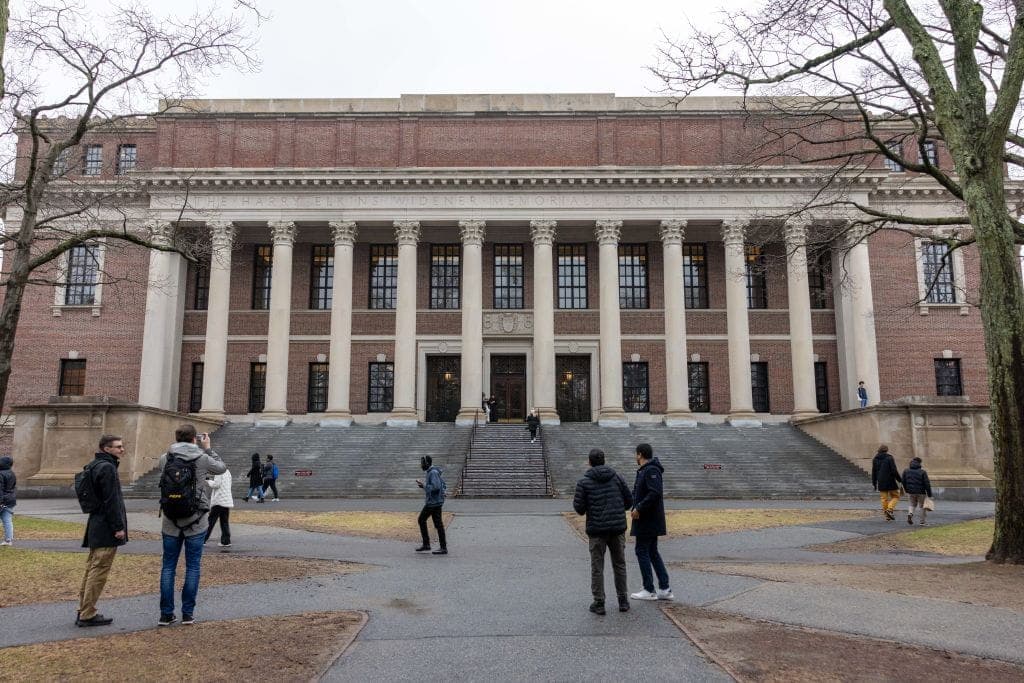
(Photo by Scott Eisen/Getty Images)
When authoritarian governments have access to American campuses.
Jan 11, 2026

Corey is a recovering bartender, and a freelance editor. He specializes in memoirs and novels but has a smorgasbord of experience in non-fiction works. In a former life, he ghostwrote several romance novels, which he denies. A cabin far away from sirens and motorcycles would be his ideal home. Instead, he lives near a construction site in New Hampshire.
Free with the Daily Briefing
85Essays
Unravel the Constitution
About the Author

Corey Smith
National Correspondent
Corey is a recovering bartender, and a freelance editor. He specializes in memoirs and novels but has a smorgasbord of experience in non-fiction works. In a former life, he ghostwrote several romance novels, which he denies. A cabin far away from sirens and motorcycles would be his ideal home. Instead, he lives near a construction site in New Hampshire.
View All ArticlesSpread the truth - share this article
See more Liberty Nation stories in Google's Top Stories.
Read More
Continue reading stories that matter

Did Trump's Visa Program Crash India's Stock Market? – Swamponomics
The timing was certainly eyebrow-raising....
Andrew Moran-Oct 22, 2026

Trump Sends a Timely Warning to Americans as France Burns
Socialists are making a deal with a devil that will destroy them....
Graham Noble-Oct 22, 2026
.jpg%20Ukraine&w=1920&q=75)
Potential Peace Breakthrough in Ukraine Negotiations
Could an unprecedented trilateral meeting with the leaders of Ukraine, Russia, and the United States create a longstandi...
Dave Patterson-Oct 22, 2026