


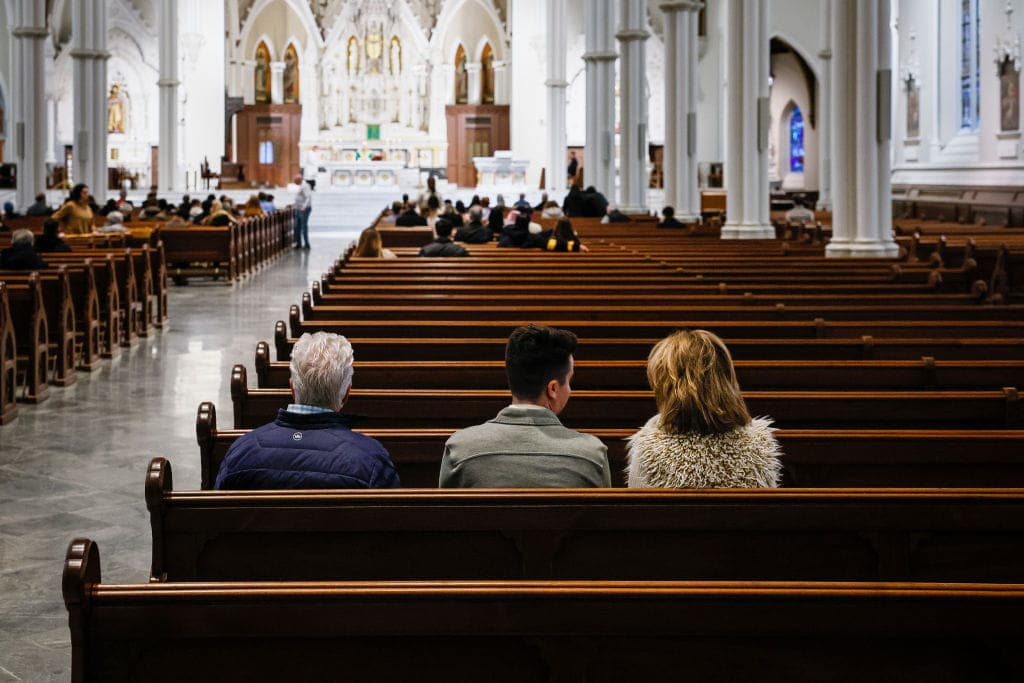

Stanford University is known for many things, but churning out converts to Catholicism isn’t one of them. Wealthy railroad titan Amasa Leland Stanford founded the school in 1885 as a memorial to his son, Leland Stanford Jr., who died of typhoid at age 15. In 1891, Stanford officially opened its doors as a non-denominational institution and ultimately made its name as a top-notch research school. It is not known for a religious studies program, nor does it attract students who feel called to go into ministry. In a nutshell, Stanford carries a level of prestige but has no particular religious bent. That’s what makes the current Catholic revival so shocking.
When Roman Catholic conversions on campus grew remarkably, people noticed, and the national media began to zero in on it. The school newspaper, The Stanford Review, called the movement a surge and provided some specifics:
“For three decades, the Catholic community at Stanford averaged 4 adult baptisms a year. This Easter, 46 students and young adults were fully initiated into the Church: 16 were baptized, 10 were received into full communion, and 20 Catholics were confirmed. The total of 46 is up from 14 initiations the year before.”
It may not sound like much; however, Fr. Bart Hutcherson, pastor of the Catholic Community at Stanford, confirmed that for the last three decades, there were fewer than a handful of converts per year. The crazy thing about this surge in the Catholic church at Stanford is that it appears to be replicating across elite universities nationwide. The school newspaper pulled participation data for the church's convert program, the Order of Christian Initiation of Adults (OCIA), from the Catholic prayer app Hallow, best known for its Mark Wahlberg commercials, and found involvement had surged 115%. Significant increases were found at the University of Southern California and New York University, and at Harvard it doubled. The data also showed the greatest growth occurred in public schools.
Unlike most Protestant denominations, the Roman Catholic Church is not particularly known for evangelizing and has largely eschewed door-to-door revival-style evangelism. It's happy to have growth, of course, but initiating conversions is generally not an in-your-face activity. This raises the question: What’s driving the growth of the Ecclesia Catholica Romana at elite US universities?
Catholic Revival: The Leading Edge of a Faith Renaissance?
As any advertising executive will tell you, celebrity testimonials matter. For years, Oprah Winfrey was the spokesperson for WW, formerly known as Weight Watchers. Likewise, on just about any day of the week, you can turn on your television and see Serena Williams hawking a GLP-1. So, is Mark Wahlberg the celebrity du jour, or is someone else behind the resurgence?
Free with the Daily Briefing
85EssaysUnravel the Constitution
Hamilton, Madison & Jay’s complete case for America, free and searchable in the Publius Reader.
Free with the Daily Briefing. Unsubscribe anytime.
Well, it just so happens that the vice president of the United States, JD Vance, is a Catholic convert who went to Yale Law School and wrote a book titled Communion: Finding My Way Back to Faith. It is a remarkable story, and Vance is a very good writer (Hillbilly Elegy was his first book, which rocketed to number one and spent more than a year on The New York Times best-seller list). Vance may not be the driver of Catholicism’s growth, but he is a cultural touchstone in a time when the death of Charlie Kirk has ramped up interest in Christianity.
In Communion, Vance talks openly about drifting away from several Protestant denominations after his family introduced him to Christianity. Vance’s experiences were shaped by an absentee father and a drug-addicted mother. His childhood was chaotic, marked by hunger, poverty, and the general instability of life in Appalachia. It wasn’t pretty.
So it isn’t surprising that, as an adult, Vance sought to revive his faith by turning to Catholicism. It is a faith with an intellectual bent. Thomas Aquinas's Summa Theologica is heavy slogging, and St. Augustine’s Confessions and City of God aren’t exactly beach reading either. Some may fear City of God, for instance, because of its sheer volume: over a thousand pages. Academic Catholics take their theology seriously, and they have two millennia of rich history to back up their faith.
From Liberty Nation News, Trivia, Facts, Check Us Out
Stay informed.
Today’s news, the Constitution and American history, written for young readers.
Visit GenerationLiberty.com
News, Trivia, Facts, Check Us Out
Stay informed.
Today’s news, the Constitution and American history, written for young readers.
Visit GenerationLiberty.com
For Vance, the calm, the sacraments, and the historic faith with its boundaries and clear cultural lines were a breath of fresh air to someone whose young life was marked by chaos and confusion. JD the boy had no stability, but JD the adult, a husband and father of four, says he found great solace in the Catholic faith.
What some consider drawbacks in the Roman Catholic Church are advantages to others. Some may complain about the fact that the Catholic Church needs to change with the times, while others are attracted by the fact that it doesn’t turn on a dime. Tradition may turn off some while others find it comforting. Whatever is causing more young people to be attracted to the Christian faith, the result is that students are leaving American universities with more faith than less, and that is something to celebrate. It is also a vast departure from godlessness and rampant progressivism.

.jpg&w=1920&q=75)