
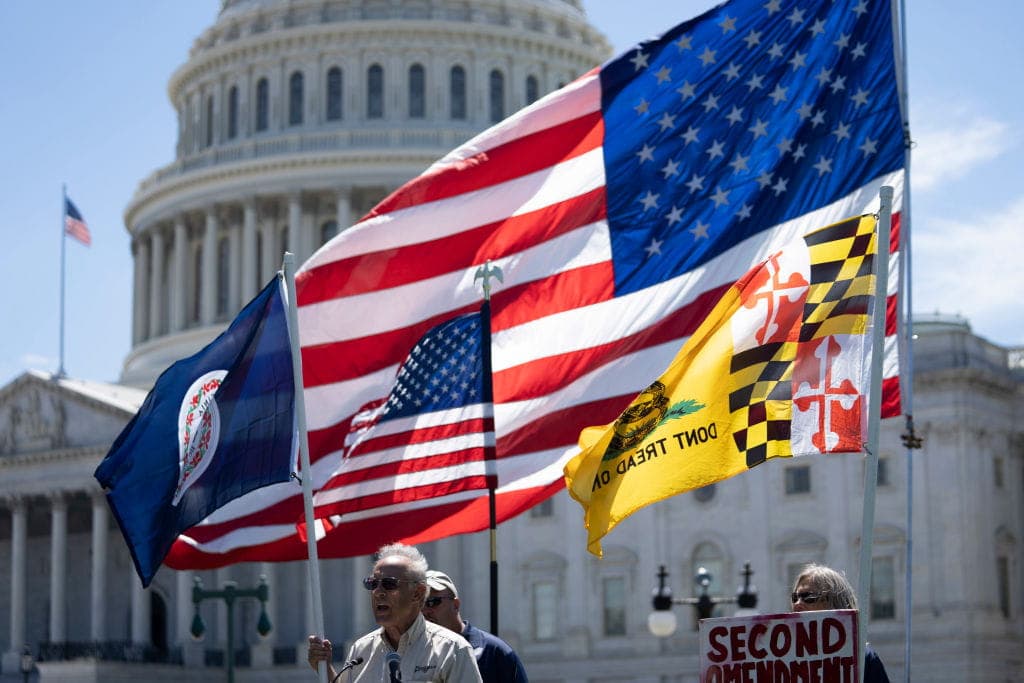

Daniel Defense is a Georgia-based family-owned gun manufacturer that has developed its own line of AR-platform semi-automatic rifles. The company professes ardent support for Second Amendment rights and it’s not the size of the big boys of the industry like Armalite or Remington. Perhaps those factors make it a ripe target for anti-gunners – as it has been in the past. Daniel Defense was sued this time over the company’s advertising, in part, which, the lawsuit claimed, inspired Raymond Spencer to carry out a mass shooting in Washington, DC, in 2022.
The National Rifle Association and the Second Amendment Foundation have now filed an amicus brief, urging the Supreme Court to take up the case. At the High Court, where Daniel Defense is the party seeking review, the case is styled Daniel Defense, LLC v. Lowy.
Free with the Daily Briefing
85EssaysUnravel the Constitution
Hamilton, Madison & Jay’s complete case for America, free and searchable in the Publius Reader.
Free with the Daily Briefing. Unsubscribe anytime.
The suit was filed by Karen Lowy, who was severely injured when some of Spencer’s rounds hit her car as she waited to pick up her child from Edmund Burke School. But, while any innocent victim of a shooting deserves sympathy, the suit itself seems to stretch the definition of the word “responsibility.” Originally, Lowy v. Daniel Defense, LLC was thrown out by a district court over standing and, separately, under the Protection of Lawful Commerce in Arms Act (PLCAA). But a divided Fourth Circuit panel reversed the standing ruling and brought the case back to life. Because the lower court had found no standing, the panel treated its PLCAA ruling as void, leaving that question for another day.
And Daniel Defense isn't the only defendant. The $75 million suit names 16 companies, plus 20 unnamed "John Doe" defendants, many of which do not manufacture firearms but produce various accessories, such as magazines and weapon lights.
Targeting the Second Amendment by Attacking the Gun Industry
Much of the filing against Daniel Defense and the other defendants reads like the boilerplate language often heard from anti-gun activists and politicians after every mass shooting. "For years, Defendants and other entities in the gun industry have, through their misconduct and illegal practices, profited off the actions of disturbed young men like the Shooter," reads one section. “They willfully ignored the public’s right to be safe from violence by placing weapons and other tools of war into the Shooter’s hands. They must be held accountable."
The coded language of those who seek to gut the Second Amendment is all there. “[T]he public’s right to be safe from violence,” “weapons and other tools of war,” “They must be held accountable.”
It all sounds very much like a suit carefully crafted by elements of the anti-gun lobby to hobble the firearms industry as a whole, rather than a sincere attempt to get some justice for the victims. And, in the harsh light of reality, Lowy’s justice came when Spencer took his own life. He was the one directly responsible for Lowy’s wounds – not the guns he had with him or the companies that manufactured them.
An Unprovable Claim
A specific point of contention in the suit is a claim that Spencer was inspired to commit his crimes by Daniel Defense advertising, characterized as employing militaristic themes. The thing is – as a Bearing Arms report points out – Lowy's legal team does not allege that the shooter ever saw the specific ads and posts the suit challenges. The complaint claims only that he was "exposed to and influenced by" the companies' marketing in general.
One would have to subscribe to a company email list or follow the company on social media or read the appropriate trade publications to even be aware of Daniel Defense's marketing. exists.
From Liberty Nation News, Trivia, Facts, Check Us Out
Stay informed.
Today’s news, the Constitution and American history, written for young readers.
Visit GenerationLiberty.com
In short, it's a steep hill to climb for Lowy’s attorneys to prove Spencer was in any respect influenced by any gun industry marketing. There is as much chance that he was inspired by movies, TV shows, first-person shooter games, a novel, or – more likely – by previous mass killings.
No firearm or accessory for it can be blamed for anyone getting shot. They are inanimate tools that only do what they are designed to do in the hands of a human being. And if it is not possible to prove that a specific product, ad, movie, or game influenced someone to kill, there’s no case. If this were not true, hundreds of movies, shooting games, and TV shows would already have been banned – and the companies that created them sued into bankruptcy.
End-Around Threats to Gun Rights
Those who are intent upon stripping the Second Amendment of all meaning have tried various ways to eliminate gun rights by circumventing the Amendment itself. Some of those ways include driving up the price of ammunition and even trying to ban certain types of ammo. There’s also, as is common practice in states controlled by anti-gun lawmakers, making would-be gun owners jump through unreasonable (and unconstitutional) hoops to exercise a protected right.
The Holy Grail for gun-grabbers would be crippling the civilian firearms industry. If they can forge a future in which guns are hard to come by – and, therefore, likely prohibitively expensive – then they will have effectively nullified the Second Amendment without any need to repeal or change it.
The 2012 Sandy Hook Elementary School shooting in Connecticut may have laid the foundation for Daniel Defense, LLC v. Lowy. Iconic American gun maker Remington was sued, and the company’s insurers decided to settle. The Lowy case, though, also brings up First Amendment issues, since the Supreme Court holds that business entities also have First Amendment protection — albeit reduced — which could cover Daniel Defense’s marketing materials.
If the Supreme Court declines to hear Lowy, and the Fourth Circuit decision stands, it potentially opens the floodgates to crushing lawsuits targeting the civilian firearms industry after every future mass shooting.