

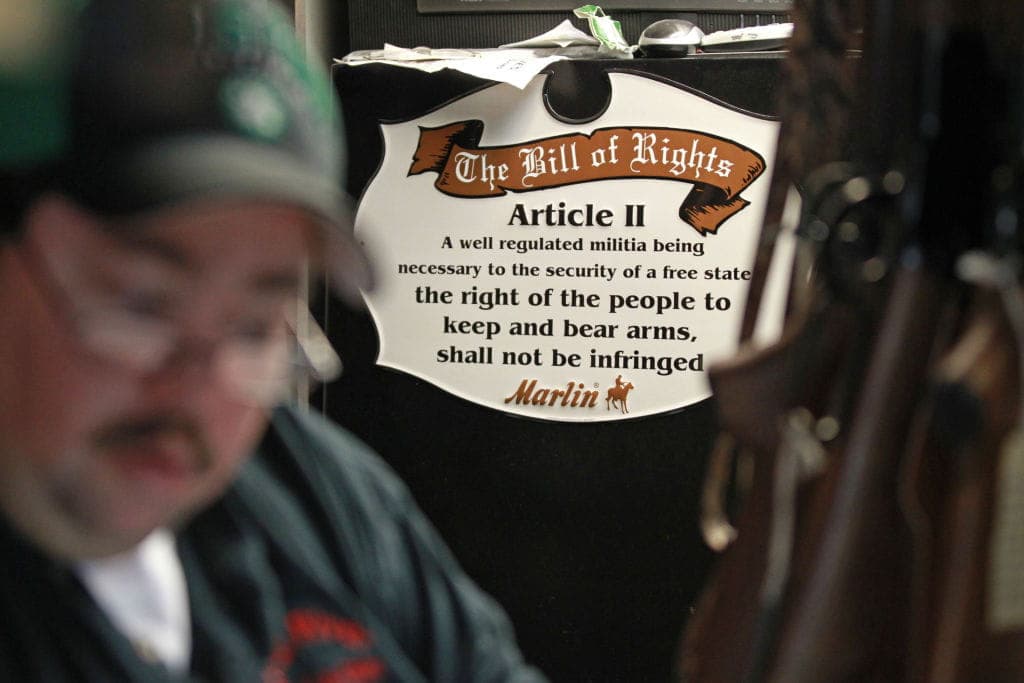

A Massachusetts man, Randy Westbrook, who was denied a license to carry by Holyoke Police Chief David Pratt, is taking his Second Amendment case to the commonwealth’s Supreme Judicial Court. It is yet another example of anti-gun (read, Democrat-controlled) states defying US Supreme Court opinions. Put simply, the nation’s highest Court ruled in the 2022 case N.Y. State Rifle & Pistol Ass’n v. Bruen that decisions on whether to issue state-mandated gun licenses must be based on objective standards. This is not how it currently works in Massachusetts, where police chiefs or other licensing officials can legally dream up any excuse to deny constitutional rights.
The case is practically identical to a legal fight in New Jersey recently reported on by Liberty Nation News. As in the Garden State, Massachusetts law regarding the issuance of gun permits allows officials to deny them for vague and subjective reasons.
Second Amendment Unsuitability?
In the case of the commonwealth, the law in question, G.L. c. 140, §131(d), states that a person shall be issued a license to carry “only if it appears that the applicant is neither a prohibited person nor determined to be unsuitable to be issued a license.”
The "prohibited person" bit is not in question. Individuals who have been convicted of certain crimes or who have a documented history of mental illness or other disqualifying behavior are prohibited from owning firearms. The problem is the “determined to be unsuitable” part. Determined to be unsuitable to exercise a constitutional right? Determined by whom? And how does one define “unsuitable”? Section 121F of the Massachusetts law explains it:
"A determination of unsuitability shall be based on reliable, articulable and credible information that the applicant has exhibited or engaged in behavior that suggests that, if issued a permit, card or license, the applicant may create a risk to public safety or a risk of danger to themselves or others."
Behavior “that suggests that” the applicant “may create a risk”: This is entirely subjective and legally unsound – and the Supreme Court said that’s a no-no. The amusing part of the statute – if there is anything amusing about it – is the conditional “if.” Apparently, applicants can be denied because they “may” pose a danger to themselves or others “if issued a permit, card, or license.”

As if the card itself represents a danger. Certainly, without a permit to carry, Massachusetts residents are not only prohibited from carrying a firearm but also from possessing one. Still, the idea that the only people in possession of guns in the commonwealth are those who have permits is laughable.
It is perhaps the deepest flaw in the so-called reasoning of those who seek to render the Second Amendment toothless – the refusal to acknowledge that criminals don’t care about gun laws. The law suggests that the very act of obtaining a license to carry “may” turn an otherwise law-abiding person into a dangerous criminal. It is a bizarre premise, entirely unsupported by facts, decades of crime statistics – and logical reasoning.
Defying the Supreme Court
Coming back to Westbrook, the denied applicant. He has no felony convictions, nor does he fall into the category of people prohibited from owning a firearm for any other reason. Pratt, the police chief who refused to issue Westbrook a permit, reached all the way back to an alleged domestic violence incident in 2011. Westbrook did not plead guilty, and the charges were dismissed by the Commonwealth of Massachusetts, which will now have to explain to its highest court why it is using a dropped charge from 15 years ago to deny Westbrook his Second Amendment rights.
Free with the Daily Briefing
85EssaysUnravel the Constitution
Hamilton, Madison & Jay’s complete case for America, free and searchable in the Publius Reader.
Free with the Daily Briefing. Unsubscribe anytime.
The Supreme Judicial Court of Massachusetts will hear arguments in the case in the coming weeks. As with the New Jersey law, it’s hard to imagine the commonwealth will be able to show its statute on the issuance of gun permits does not violate the Second Amendment. Certainly, as written, it directly contravenes the US Supreme Court’s ruling that such decisions should not and cannot be based upon subjective judgments, but can only be decided with binary determinations – does the applicant check any of the prohibited person boxes, yes or no?
Organizations that advocate for Second Amendment rights across the country continue to challenge state laws that allow anti-gunners in positions of authority to arbitrarily deny citizens their rights. Since, with the Bruen opinion, the US Supreme Court has already settled the matter, it seems puzzling – but maybe unavoidable – that a similar case will eventually get to that level once again. If the Supreme Court agrees to hear such a case and reaffirms the Bruen decision, we can only wonder what the anti-gun states will try next.

.jpg&w=1920&q=75)