


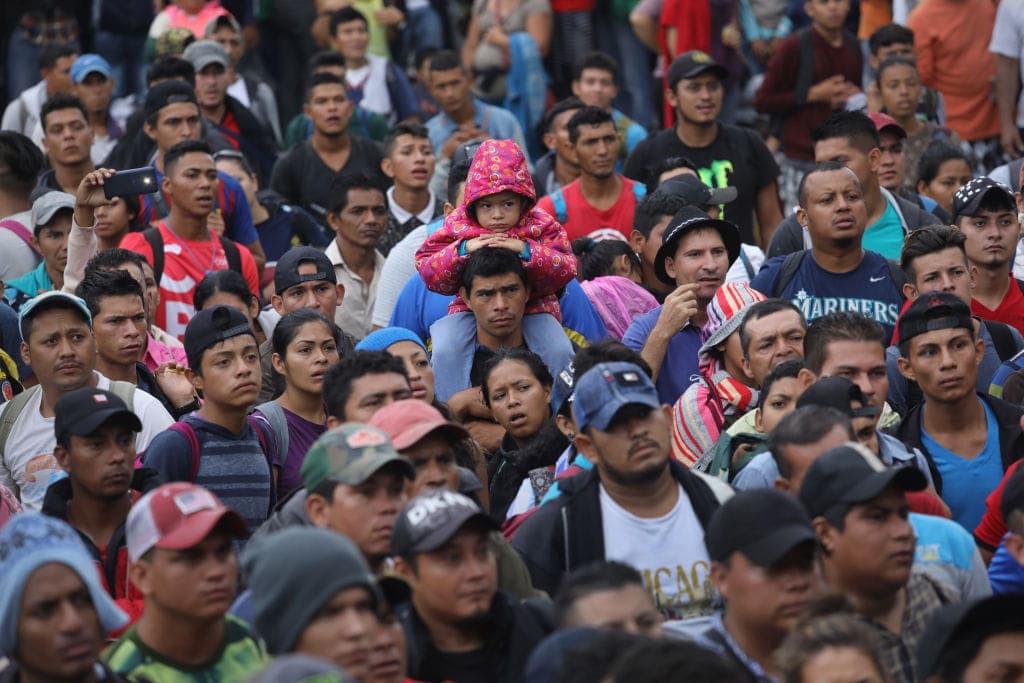

Illegal immigration has been a buzz topic for a few years now, especially during former President Joe Biden’s administration when millions of undocumented crossed into the nation via, for all intents and purposes, an open border policy. President Donald Trump and his administration have aggressively gone after these individuals. That’s not news, though. The question is, where did all the immigrants land when they came to the Land of the Free? Some of the destinations might surprise you.
A Little Background
The Associated Press published an exclusive piece detailing where the immigrants who came to the United States between 2018 and 2025 ended up. They obtained the information through a Freedom of Information Act request to US Customs and Border Protection (CBP) and put together records of 4.5 million migrants after they crossed the US-Mexico border, both legally and illegally. Originally, CBP provided information on 5,619,982 people who were apprehended at the border crossing illegally into the US, but AP removed records that didn’t have a destination zip code and any duplicates, bringing their version of the illegal count down to 3,652,313. AP then added a separate release of 858,537 who came through official ports of entry – mostly using the CBP One App – to arrive at that roughly 4.5 million total. One distinction to make is that the addresses that were given to CBP didn’t necessarily mean the migrants went there.
Historically, migration across the southern border was heavily dominated by Mexico, and more recently, Central America. However, during this time period, immigrants arrived from more than 150 countries. In one year, Border Patrol encountered people from 174 countries. AP found that approximately one million Venezuelans were released into the US during the 2018-2025 timeframe. For those of you who enjoy the numbers, that’s roughly 22% of the entire 4.51-million-person dataset.
The federal data revealed that nearly six out of every ten people released were women or children. That’s a change from the overwhelmingly adult male migration that was historically associated with the southern border.
So what were the top destinations people sought to relocate to in America?
Where Did the Immigrants Land?
On their journey to the land of the free, where did hopeful immigrants decide as their destination? AP’s data doesn’t have a simple pattern showing migrants crossing the border and staying in specific states. Instead, the destination records show people dispersing throughout the country, including cities that historically received little international migration. While it’s hard to be sure since addresses listed weren’t always verified, there are some statistics to give us a good idea.
California
Free with the Daily Briefing
85EssaysUnravel the Constitution
Hamilton, Madison & Jay’s complete case for America, free and searchable in the Publius Reader.
Free with the Daily Briefing. Unsubscribe anytime.
The Chinese seemed to migrate to two main places in the US – on the opposite ends of the nation: New York and California. In The Golden State, immigrants gathered near the Los Angeles area and the Silicon Valley.
Colorado
The Centennial State attracted Colombians and Venezuelans, especially in Aurora and Denver. In fact, 32% of the migrants in Aurora were Colombian.
Florida
Florida was the number one destination state overall. About 90% of Cuban immigrants listed their addresses in the Sunshine State, and nine of the ten most common zip codes for Cubans were here. Venezuelans and other Latin American nationalities also made this their destination.
Georgia
A good portion of Venezuelan immigrants chose to relocate to the Atlanta metropolitan area. Savannah was another, smaller, destination.
Illinois
Chicago was one of the country’s major destinations for Venezuelans, according to AP.
Indiana
For whatever reason, Elkhart was the place to relocate for multiple nationalities.
Kansas
Multiple nationalities chose the destination of Dodge City. The city’s 2025 annual report described its immigrant-integration programs, and specifically mentioned services involving the Mexican and Guatemalan consulates.
Kentucky
Many Cuban immigrants who didn’t go to Florida instead traveled to Louisville.
Massachusetts
The Boston metropolitan area was a significant destination for Colombians.
Nebraska
Grand Island was another area Cubans relocated to.
New Jersey
Paterson was the number one destination for Peruvian immigrants.
New Mexico
Although Venezuelans migrated to Albuquerque, it was one of the smaller cities receiving immigrants from Venezuela.
New York

New York City attracted the Chinese, Ecuadorians, Colombians, Venezuelans, and Indians, as well as other nationalities. The Chinese were heavily concentrated here, especially in Queens and Brooklyn. In Queens, AP found at least 25 nationalities with significant numbers: China, Colombia, Ecuador, India, and Venezuela. These five nationalities each accounted for more than 7,000 immigrants, or at least 35,000 combined.
Ecuadorians, especially women and children, seemed to be drawn to Spring Valley.
Ohio
Ohio’s migration wasn’t dominated by Latin America. AP found substantial migration from West Africa, Uzbekistan, and India in the Cincinnati area. Associated Press reported that thousands of migrants, most from Mauritania, arrived in Lockland beginning around three years ago, seeking asylum after saying they fled political persecution.
Oklahoma
Mexicans tended to relocate to Tulsa, with a notable concentration of Mexican women and children.
Pennsylvania
AP found 11 nationalities in Philadelphia with at least 1,000 arrivals each. The largest group of immigrants included people from Brazil, Haiti, and the Dominican Republic. A large number from Russia and Venezuela relocated there as well.
Tennessee
Chattanooga attracted Guatemalans, especially Guatemalan women. Knoxville, on the other hand, became home to a number of various nationalities, although the AP didn’t identify any specific peoples.
Texas
Texas was a very popular destination. Dallas was one of the major cities of relocation for Venezuelans, with one zip code listing nearly 19,000 Venezuelans on its own. Houston also attracted Venezuelans, and Odessa had a high Cuban concentration. AP’s analysis puts Cubans at 74% of the migrants represented in the city.
Utah
Of the approximately one million Venezuelans who were released into the US, about 30,000 said they were going directly to Utah. The Salt Lake City suburbs was a popular destination.
Wisconsin
Madison was a destination for Venezuelans, although on a much smaller scale than some of the other cities.
When people think about immigration at the southern border, places like Texas, California, and New York probably come to mind. But Nebraska, Kentucky, Tennessee, Ohio, and Utah? Probably not so much. Yet the data show just how far across the country this wave of immigration reached, with people from Venezuela, Cuba, China, Peru, Mauritania, and dozens of other nations choosing destinations from major metropolitan areas to much smaller communities. The addresses may not tell us where every migrant ultimately put down roots, but they do reveal something we haven’t been able to see quite this clearly before: Crossing the border was only the first stop. Where people planned to go next stretched from one end of America to the other.

.jpg&w=1920&q=75)
.jpg&w=1920&q=75)