
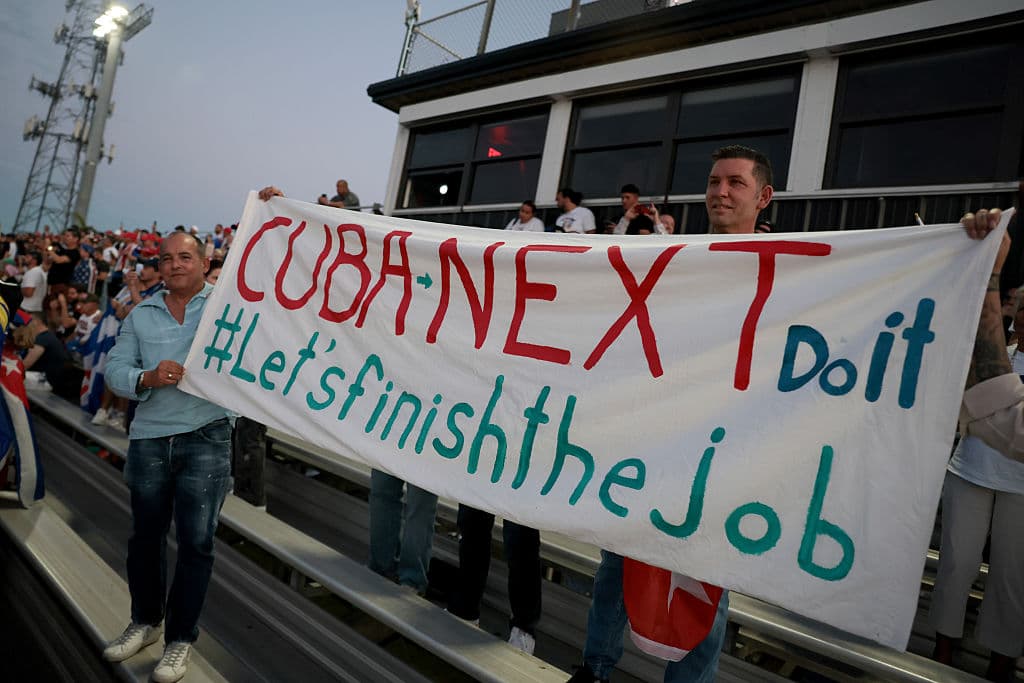

Recent media reporting raises the specter of armed conflict with Cuba. However, the likelihood of that happening seems slight. US tensions with the island nation, 90 miles off the Florida coast, ebb and flow, and they are currently on the high side, but nothing approaches overt hostilities. The United States takes issue with Cuba exporting its communist propaganda and ideology into America. Given that the latest National Security Strategy emphasizes addressing problems in the Western Hemisphere, it makes sense to consider what to do about Cuba.
Cuba – The 67-Year Problem
From the time Fidel Castro entered Havana in 1959, Cuba has been a thorn in America’s side – an irritation punctuated by the failed, CIA-backed Bay of Pigs invasion in 1961 and by the Cuban Missile Crisis the following year. The Mariel boatlift in 1980 saw 125,000 asylum seekers leave Cuba for Florida over just a few months. The exodus strained the United States' capability to absorb the influx and demonstrated the Cuban government’s desire to export its domestic problems to America. Over the years, the relationship has been a mixed bag. As the Council on Foreign Relations explained:
“The U.S.-Cuba relationship has been plagued by distrust and antagonism since 1959, when Cuban political leader Fidel Castro overthrew a U.S.-backed regime in Havana and established a socialist state allied with the Soviet Union. Over the next half century, successive US administrations pursued policies aimed at isolating the Caribbean island economically and diplomatically. The United States has sanctioned Cuba longer than any other country.”
Unlike his recent predecessors, Donald Trump has put the Western Hemisphere at the top of his to-do list. The latest National Security Strategy rates America's neighbors to the south and north as the highest priority in national security concerns. Secretary of State Marco Rubio made his first diplomatic trip to Central America to emphasize the US intention to focus more on its geopolitical interests there and in South America, with Cuba as a special-interest adversary.

Free with the Daily Briefing
85EssaysUnravel the Constitution
Hamilton, Madison & Jay’s complete case for America, free and searchable in the Publius Reader.
Free with the Daily Briefing. Unsubscribe anytime.
In a recent speech at the UN General Assembly, President Trump called changing the government and behavior of Cuba an imperative. He observed, “My administration is also seeking a fundamental change in the situation in Cuba where the communist regime is under great pressure, the biggest pressure they've ever been under. It's an absolutely failed state. It's failing like never before, and it will fall.”
He went on to explain that Rubio was handling ongoing negotiations and made one point absolutely clear: The United States “will not allow a haven for foreign adversaries to threaten America on our own doorstep,” the president said. “It’s right at our doorstep. The Cuban regime has also spent decades coordinating with the left-wing radicals and communist networks here in the United States.”
Military Action Not Being Considered
Though Trump did not indicate that the White House had any military actions in mind, some legacy-media journalists have suggested that there is a potential for the use of force against Cuba. For now, the administration is taking economic actions against the island. “The State Department announced that it has also tightened the financial vise around Cuba's state-owned entities that ‘funnel revenue to the regime and paramilitary forces’ that repress the Cuban people, including rapid response brigades,” CBS News explained. The news outlet also suggested that because planning is going on for actions against Cuba, hostilities could be a near-term possibility.
From Liberty Nation News, Trivia, Facts, Check Us Out
Stay informed.
Today’s news, the Constitution and American history, written for young readers.
Visit GenerationLiberty.com
News, Trivia, Facts, Check Us Out
Stay informed.
Today’s news, the Constitution and American history, written for young readers.
Visit GenerationLiberty.com
The Daily Caller picked up the story and reported, “The US Army Reserve is assessing whether it can provide additional troops to US Southern Command within three to four months as American military planners continue examining possible operations involving Cuba.” What’s missing is the context that the Pentagon and combatant commanders are continuously planning for possible contingency operations. But planning is not acting. Regarding Cuba, Trump explained it best as he spoke to reporters just before getting on the presidential helicopter on Sept. 26. He made it clear: “I would say that Cuba and us will make a deal. I don’t think we’ll need the military. Cuba’s failing very badly. … We want to help Cuba. We want to open Cuba up to our people.”
~
The views expressed are those of the author and not of any other affiliate.

.jpg%20Socialism&w=1920&q=75)
.jpg%20data%20centers&w=1920&q=75)