


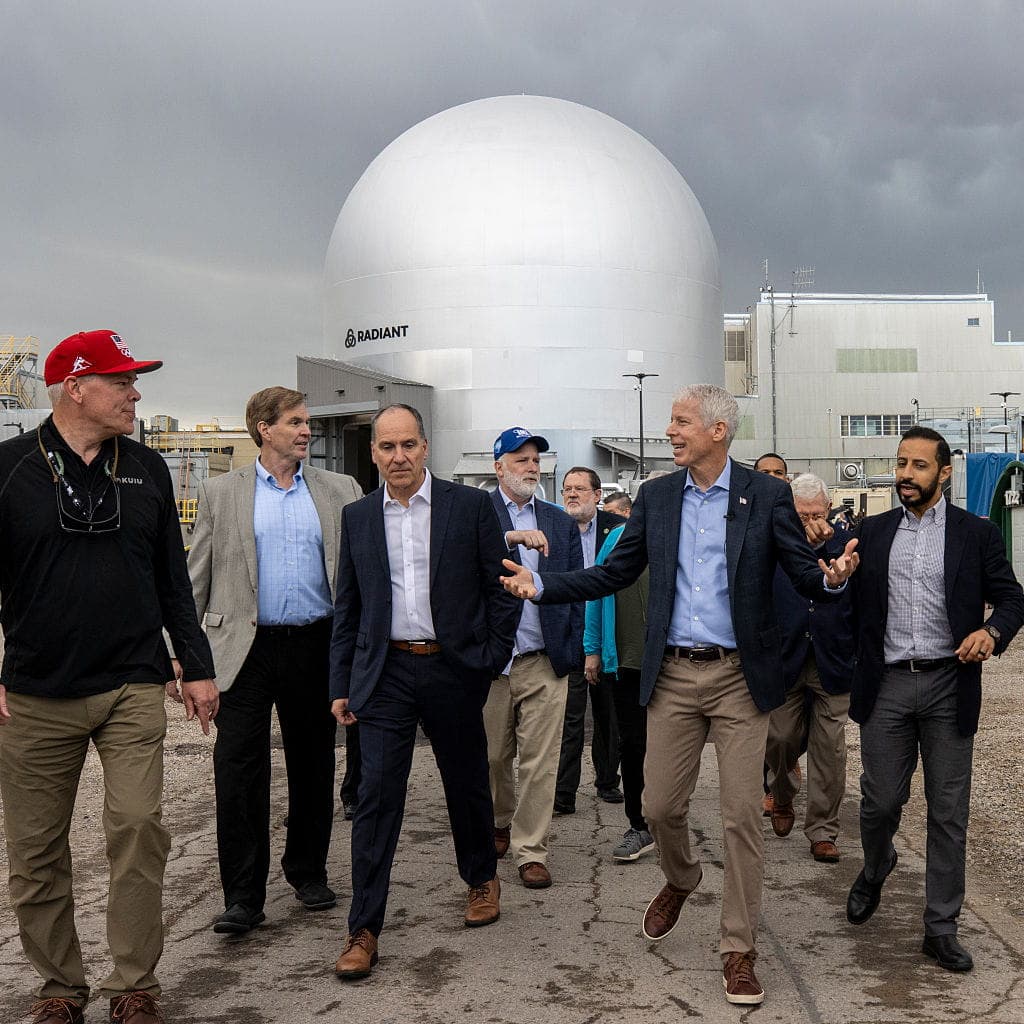

On Wednesday, August 26, the US Army announced a big step in bringing the military truly into the age of nuclear power, selecting companies to build its microreactors. On May 23, 2025, President Donald Trump issued an executive order that directed “Deployment and Use of Advanced Nuclear Reactor Technologies at Military Installations.” The president tapped the US Army secretary to implement the executive order, and the Army recently announced it is carrying out the president's directive.
US Army Investing Billions in Microreactors
Trump’s executive order made the timeline clear for getting a microreactor up and running at a military base: “The Secretary of Defense, through the Secretary of the Army, shall commence the operation of a nuclear reactor, regulated by the United States Army, at a domestic military base or installation no later than September 30, 2028.” That’s a little over two years away, and that’s a tall order. Nonetheless, the US Army is marching out smartly to get the job done.


Free with the Daily Briefing
85EssaysUnravel the Constitution
Hamilton, Madison & Jay’s complete case for America, free and searchable in the Publius Reader.
Free with the Daily Briefing. Unsubscribe anytime.
According to Military Times, “The Army is investing billions of dollars to bring nuclear power to military bases, selecting five companies to build nuclear microreactors at installations across the US, the service announced Wednesday [August 26] in collaboration with the Pentagon’s Defense Innovation Unit.” The five companies and the US Army installations where the microreactors will be built are Antares Nuclear at Fort Bragg, North Carolina; Radiant Industries at Fort Benning, Georgia; BWXT Advanced Technologies at Fort Campbell, Kentucky; General Atomics Electromagnetic Systems at Fort Hood, Texas; and Westinghouse Government Services at Fort Drum, New York.
The combined value of the agreements is up to $2.2 billion. As Military Times explained, this effort is a step forward in the Army’s “Janus program, an initiative that aims to introduce microreactors to energy installations independently rather than relying on civilian electrical grids.” In an August 26 press release, the Army pointed out that, in addition to the five military installations mentioned above, it expects the number of microreactors built and operated to exceed 20 across Department of War facilities.
Secretary of the Army Dan Driscoll explained:
"Since launching the Janus Program, our mandate from President Trump and Secretary Hegseth has been clear: secure the power our warfighters need to train, deploy and win. Awarding these contracts accelerates our ability to deliver safe, reliable baseload power directly to our installations. We are building the energy resilience necessary to project combat power globally, without relying on potentially vulnerable external grids.”
On April 8, the US Air Force identified Buckley Space Force Base in Colorado and Malmstrom Air Force Base in Montana as among the installations being considered for hosting small nuclear reactors. The Air Force explained that these bases were chosen “as the top candidates for a mini-reactor because of their utility infrastructure, availability of land, and the critical missions the bases perform,” Air and Space Forces Magazine reported.
Additionally, in determining which bases should receive the microreactors, the Pacific Northwest National Laboratory assessed the “environment, nuclear safety, and energy integration” of the candidate bases. The Air Force aspires to have the microreactors up and running by the end of the decade. However, if the progress on the Air Force’s pilot microreactor program at Eielson AFB, Alaska, is any indicator of how swiftly the Buckley and Malmstrom projects can be completed, we’re in for a long wait.
US Air Force Is Way Behind
In August 2018, the Department of the Air Force Office of Energy Assurance recommended Eielson AFB as the site for the pilot microreactor program. That’s right, nearly a decade ago. It wasn’t until three years later that the Department of the Air Force officially selected Eielson AFB as the pilot site.

According to an Air Force Office of the Deputy Assistant Secretary for Environment, Safety, and Infrastructure bulletin, the Eielson program should have had an executed contract two years ago, in 2024, with construction having begun last year; it didn’t. Pre-operational testing was supposed to begin this year; it won’t, and commercial operation is next year, in 2027. Now, the latest completion date is set for 2030. Still, the Department of the Air Force, in a March 2026 bulletin of frequently asked questions, stated that the agencies involved “have been advancing the microreactor pilot with urgency.”
A betting man would put his money on the US Army getting a microreactor on a military base before the Air Force. Independent sources of electricity for US military installations would keep them from being held hostage to local municipal power grids. If the War Department is successful in developing and deploying practicable microreactors, others may follow. The most obvious followers could be large data centers. In any event, the War Department has made microreactors and national security imperative.
~
The views expressed are those of the author and not of any other affiliate.

.jpg%20Social%20Media&w=1920&q=75)
.jpg%20Trump&w=1920&q=75)