
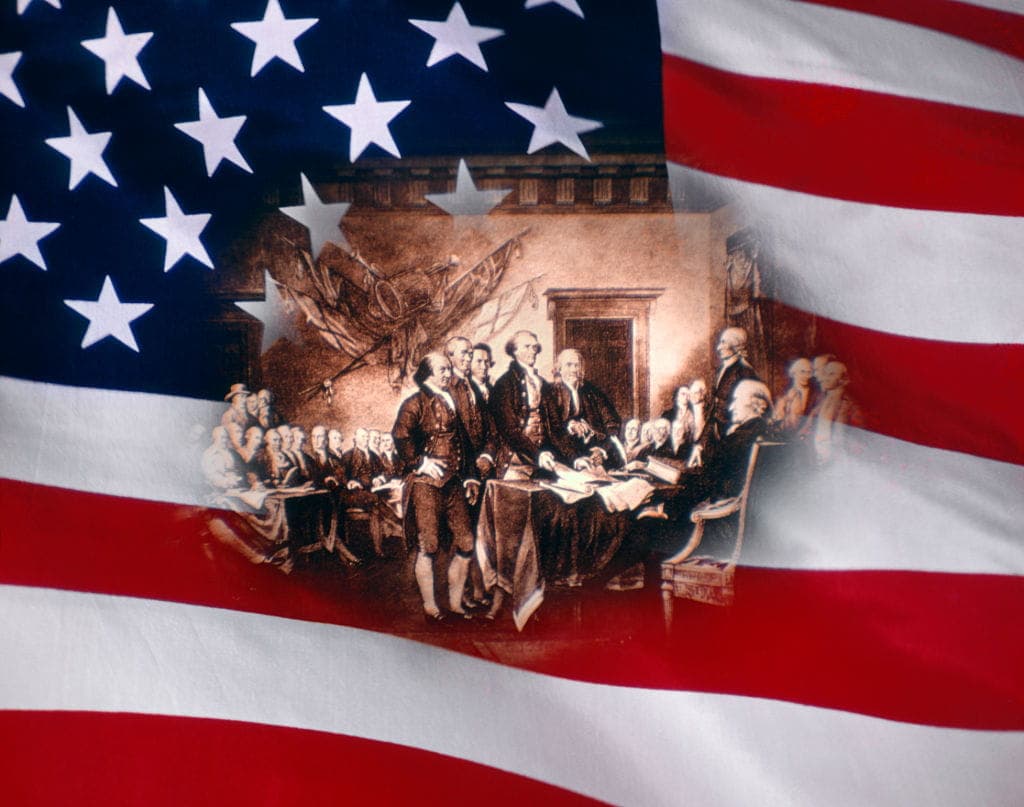

They stood outside under a “bright and sunny” sky, in an unconscious restless shuffling, engaged in low conversation as if assembled inside a house of God. Summoned to the State House Yard by the bells of the city, men, women, children, Continental soldiers, working-class laborers, merchants, and farmers did not know what was in store, only that it would be life-changing – the very reason they had come to the Colonies or stayed. The air was electric with possibility, energy, and a single-mindedness as Colonel John Nixon finally appeared at noon to read the one-page parchment, its ink barely dry: the Declaration of Independence.
There was anxious anticipation, enthusiastic support, and, for some, fear of the consequences. But mostly there was pride. Following the recitation, Nixon made the words come to life, ordering his men to remove all public signs and seals of King George III, including the Royal Coat of Arms in the Philadelphia State House – all of which was hauled up Market Street and burned. Bonfires and celebrations carried on through the night.
Deep inside, Americans are a hardscrabble lot, teeming with a specifically unmistakable hunger for the win. But in this country’s darkest moments, history shows how patriotism comes roaring back, almost as if channeling that day on the grass in front of Independence Hall.
American-Style Independence on the Homefront
There was a lot going on in America during the years following World War I: the excess of the Roaring Twenties, the Wall Street crash of 1929, and the Great Depression that followed. America had had her bell rung and was still trying to find balance on the eve of World War II. Feelings of the citizenry were much the same as when Colonel Nixon made it all real in 1776.
But pride and that innate independence bubbled up. According to the National World War II Museum: “Approximately 50 million American men registered for the draft between 1940 and 1945, with over 10 million men inducted into the armed forces.” In total, that was “approximately 16.1 million Americans,” including 358,000 women and the rest volunteers.
“They have given their sons to the military services. They have stoked the furnaces and hurried the factory wheels. They have made the planes and welded the tanks, riveted the ships and rolled the shells.” President Franklin Delano Roosevelt gave the gals a morale boost during the height of World War II when most men eligible for duty were off to war, only God and the government knew where. More than 6 million women hung the dress in the closet, donned coveralls, and entered the industrial workforce.
Both men and women rationed food, recycled metal, and had war bond parties to help finance the effort. Whether a square foot of yard or an acre, victory gardens produced more than 1 billion tons of food. Patriotism and pride of country were unequaled during the lives of the Greatest Generation.
Perhaps it was top-down implementation that Roosevelt knew, viscerally, was necessary as the war dragged on for American soldiers and their families. He used the radio and instituted weekly fireside chats that were as much good propaganda as news. Movie houses ran positive short films with overseas soldiers that highlighted the hard work and progress in the fight. The media was fully supportive and behind the president’s efforts. The United States was victorious, but there were more moments to come when pride of patriotism again flooded this country.
Never Forget – and ‘Let’s Roll’
Those of a certain age will remember the gorgeous, sunny, and mild September day in New York, Washington, DC, and Pennsylvania as folks went about the business of life. The people of America did not see it coming, the hijacking by Middle Eastern terrorists of four planes, the taking of nearly 3,000 lives, when it should have been just an uneventful day.
One flight, United 93, had been airborne for 46 minutes when hijackers – Ziad Jarrah (the pilot, from Lebanon) and three Saudi Arabian men: Saeed al-Ghamdi, Ahmed al-Haznawi, and Ahmed al-Nami – announced they had control of the aircraft. Several passengers had already seen the news of the crashes into the World Trade Center Towers and now knew they had to act. Todd Beamer, a 32-year-old account manager for Oracle could have just hoped for the best. But Americans don’t wait to have someone else choose their path. Beamer, well, he chose courage. He and most of the other passengers, in a matter of minutes, made a plan to disrupt, if not regain control of the plane. He used the airphone to let the government know what was about to take place, and then, after a few minutes, he led a real resistance movement, however brief, after saying, “Let’s roll.”
President George W. Bush gave an address to the Joint Session of Congress, nine days after the attacks, saying: “In the normal course of events, Presidents come to this Chamber to report on the state of the Union. Tonight, no such report is needed. It has already been delivered by the American people."
This country, only 200 years old, noted with pride, these colors don’t run. After the shock wore off, within hours, people began gathering supplies – medical gear, water, and food – and loaded up the search and rescue dogs. They ran toward the danger, not away. That independent spirit is simply in the DNA of America.
But that pride of country can be witnessed in all manner of life’s challenges – in victory and defeat. But some just taste sweeter: like a 1980 flamethrowing event in the middle of the Cold War. The USA Olympic hockey team upset the four-time defending gold medalist Russian team. Rightly dubbed the Miracle on Ice, the event stoked the fire of all Americans cheering for their home team with Olympic pride in Lake Placid, NY.
And then there was the Chicago Cubs, the Lovable Losers that hadn’t won the World Series in 108 years. In 2016, in a nail-biting World Series championship in the tenth inning of Game 7 on Nov. 2, well, that changed. The W flag was going to fly that night as Ben Zobrist hit an RBI double, and Miguel Montero managed an RBI single, putting them ahead 8-6. The final play was a ground ball from Cleveland's Michael Martinez to third baseman Kris Bryant, who threw to Anthony Rizzo at first for the final out. No one was unhappy with that outcome. Even Indians manager Terry Francona praised his team's effort and acknowledged the magnitude of the moment, calling it "an honor to be in a game like that.”
Americans Are Born With Independence and Pride
Somehow they knew, those 56 delegates to the Continental Congress that signed the Declaration of Independence, that this great experiment was going to gain their freedom. Who else knew? Those men, women, and children, from all walks of life, who understood a life on this soil could become anything they’d like. America became about opportunity, education, and freedom. Our Founding Fathers exuded patriotic pride, and that genetic instinct has been strengthened generation after generation. In the midst of wars, economic hardships, and uncertainties, when it counts, when united, this nation rallies around freedom and resilience, and knows inherently where we come from.
Dig Deeper Into the Themes Discussed in This Article!
Liberty Vault: The Constitution of the United States

.jpg&w=1920&q=75)
.jpg&w=1920&q=75)
.jpg&w=1920&q=75)