


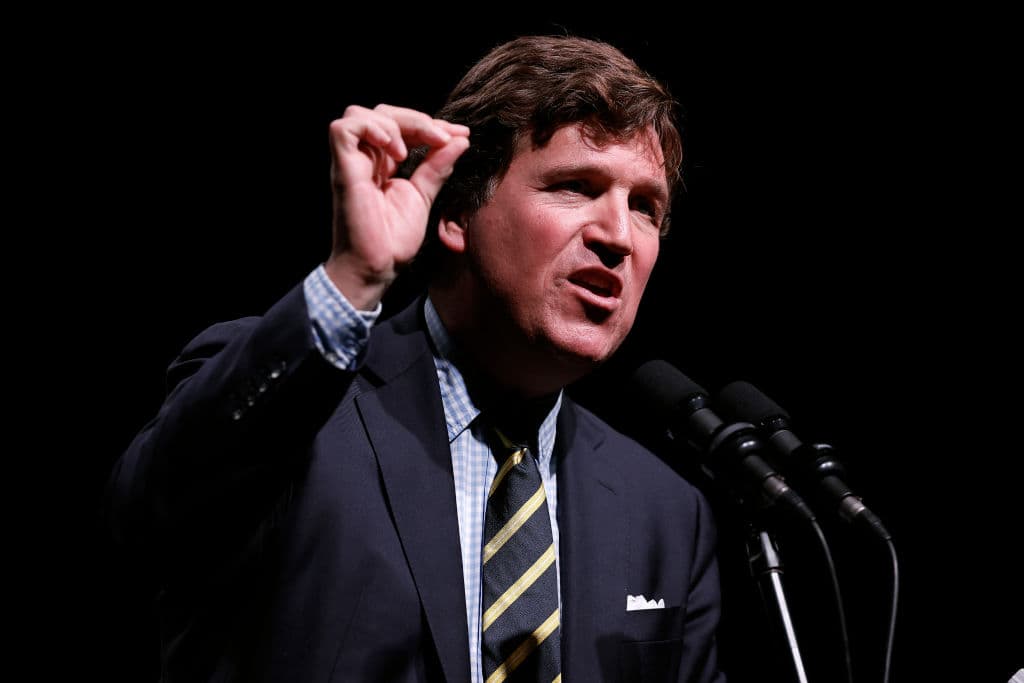

The war in Iran, approaching its 11th week, has lifted global energy prices. US crude oil is at $95 a barrel, Brent is slightly above $100, and motorists are paying a national average of $4.50 per gallon. The main reason has been the closure of the Strait of Hormuz, a global chokepoint that handles about 20% of the world’s black gold supply. Despite on-again, off-again ceasefires and peace proposals, oil markets have been stable over the last two weeks. This suggests some type of manipulation, says Tucker Carlson.
Tucker Carlson Eyes Oil Markets
In a recent podcast episode, the former Fox News host noted that crude oil, gold, and other commodities have been lower than "you would expect them to stay after 60 days of terrible news." The Strait of Hormuz closure is impacting a fifth of the world's oil supply, so prices should be trading similarly to 2008, according to Tucker Carlson.
Almost 20 years ago, crude prices shot up to $140 per barrel due to stagnant output, strong demand from emerging economies, geopolitical instability, and a weaker US dollar. Two decades later, the world is witnessing robust consumption levels, conflict in the Middle East and Eastern Europe, and a greenback under pressure for the past 15 months.
Therefore, he says, the situation is "bizarre" and "fake." Carlson continued:
"Over the past couple of months, public markets have not been what they told us they were, which is to say, open and free, equal for everyone to participate in... gonna take a long time for that understanding to percolate down to the level of retail investors. The knowledge is there, and you can't kind of deny it. Some people are getting rich from this, and most people aren't."
But while some may be profiting from insider knowledge, the way energy markets operate, at least in the United States, is based purely on fundamentals. Put simply, 2026 is different from 2008.
2026 vs 2008
Peak oil? That was all the craze in 2008. It was a joke then, and it is a joke now.
The biggest contrast from 2008 is that the world, particularly the United States, is producing more oil than ever before. Domestic production is close to 14 million barrels per day, compared to approximately five million during the global financial crisis. On the world stage, countries are producing as much as 100 million barrels a day, up from around 85 million barrels in 2008.
More production, of course, allows the world to stock up on oil for a rainy day. Suffice it to say, the world is drowning in oil. At home, the Strategic Petroleum Reserve sits at around 400 million barrels, though it was almost double that number in 2008. Global emergency oil stocks are also firmly above one billion barrels, with a capacity of up to 1.8 billion barrels.
New research by JPMorgan Chase suggests that demand for oil has declined by about four million barrels a day since the start of the joint US-Israel operations in Tehran. This is greater than the 2.5 million barrels per day registered during the Great Recession. The issue is that many pockets of Asia and the Pacific have seen fuel shortages, and Europe is warning of similar challenges in the coming months.
Lastly, while financial markets can seem irrational, they are typically forward-looking. Wall Street was booming in 2020, despite millions of Americans being out of work and the economy being shuttered. One reason was the astronomical amount of fiscal and monetary stimulus, and the other was investors bracing for the reopening. In oil markets, investors believe the worst is likely over and are now preparing for Washington and Tehran to reach an agreement. In other words, investors are cautiously optimistic that a resolution is on the horizon. Based on how much oil is coming to market, they are pricing in a steady drop.
No Conspiracy
That’s it, Mr. Tucker Carlson. There is no conspiracy. Oil markets are not rigged. There is no man behind the curtain. It is good old-fashioned fundamentals that drive energy prices. Prediction and futures markets, of course, could attract traders who take advantage of inside scoops. For the most part, however, movements in the aggregate are driven by the macro and the micro.

.jpg&w=1920&q=75)

.jpg&w=1920&q=75)