
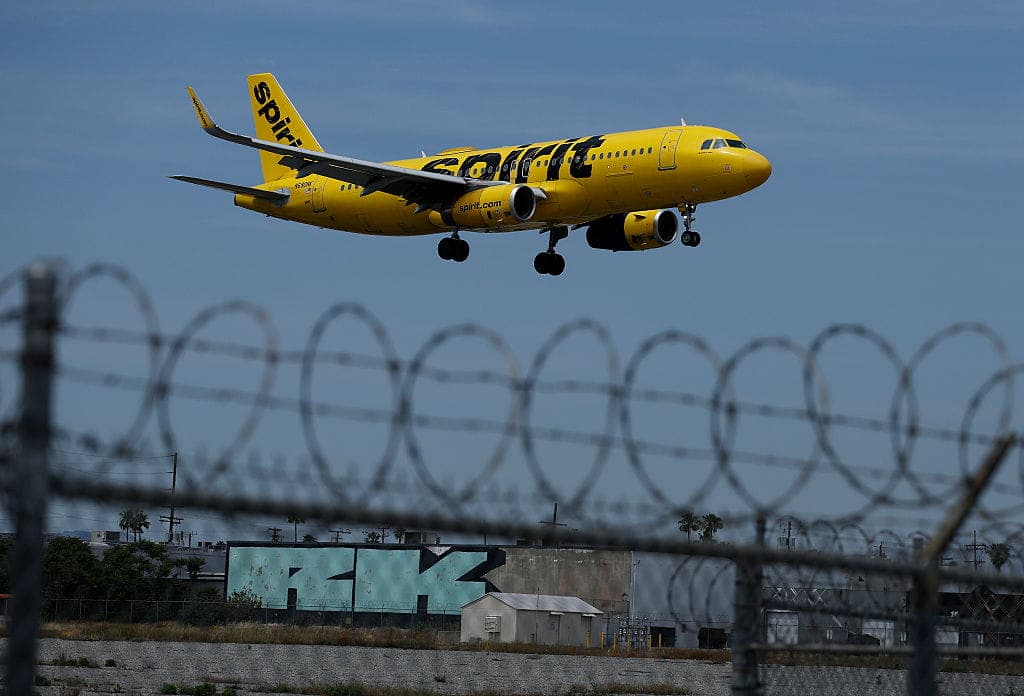

It was a wild trading week for Spirit Airlines, the struggling ultra-low-cost airline headquartered in Florida. The company soared as much as 500% before giving back its gains, but it is still poised for a weekly rally of about 300%. The airline's roller coaster ride, which has turned into a penny stock over the past year, began when President Donald Trump suggested a bailout could be on the way.
Feeling the Spirit Airlines
In an April 21 interview with CNBC's Squawk Box, President Trump teased a possible federal rescue package for Spirit Airlines. “I don’t mind mergers. I think I’d love somebody to buy Spirit, as an example. You know, Spirit’s in trouble. Maybe the federal government should help that one out," he told the business news network’s flagship morning show.
For the past several years, Spirit Airlines has faced a series of headwinds, including surging costs, evolving consumer trends, and court rulings blocking an acquisition by JetBlue Airways. Prior to Trump's remarks, the stock had cratered about 95%.
A financial package from Uncle Sam could stabilize operations and bolster the share price. Various media reports, citing sources close to the matter, suggested Washington could float about $500 million in financing, potentially leading to a 90% equity stake in the carrier. Without government intervention, Spirit could face liquidation soon.
For now, the White House says Spirit’s troubles are a result of former President Joe Biden. White House spokesman Kush Desai said in a statement to CNBC:
“Spirit Airlines would be on a much firmer financial footing had the Biden administration not recklessly blocked the airline’s merger with JetBlue. The Trump administration continues to monitor the situation and overall health of the U.S. aviation industry that millions of Americans rely on every day for essential travel and their livelihoods.”
But while the president signaled potential support, other members of his administration are ostensibly opposed to the idea. One of these officials is Transportation Secretary Sean Duffy, who asked Reuters this week, "What would someone buy? If no one else wants to buy them, why would we buy them?”
Corporatism
Legendary economist Milton Friedman regularly quipped that the worst defenders of capitalism were business leaders and entrepreneurs, because they typically acted in their short-term self-interest rather than in accordance with the principles of the free enterprise system. In other words, taxpayer-funded bailouts, rescue packages, and other interventionist measures are hallmarks of crony capitalism, or corporatism.
The current administration has used state tools to purchase equity stakes in scores of companies. Most notably, the federal government acquired a 9.9% share of chipmaker Intel. While it has yielded $25 billion in profits for taxpayers, should Washington be running a brokerage firm?
US officials have argued that this investment, as well as the others in firms specializing in critical minerals, was vital to securing domestic semiconductor manufacturing and supporting an essential tech firm. Proponents would also contend that, since China is engaging in state capitalism, why shouldn’t the United States remain competitive and retain access to crucial materials?
Critics, however, point out that these measures violate free-market conservative principles. Additionally, an imperative “what if” needs to be asked: What if the other side showered green energy companies with lavish sums of taxpayer cash? Oh, wait, they already wasted hefty amounts on green energy boondoggles (hello, Solyndra!), and the right was outraged.
Mainstays of the Republican Party have had to champion tariffs, but could they shrug off capitalist principles by nodding in agreement and favoring a bailout of Spirit Airlines? What’s more, should the likes of Gov. Gavin Newsom or former Vice President Kamala Harris move into 1600 Pennsylvania Avenue and propose buckets of cash for companies in industries they favor, how could GOP lawmakers push back without appearing hypocritical?
Middle of the Road
Interventionism begets interventionism. First, it was Intel. Then it was MP Materials and USA Rare Earth. Now, if reports are accurate, the administration will bail out a failed airline. Eminent economist Ludwig von Mises argued in 1929 that the "middle of the road" between socialism and free-market capitalism was incompatible. For now, Washington is taking a hands-off approach with day-to-day business operations, but how long until the United States goes full Zwangswirtschaft?
.png&w=1920&q=75)