


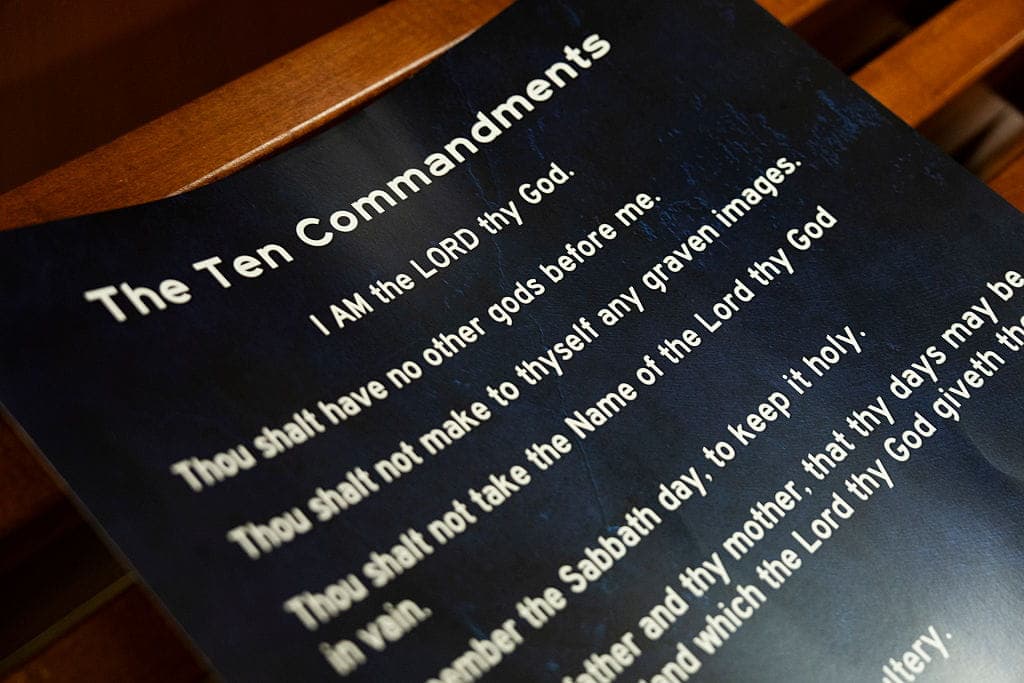

French philosopher and social activist Simone de Beauvoir once remarked: "If you live long enough, you'll see that every victory turns into a defeat." This profound observation eventually becomes evident to those who have been hanging around this planet for some time. A case in point is the legal battles being waged in courtrooms throughout America regarding the legality of posting the Ten Commandments in government schools.
Oh, That Again!
The Ten Commandments, found in two books of the biblical texts – Exodus and Deuteronomy* – are gaining popularity again. Thus far, three states – Louisiana, Arkansas, and Texas – have passed laws requiring the Ten Commandments to be displayed in public schools. It's the same push-me, pull-you argument that was supposedly settled in 1980 by the US Supreme Court in Stone v. Graham.
However, it seems the decision in that case is being reconsidered. At issue is the Establishment Clause of the First Amendment to the US Constitution, which reads:
“Congress shall make no law respecting an establishment of religion, or prohibiting the free exercise thereof; or abridging the freedom of speech, or of the press; or the right of the people peaceably to assemble, and to petition the Government for a redress of grievances.”
The key part of this vital First Amendment was interpreted back in 1980 with the emphasis on the "establishment of religion," whereas the courts now appear to have woken up to the clause right behind it, which reads: “or prohibiting the free exercise thereof." As the Cornell Law School Legal Information Institute put it, "This clause not only forbids the government from establishing an official religion, but also prohibits government actions that unduly favor one religion over another."
In the Stone v. Graham decision, the Supreme Court "invalidated a similar Kentucky law decades ago," according to the Fifth Circuit opinion. They were adamant that the new Texas law in question "looks nothing like a historical religious establishment. It does not tell churches or synagogues or mosques what to believe or how to worship or whom to employ as priests, rabbis, or imams. It punishes no one who rejects the Ten Commandments, no matter the reason. It levies no taxes to support any clergy. It does not co-opt churches to perform civic functions. These are the kinds of things ‘establishments of religion’ did at the founding. S.B. 10 does none of them."
Ten Commandments: What a Difference a Couple of Decades Can Make
Since the Rehnquist Court's 1980 decision, the Ten Commandments have not changed. They are precisely the same as they were when the Holy Scriptures were written. So, what has caused the Fifth Circuit to rule in favor of Texas all these years later?
It could be said that our culture is vastly different from what it was in 1980. Culture rot has seemingly invaded every area of our society. There is a lack of civility that rears its head when gangs of teens flash rob retail stores, helping themselves to everything from designer handbags to fine jewelry. There is also a lack of courteous behavior and respect for authority. Thus, we can rightly ask: "Has removing the Ten Commandments served us well in the last 40-plus years? Or have we reaped what we've sown by removing moral laws from the public square?”
While the Fifth Circuit ruled in favor of the Texas law, the decision sets up a showdown at the US Supreme Court, which court watchers say is likely to be a "landmark decision." Kelsey Dallas, who runs SCOTUSblog, astutely noted: "[O]ne thing is clear: the outcome of these cases is certainly not set in stone."
However, the winds of religious freedom are blowing strongly and may, in fact, spark a cultural revolution should the high court reverse course on the establishment clause. In the words of that great philosopher, Yogi Berra, "It’s not over until it’s over.”
~
*The Ten Commandments, from Deuteronomy 6-21:
6 “I am the Lord your God, who brought you out of Egypt, out of the land of slavery.
7 “You shall have no other gods before[a] me.
8 “You shall not make for yourself an image in the form of anything in heaven above or on the earth beneath or in the waters below. 9 You shall not bow down to them or worship them; for I, the Lord your God, am a jealous God, punishing the children for the sin of the parents to the third and fourth generation of those who hate me, 10 but showing love to a thousand generations of those who love me and keep my commandments.
11 “You shall not misuse the name of the Lord your God, for the Lord will not hold anyone guiltless who misuses his name.
12 “Observe the Sabbath day by keeping it holy, as the Lord your God has commanded you. 13 Six days you shall labor and do all your work, 14 but the seventh day is a sabbath to the Lord your God. On it you shall not do any work, neither you, nor your son or daughter, nor your male or female servant, nor your ox, your donkey or any of your animals, nor any foreigner residing in your towns, so that your male and female servants may rest, as you do. 15 Remember that you were slaves in Egypt and that the Lord your God brought you out of there with a mighty hand and an outstretched arm. Therefore the Lord your God has commanded you to observe the Sabbath day.
16 “Honor your father and your mother, as the Lord your God has commanded you, so that you may live long and that it may go well with you in the land the Lord your God is giving you.
17 “You shall not murder.
18 “You shall not commit adultery.
19 “You shall not steal.
20 “You shall not give false testimony against your neighbor.
21 “You shall not covet your neighbor’s wife. You shall not set your desire on your neighbor’s house or land, his male or female servant, his ox or donkey, or anything that belongs to your neighbor.”
Dig Deeper Into the Themes Discussed in This Article!
Liberty Vault: The Bill of Rights

.jpg&w=1920&q=75)
.png&w=1920&q=75)
