


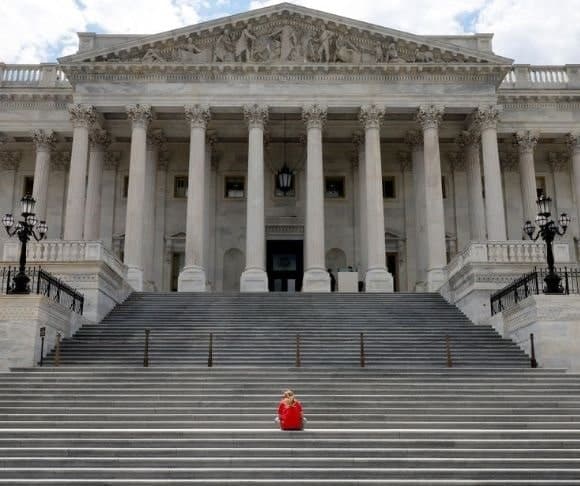

A new and thankfully brief phase of the Senate impeachment trial of President Donald Trump began on Wednesday, Jan. 29: The 16-hour window for senators to ask questions of both the president’s counsel and the House impeachment managers. One could be forgiven for thinking that this stage of the trial would be an opportunity for members of the Senate to cross-examine the “other side” – for Democrats to question the case for the defense brought before them by Trump’s attorneys and for Republicans to challenge the House managers who seek to persuade the Senate to convict the president. Alas, this is not what transpired.

With only a few exceptions, Democrat senators addressed their questions only to the Democrat House managers. With similarly few exceptions, Republicans submitted questions only to the president’s team. In both cases, most of the questions were loaded – designed to give the respective sides an opportunity to merely restate their arguments for conviction or for acquittal.
Confirmation Bias
The almost complete lack of cross-examination signifies that few, if any, senators are attempting to challenge their own views about the president’s conduct with regard to Ukraine. They were not trying to clarify, in their own minds, some aspects of the case against Trump or for his defense. The day’s session, in fact, was an eight-hour exercise in confirmation bias.
What does that mean? A concise description of confirmation bias is given by Shahram Heshmat, Ph.D., an associate professor emeritus at the University of Illinois. In Psychology Today, Heshmat writes:
“Once we have formed a view, we embrace information that confirms that view while ignoring, or rejecting, information that casts doubt on it. Confirmation bias suggests that we don’t perceive circumstances objectively.”
This is precisely the manner in which the impeachment trial is now proceeding. There were some instances in which Senators on both sides submitted questions to be answered by both the House managers and Trump’s counsel. None of those questions solicited new information, though, or even new and compelling ways in which to view the evidence of either guilt or innocence.
An Exercise in Futility

(Photo by Chip Somodevilla/Getty Images)
Republicans and Democrats submitted questions alternately and, on several occasions, the questions called upon either the president’s lawyers or the House managers to refute the answer given by the other side to the previous question. At times, it felt akin to watching a tennis match in slow motion.
This question phase continues Jan. 30, but, in the absence of more thought-provoking inquiries from either side, it adds little value to the trial – which is a great shame. If senators on either side were truly interested in dissecting the case before them, their interrogatories would have been designed to elicit definitive and persuasive arguments for the president’s removal or vindication.
As it is, the Senate will likely commence the debate on Jan. 31 to decide whether witnesses will be deposed and documents sought. If the senators vote to forego witness testimony, the articles of impeachment themselves could be voted on later that day or the next. The distinguished body could have saved itself a couple of days by skipping questions and getting straight to it.
~
Read more from Graham J. Noble.

.jpg&w=1920&q=75)
.jpg&w=1920&q=75)
.jpg&w=1920&q=75)