


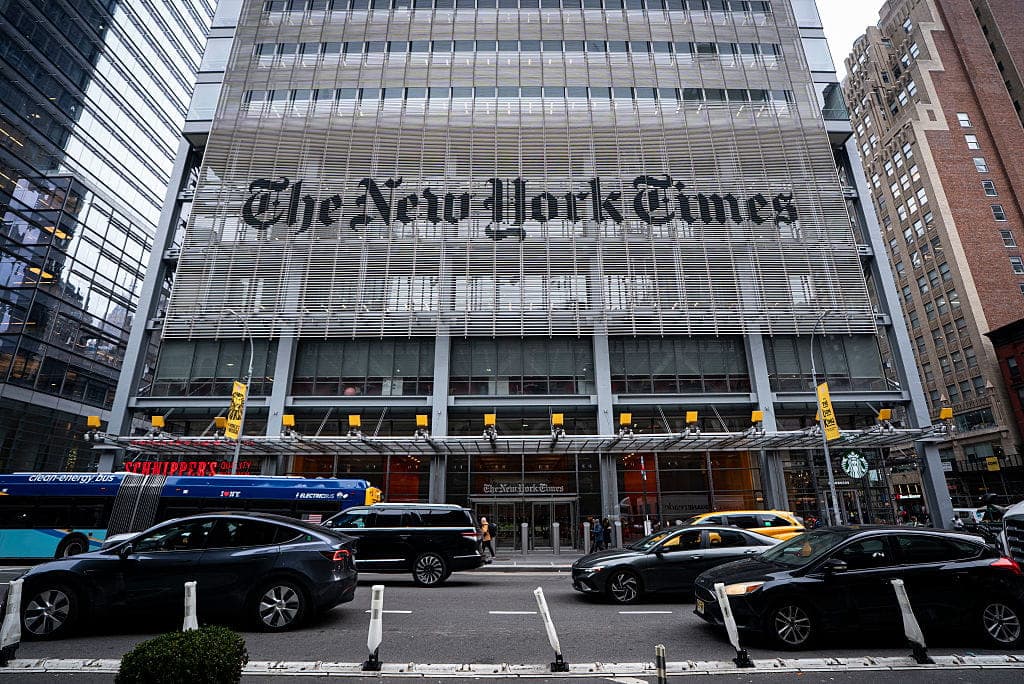

Perhaps a lawsuit filed on May 5 by the US Equal Employment Opportunity Commission (EEOC) against the storied New York Times will mark the beginning of the end for diversity, equity, and inclusion (DEI). A 12-year employee of the Gray Lady, an unidentified white male, filed a complaint in 2025, alleging that he had been passed over for a promotion to the editorial staff because of his ethnicity. If the man’s claim is proven to be true, The Times will have violated the employee’s civil rights, which is what the EEOC is charging. And if the agency’s legal action against the paper is successful, the repercussions are potentially far-reaching – particularly in left-wing-dominated sectors such as the media industry, entertainment, and academia.
According to the EEOC, the employee was excluded from a final shortlist of candidates for an editorial position that included “a white woman, a Black man, an Asian female and a multiracial female.” According to a New York Post report, the position apparently called for someone with real estate news experience, which the white male applicant had. The job ultimately went to the “multiracial” female who was “less qualified.”
A spokeswoman for The Times, Danielle Rhoades Ha, accused President Donald Trump’s administration of bringing a “politically motivated” case against the paper. She said in a statement:
“Our employment practices are merit-based and focused on recruiting and promoting the best talent in the world. We will defend ourselves vigorously.
“Neither race nor gender played a role in this decision – we hired the most qualified candidate, and she is an excellent editor.”
EEOC Brings the Receipts to New York Times Fight
However, the paper has a history of basing its hiring policies on DEI principles, as shown by its own stated intentions and internal communications. The EEOC lawsuit cites a “Call to Action,” created by The New York Times in 2021, which says that “people of color — and particularly women of color — remain notably underrepresented in [the newspaper’s] leadership.”
The federal lawsuit further claims that The Times’ “stated race and sex-based representation goals influenced the decision not to advance” the complainant’s candidacy for a deputy real estate editor role.
As reported by The Times on May 5, the suit “detailed N.Y.T.’s express efforts to make employment decisions on the basis of race and sex to achieve its desired demographic goals. A decrease in the percentage of White male employees (whether new hires, existing employees or those in leadership, as appropriate) was a necessary consequence for the N.Y.T. to achieve these results.”
Additionally, the suit “quotes from exchanges on the messaging platform Slack among newsroom leaders about trends in diversity hiring, and from internal correspondence related to the hiring process of the deputy editor role.”
Reverse Discrimination Is Still Discrimination
The EEOC is asking the judge in the US District Court for the Southern District of New York to compel the newspaper to “provide equal employment opportunities for individuals regardless of race or sex.”
Whether the agency’s complaint has merit is not yet entirely clear. There’s an interesting parallel, though, between this affair and the recent Supreme Court ruling that Louisiana’s race-based legislative map is unconstitutional. The push from the political left to practice what has commonly become known as “reverse discrimination” inevitably clashes with the various constitutional amendments and laws created to protect civil rights and eliminate discrimination.
To put things in rudimentary terms, one might say that “woke” DEI-promoting progressives are finding out that, legally and constitutionally, there is no way to atone for past discrimination against non-whites by now discriminating against whites. It’s a classic example of the adage that two wrongs do not make a right.

.jpg&w=1920&q=75)
.jpg&w=1920&q=75)
.jpg&w=1920&q=75)