


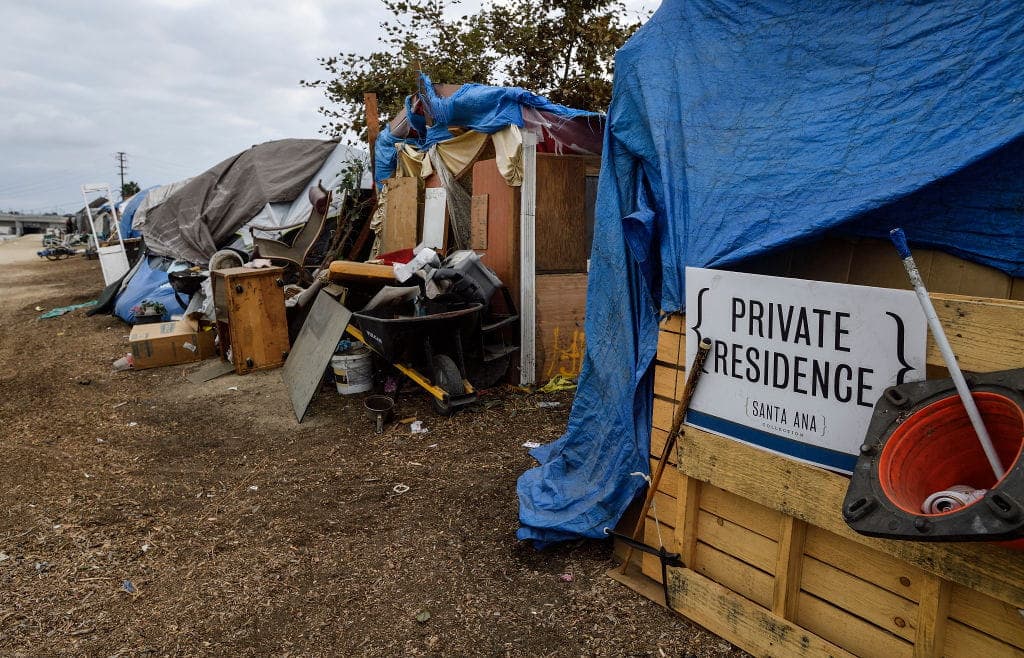

City officials across the nation struggle to deal with the growing number of homeless people. How do lawmakers balance between being humane to the unhoused and providing safety for their constituents? Part of the problem is that many on the streets don’t want help and would rather be left alone. But that doesn’t help communities and businesses forced to deal with the mess and danger associated with that kind of lifestyle. But one California city has had enough and given the homeless an ultimatum: jail or help. How is that working out?
The Homeless Get a Choice: Jail or Help
Santa Ana, a city about 35 miles south of Los Angeles, has a population of just over 315,000. It is the county seat and one of the largest cities in Orange County. And it has a homeless population of 1,315. Unlike many other blue-run cities, Democrat Mayor Valerie Amezcua is not content to let the situation grow even more out of control.
Last week, Amezcua took to social media to report on a new program to address the city’s homeless situation. Santa Ana passed its "no camping” policy last year, which, among other things, essentially bans tent cities. The program includes two Quality of Life teams that canvass the city seven days a week. The mayor reported that about 80 to 100 people were picked up last week and were provided services and offered shelter, or they had the option to go to jail instead.

Free with the Daily Briefing
85EssaysUnravel the Constitution
Hamilton, Madison & Jay’s complete case for America, free and searchable in the Publius Reader.
Free with the Daily Briefing. Unsubscribe anytime.
"We're offering them services, whether it's detox, a shelter program, and if they refuse all the services, then they end up going to jail," Amezcua said. "Because Santa Ana deserves a good quality of life, just like all the other cities around us."
How did last week’s operation work out? According to a report, 69 were jailed, 11 accepted placements at shelters, and one agreed to be reunited with family. Which means the overwhelming majority of those picked up would rather go to jail than get the help they need. This should be something lawmakers consider when setting up programs that enable instead of encouraging rehabilitation.
The point-in-time count, which is not a census but tracking the number of people encountered at a single time, in 2024 was 871 unsheltered. This year, that number dropped to 601, proof to some that this new system is working.
Restaurant owner Charlie Cosmas told CBS News that, at one point, things were so bad with the homeless in the area, he’d thought about moving his business, Charlie’s Best Burgers, to another city. He claimed that around 20 to 30 people would hang out along First Street near his restaurant, but this new process has helped to change that.
“And I see a tremendous difference,” Cosmas said. “I would say at least 80% difference just in the last two months. I’m very, very thankful because we were literally on our way out.”
The Fight Began in the 1990s
Mayor Amezcua may be getting credit for the program, but the city has been fighting homelessness for decades. Santa Ana had anti-camping laws dating back to 1992, but there was a legal barrier to enforcing them.
The original ordinance was challenged by homeless plaintiffs, and the case eventually reached the California Supreme Court in Tobe v. City of Santa Ana. The Court upheld the ordinance despite several constitutional challenges. In 2018, the Ninth Circuit’s decision in Martin v. Boise held that cities could not impose criminal penalties on the unhoused for sleeping outside on public property if the homeless population exceeded the number of “practically available” shelter beds. Since California is part of the Ninth Circuit, it had to follow this ruling.

Then, in 2024, the Supreme Court handed down its decision in City of Grants Pass v. Johnson with a ruling of 6-3. It declared, “The enforcement of generally applicable laws regulating camping on public property does not constitute ‘cruel and unusual punishment’ prohibited by the Eighth Amendment.” Meaning, it overturned the main restriction imposed by the Martin v. Boise case, and cities were no longer barred under the Eighth Amendment from enforcing anti-camping laws just because there weren’t enough shelter beds available.
“They should not be passed out, drugged out, half naked on our bus stops because people need to use the bus and they need to sit there,” Amezcua said. “I would love to help people more, but we don’t have the ability to carry every single person on our back in the city of Santa Ana.”
So far, the program seems to be working. There are fewer homeless on the streets of Santa Ana, but the problem persists, especially when so many would rather spend time behind bars than get needed help. Will this success spread to other cities, and will it be a wake-up call to blue states that continue to enable instead of providing realistic assistance?


.png&w=1920&q=75)
