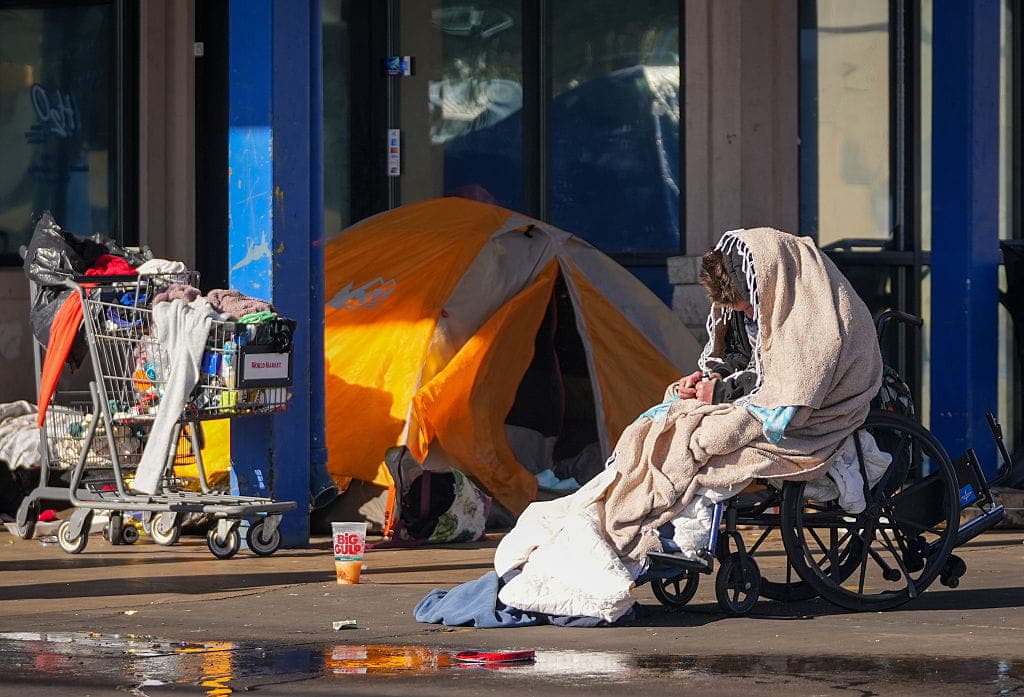

The 2025 Point-in-Time (PIT) report estimates that about 755,000 people in the US were homeless last year. There is a plethora of programs to help those in need including shelter, clothing, food, medical, and even haircuts. But not all homeless people are treated the same.
Skewed Homeless Benefits
An exclusive by The Washington Free Beacon reported on how some programs to help the homeless are regulated by race-basis systems, giving necessities to people of color and LGBT persons first, sometimes even before white people with children. The outlet discovered five states and many cities “that have incorporated racial preferences into their housing programs.”
According to the report, Maryland and Minnesota appear to use race as the “single largest factor in allocating certain forms of rent relief.” An index, developed by the Urban Institute, uses “equity” indicators which includes a neighborhood’s number of “people of color” to prioritize housing assistance. “Race is the single most indicator,” The Free Beacon explained, “receiving twice as much weight as ‘people living in poverty’ and four times as much weight as ‘adults without health insurance.’”
“The upshot is that a poor black area could receive more money than an equally poor white area simply because of its racial composition,” the outlet said.
Gail Heriot, a senior fellow at the Manhattan Institute and a former member of the US Commission on Civil Rights, told The Beacon that such schemes were unlawful. “… in the absence of really extraordinary circumstances—Which I haven’t seen here—for a state or local government to treat one homeless person better than another on account of that person’s race is illegal and unconstitutional.”
Rhode Island requires that applicants for a homeless prevention grant “must have an intentional focus on eliminating racial inequities … by prioritizing communities of color.” The Oregon Rehousing Initiative requires projects to give “priority placement” to “BIOPIC” and “LGBTQ+youth.”
Washington state has several programs geared toward helping people of color and the LGBTQ population. For rent reliefs grants, the Evergreen State requires 10% of grants to go to organizations that “serve and are substantially governed by marginalized populations.” It also funds a private grant program, the Washington Youth and Families Fund, the “prioritizes BIOPOC and LGBTQ2+ families.” In 2024, the state set aside $1.2 million in homeless funding for “’by-and-for’ organizations” that “have a primary mission” of “providing services to BIOPOC … communities” – including “$167,291 to serve African diaspora immigrants,” “$150,000 to serve West African immigrants,” and “$252,118 to serve Hispanic, native and migrant seasonal workers.”
In 2022, the Continuum of Care program in Los Angeles, CA, pledged that “at least 500 Black and Hispanic/Latino” people would be moved from interim to permanent housing each year, The Beacon wrote. San Francisco, CA, promised to increase the number of Hispanic recipients to 30%. Oakland set a goal to make sure that 59% of those who received homeless services were Black or African American, according to the California Interagency Council on Homelessness.
Oregon Ranks as One of the Worst Offenders
Oregon has its fair share of problems when it comes to the homeless. Between 2019 and 2023, the number of deaths of homeless people in Portland quadrupled according to the county health department. Multnomah County is one of the worst when it comes to providing benefits to those based on race and gender identity. It has a homeless rate of 1.3% per capita, according to KGW8, but the funding isn’t there and more and more shelters are closing due to budgeting problems. The county uses a points-based system to determine who should receive the benefits, and while several factors are considered such as the length of time someone has been homeless, if they are a victim of domestic violence, and the ages of any children, these factors are compared with others, such as if the person is a non-native English speaker, if they are a minority, and if they are LGBTQIA2S+
The Multnomah Services and Screening Tool began in 2024 and awards “up to 5 points to non-white, non-straight applicants who speak English as a second language—more than the 4 points it would award a domestic violence survivor with a six-year-old child who has been homeless for over a year,” The Beacon explained.
“The rubric, obtained by the Washington Free Beacon through a public records request, is ‘designed to prioritize … BIPOC households, LGBTQIA2S+, [and] people with disabilities,’ according to a Frequently Asked Questions pamphlet. It awards 1 point for ‘interest in LGBTQ services,’ 2 points for ‘English as a second language,’ and another 2 points for ‘interest in culturally specific services,’ a catch-all term for Portland's race-based housing programs.”
"There is no 'compelling' reason to choose who sleeps on the streets by race," Dan Morenoff, the director of the American Civil Rights Project, told the outlet. "No governmental housing program 'prioritizing'—and necessarily de-prioritizing—homeless families by color, as Multnomah County's screening system openly does, should be expected to survive judicial scrutiny."
According to KFF, “White (32%), Hispanic (31%), and Black (30%) people each accounted for about three in ten of people experiencing homelessness on a single night in January 2024.”
The irony is hard to ignore. Democrats and activists on the left have yelled and screamed, condemning racism and demanding “equity” in nearly every aspect of American life, yet many of these same governments and agencies are openly supporting programs that sort homeless people by race and gender identity. Prioritizing one homeless person over another simply because of their skin color is not equality at all, but government-backed discrimination dressed up in modern political language.

.jpg&w=1920&q=75)
.jpg&w=1920&q=75)