


Who would have ever thought we would place preeminent economist Milton Friedman and Christian nationalism in the same sentence? But here we are, after Vice President JD Vance made head-spinning remarks on two fronts that are bound to stir up a hornet’s nest as the two parties consider who should succeed Donald Trump in the White House. In fact, the VP provided valuable ammunition for both fellow Republicans who might challenge him for the 2028 presidential nomination and the eventual Democratic Party candidate.
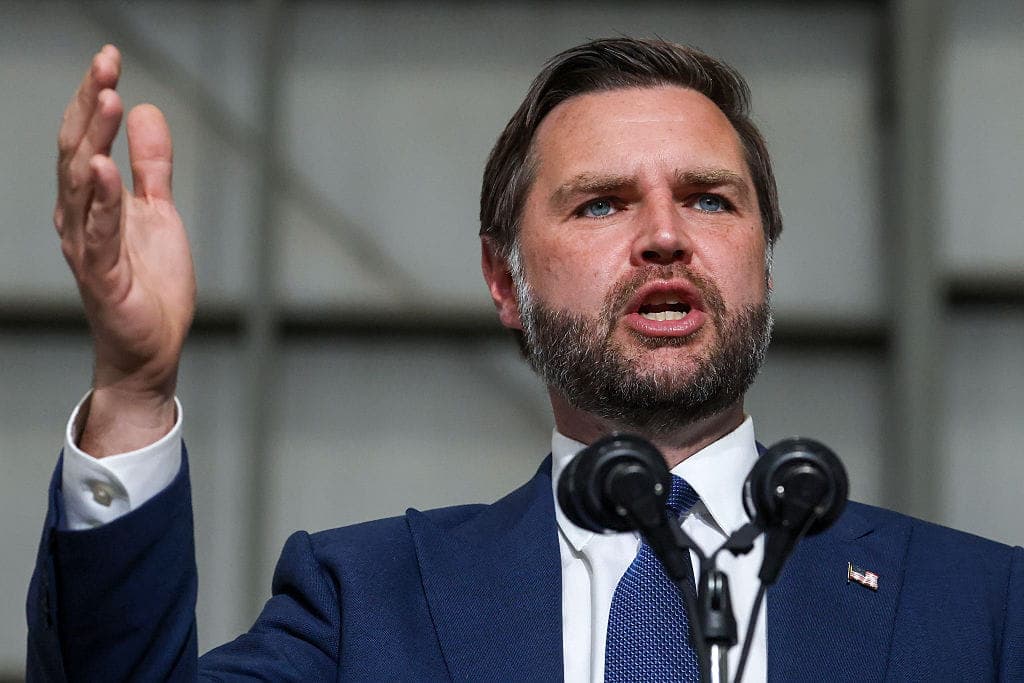
In an interview this week on The Matt Walsh Show, Vance essentially said the timeless economic principles of the north star of free market economics have become irrelevant and then went on to play right into the hands of leftists who have accused the VP of “white nationalism.” “Milton Friedman's ideas made more sense in the 1980s,” said Vance, “because they were being advocated in a country that still had a very rich and powerful institutional Christianity.” Then, the vice president seemed to discard the very foundation of free market economics by saying, “American economic policy on the right is now much more Alexander Hamilton than it is Milton Friedman. I think that's obviously a good thing.”
Obviously a good thing? For statist Democrats, sure. But for conservatives who dominate the GOP, this will not sit well at all. Donald Trump is, by all accounts, an admirer of Milton Friedman, and of course, the world’s most famous capitalist. But as LNN’s Andrew Moran put it, “Vance’s remarks are not entirely surprising, as his political career has been reliant on advancing the tenets of right-wing populism, mainly in the form of Hamiltonian protectionism.” Indeed, Hamilton, the nation’s first Treasury Secretary, is the least popular of the founders among many, if not most, conservatives because of his affinity for a powerful central government.
So, in the space of two sentences, the VP has both provided conservatives with reason for skepticism about his economic principles and offered valuable ammunition to his multitudinous enemies.
JD Vance and a Christian Nation
No matter your view on church and state, calling so openly for a return to the nation’s Christian heritage, now defined as Christian nationalism – or white nationalism, as the left likes to call it – will hardly be attractive to independent voters, who make up 40% of the electorate. And that’s to say nothing of Democrats. Will agnostics and atheists, Muslims, Jews, and other religious non-Christians consider supporting a man with such a pronounced Christian predilection? In politics, perception is reality, and the last thing a GOP presidential hopeful needs is self-inflicted, unforced errors sure to be exploited by elite media and their allies on the left.

Populism, which best describes Vance’s evident economic worldview, does not create prosperity. Free markets do – with the stipulation that “free” is a relative term because taxes, tariffs, and trade deals often make the market more managed than free. Nevertheless, free market principles are based on a profound understanding of immutable human nature and behavior. Economic populism, by definition, means bending to match up with contemporaneous popular opinion, which will always change with the winds of time.
Throughout his recent book, Communion, JD Vance argues that a return to virtue and religion is more important for America than economic prosperity. But virtue itself does not guarantee happiness. Far from it. Millions of virtuous and religious people across the world live in misery. Rather, virtue properly applied to politics is the means to a logical political end, namely freedom. Free market economics have defined America since its founding 250 years ago, generating wealth beyond measure while providing boundless opportunity for those willing to seize it. The principles of Milton Friedman are indispensable to a proper understanding of how economics works, not in theory, but in the real world. To argue that the wisdom the Nobel Prize-winning economist imparted and popularized is no longer relevant is breathtaking at best, disqualifying for the presidency at worst.
Class Warfare?
Vice President JD Vance, who was raised amid abject poverty, revealed an edge of class resentment and the limits of capitalism in his book: “Pretending that everyone can fill the void left by community and family and faith with a job is a way of taking the preferences of a small number of rich people and projecting them on everyone else. … Work has supplanted religion as a core source of meaning.” While it is hard to argue with his sentiments, politics is a contact sport where you cannot hand your rivals or opponents issues sure to boomerang on you.
The vice president may have done just that and shot himself in the foot. If he is challenged for the 2028 GOP presidential nomination, he has set himself up to be attacked by rivals as anti-capitalist, a devastating accusation in Republican circles. If he runs unopposed in the primary, he has provided leftists with all the ammunition they need to validate their claims about white/Christian nationalism in the MAGA world. Other potential GOP presidential candidates would not be weighed down with similar baggage on either economics or religion. If he expects to become the 48th president, we should hope that he studies up on capitalism and embraces the profound reality that virtue without freedom is virtue spoiled.