


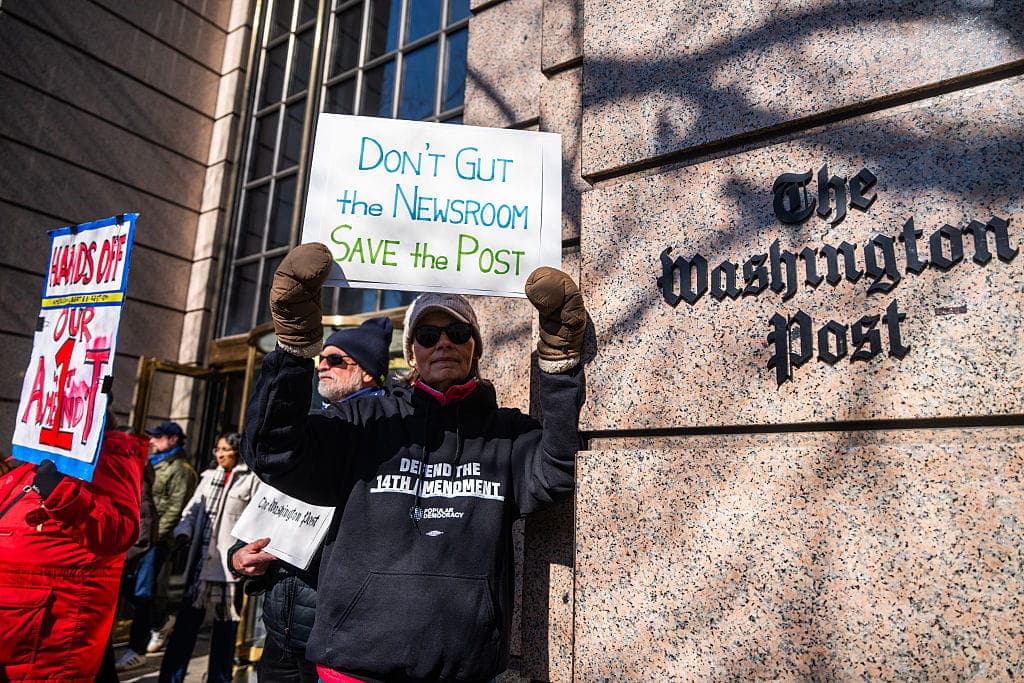

Legacy media fans expressed shock and disgust when The Washington Post cut nearly a third of its staff on February 4, firing about 300 people and closing entire departments. Despite rumors circulating for more than a week claiming layoffs were coming, former staff and leftists advertised their outrage on social media and acted as if journalists losing their jobs was the catastrophe of the century. Adding to the confusion, publisher and CEO Will Lewis, who was effectively AWOL during the mandatory Zoom call with the newsroom on Wednesday, announced on Saturday that he was stepping down. Nobody should be surprised by the newspaper’s shrinking staff. The Post’s decline has been a spectacle for years. Why? Four words: Democracy Dies in Darkness.
The Washington Post Misreads the Room
Ever since Amazon founder Jeff Bezos spent $250 million to purchase The Washington Post from the Graham family dynasty in 2013, the paper has seen multiple leaders, pulling the outlet in various directions. Will Lewis presided over numerous staff reductions in his two years as CEO and publisher, leading to the massive cut this month. Now, former CFO Jeff D’Onofrio will step in as the acting chief executive.
Aside from its various strategic mistakes, though, a turning point occurred in February 2017 when it rebranded under the catchy slogan “Democracy Dies in Darkness,” a phrase symbolizing its “resistance” to the first Trump administration.

The Post ostensibly drove away its core subscribers while developing a cozy echo chamber for a distinct group of people, pumping out ideological screeds and anti-Trump drivel. With sensationalistic propaganda, it seemed to strengthen its readers’ confirmation bias to the point of creating an alternate reality, as most echo chambers do.
A majority of news outlets appear to do this, carefully delivering slanted articles while tiptoeing around their readers’ feelings to maintain a reliable base – but The Post’s strategy was limited. It was profitable back then, but after Biden entered the White House in 2021, the so-called resistance was over – and the outlet seemed lost without its protagonist. Numerous left-leaning news outlets capitalized on the first Trump presidency by publishing out-of-context articles lambasting every minor thing he said – and still do – but most had more to hang their hats on in 2021 than just denigrating one man.
“We are losing large amounts of money,” Lewis told Post staffers after the firing of the paper’s executive editor in 2024. “Your audience has halved in recent years. People are not reading your stuff. I can’t sugarcoat it anymore.”
Months later, Bezos announced the publication would not endorse a presidential candidate for the election – the first time in 36 years. The editorial board had supposedly drafted a piece with a nod to Kamala Harris, but to no avail. Nearly 250,000 digital readers unsubscribed, and the paper reportedly lost $100 million in 2024.
Things only got worse in February 2025 when Bezos announced that the paper’s editorial pages would promote two pillars: “personal liberties and free markets.” Anything opposed to those principles, he said, would not be published. A slew of subscribers and staffers were irate; they saw the move as Bezos attempting to “curry favor with President Trump.” Another mass exodus occurred, with readers flocking elsewhere for their anti-Trump fix.
Essentially, the rightward shift was an open invitation for outsiders to join the silo, which dedicated leftist readers seemingly saw as an assault on their identities and their turf. Why the paper thought it could suddenly change its brand after nearly 150 years is beyond comprehension. Perhaps Bezos saw the results of the 2024 election and concluded that the market would reward a more right-wing Washington Post. Either way, the DC outlet had cultivated a specific audience and then seemingly abandoned it in search of a broader and much different group – one that probably wouldn’t turn to the paper for even the weather. Despite the coverage staying to the left, angry readers went elsewhere for their news.
Circling the Drain
By July 2025, Lewis was urging employees who didn’t “feel aligned” with the newspaper’s direction to take a buyout and leave. Many of its top writers have left in recent years. Some fled to outlets like The New York Times and The Atlantic, while others turned independent and started newsletters on platforms like Substack.
Of course, The Post’s left-leaning bias and anti-Trump rhetoric are not solely responsible for its decline. The New York Times is just as biased as the DC outlet, and The Times is not only surviving but thriving, perhaps because it figured out how to adapt to an ever-changing media environment. It purchased Wirecutter, The Athletic, the widely popular word game Wordle, and created a cooking section. So when people subscribe to the Times, they receive much more than just current events. The Post, on the other hand, went all-in on its resistance brand, and when the main character of its stories was no longer in the White House, it tried to go in too many directions at once and lost the plot.
Now the paper seems destined to go extinct. Its print circulation dropped below 100,000 in 2025 for the first time in almost 50 years. Few long-running papers remain; even the centuries-old Pittsburgh Post-Gazette is shutting down – after losing $350 million. The old media world primarily converges around The New York Times and The Wall Street Journal. Meanwhile, outlets like The New York Post are expanding.
All this overlooks one vital factor: quality. Out of all the outrage people expressed on social media over the recent cuts, few people seem to consider why The Post was bleeding millions of dollars or why so many people disliked the newspaper. Perhaps people just aren't that interested in what it offers. The media is a highly competitive market and one of the least popular institutions, with record-low trust. So if an outlet wants more customers, it needs to give people a reason to trust their coverage while delivering top-notch writing that doesn't make people roll their eyes. Does The Washington Post hit these marks? Ask one of its readers – if you can find one.




.jpg&w=1920&q=75)