


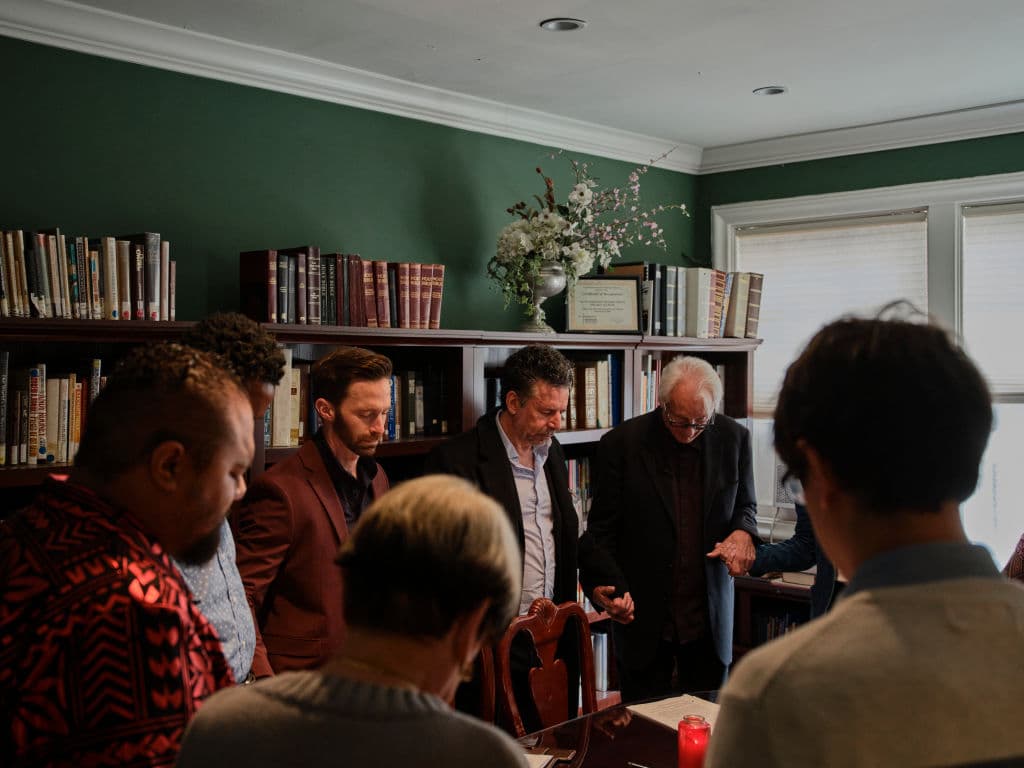

It sounds ludicrous, but the legality of holding religious meetings in your home has made it all the way to the US Supreme Court. At issue is whether homeowners need to obtain a permit to host a prayer meeting or Bible study at their house. The specific case, Grand v. City of University Heights, involves an Orthodox Jewish man in Ohio who wanted to hold at his home a prayer “minyan,” which requires at least ten men to be present. Here’s his story in a nutshell:
University Heights homeowner Daniel Grand has been in a tug-of-war over his right to hold a minyan at his home on the Sabbath. Grand had many reasons for this, including the Orthodox Jewish mandate to avoid driving on the holy day. A neighbor reported this activity to local politicians, which resulted in a “cease and desist letter” because Grand was “violating zoning laws.” Since the Ohio man’s home was not zoned as a place of worship, he was informed that if he continued to hold the prayer meetings, he could be subject to building code violations.
The situation gets messier, but suffice it to say Grand was in hot water with local authorities who essentially accused him of starting a synagogue. The case dragged on with no decision from the zoning board until Grand finally withdrew his request. It was then that the city began to persecute him by skipping his trash removal and subjecting him to police surveillance to make sure he wasn’t having prayer meetings in his home.
Prayer Meetings and the Nosy Neighbor
Neighbors kept up the fight, positing the meetings could cause traffic and parking issues. Grand replied this was a canard because Orthodox Jews aren’t allowed to drive on the Sabbath. But the harassment wouldn’t stop, so the Buckeye resident took the matter to federal court on the basis that the city of University Heights violated his First Amendment rights, as well as the Ohio constitution.
The district court and the US Court of Appeals for the 6th Circuit both dismissed the case. They rejected it because the local zoning process was not completed. After all, Grand withdrew his complaint. As Michael A. Helfand wrote in The Washington Post:
“If a municipality can avoid judicial review by insisting that the zoning process continues, what prevents it from extending that process indefinitely? An inflexible rule requiring a final decision ultimately incentivizes bureaucratic gamesmanship. More hearings. More requests for information. More procedural hurdles. All the while, no federal court can address the merits of the case.”
Meanwhile, Grand’s right to exercise his religion is being trampled. The Supreme Court determined that it needed to step in before things got totally out of hand. It will not decide on Grand’s right to hold the prayer meeting, but rather it will focus on a local authority's right to decide not to decide. That is, it just keeps stringing out the request with no answer until the matter is either forgotten or withdrawn.

Free with the Daily Briefing
85EssaysUnravel the Constitution
Hamilton, Madison & Jay’s complete case for America, free and searchable in the Publius Reader.
Free with the Daily Briefing. Unsubscribe anytime.
It should be noted that money plays a large role in situations like this. Often the complainant doesn’t have the funds to hire attorneys to litigate on his behalf. Other monetary considerations may be the cost of local fines. How much does it cost to violate a cease-and-desist order? Grand does not say, but you can bet that the amount of money one has to fight local authorities should be taken into account. Another way to put it is: How much money do I need to assert my rights?
The outcome of this case will have far-reaching consequences. In an amicus curiae (friend of the court) filing, Jay Sekulow of the American Center for Law & Justice wrote:
“In the Christian tradition, home-based fellowship, Bible study, and communal meals have been central to the faith since the earliest days of the Church …
“A finality rule that requires those Americans to complete an institutional-scale administrative process before seeking relief from that targeting penalizes the very qualities — smallness, informality, home-based intimacy — that make the religious practice most vulnerable to death by red tape.”
Death by red tape is a good way to put it. Taking away homeowners’ rights to hold a small religious meeting in their home should not be a decision for local authorities but rather the person who owns the house. After all, America has always been a place where a man and woman are king and queen of their castle. What goes on in their home is really no business of anyone else unless, of course, something illegal is going on.
That a minyan or a Bible study may be deemed illegal is a stretch from the words of the First Amendment: “Congress shall make no law respecting an establishment of religion, or prohibiting the free exercise thereof …” That last part, “the free exercise thereof,” may get the city of University Heights a well-earned smackdown by the US Supreme Court.
Dig Deeper Into the Themes Discussed in This Article!
Liberty Vault: The Constitution of the United States

.jpg&w=1920&q=75)