
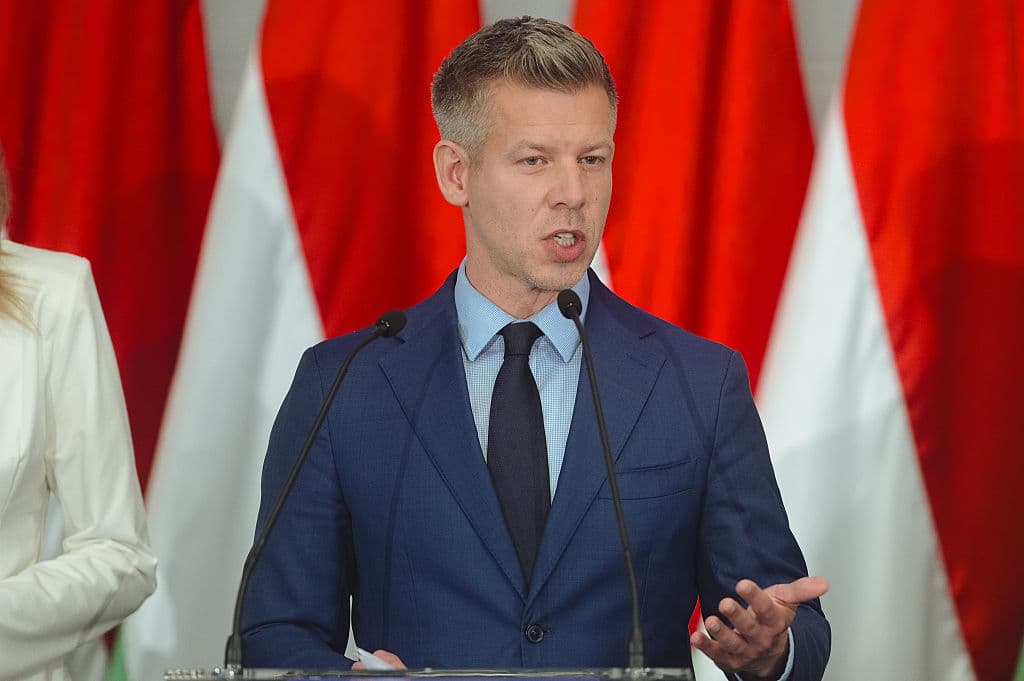

Perhaps the greatest trick Péter Magyar, Hungary's new leader, ever pulled was convincing the globalists he was one of them.
Following the April 12 election, a chorus of leftist icons, from Alex Soros to Hillary Clinton, took to social media and hailed Viktor Orbán's ouster from his 16-year reign. Based on their celebratory comments, they likely did not follow the electoral contest closely enough. If these paragons of open borders did, they might have been apprehensive about supporting the now-former prime minister’s opponent.
The politics unfolding in Budapest could quickly morph into a case of “better the devil you know than the devil you don’t,” and perhaps you should refrain from commenting on something you do not know.
Feeling Hungary for Peter Magyar
On April 13, Prime Minister-elect Péter Magyar held an international press conference to outline his new government's priorities, which could start being implemented as early as May 5. The three-hour briefing covered a wide range of topics, including immigration.
In 2024, the bloc formally adopted the Pact on Migration and Asylum, the largest migration policy reform package in the European Union's (EU) history. Some of the measures include faster asylum processing, covering the financial and logistical costs of relocating asylum seekers, and merely changing the lock on the door rather than installing a new border security system.
For the past two years, Hungary has been facing a daily fine of 1 million euros for flouting the EU's asylum laws. While Magyar wants to resolve this pecuniary problem, he says he does not intend to comply with the pact, arguing that leaders had failed when they allowed more than 1 million people to seek refugee status a decade ago.
"There are other countries that have managed to comply with EU law without allowing irregular migrants to enter. If Slovakia and Poland could solve this, then so can we," he told reporters. "Hungary takes a very strict stance on illegal migration. It will not accept any pact or allocation mechanism, and we will keep the southern border fence, and patch up the holes that are there now."
But the incoming prime minister is taking an even harder stance on immigration. Effective June 1, his government will end the recruitment of non-EU guest workers and remove them from the country. The goal is to support the left-behind Hungarian youth in the nation’s rural communities.
Put simply: “We really want to protect our country and Europe from illegal immigration.”
In what sounds like something one would hear at a MAGA rally, Magyar had a New Year’s Day message that pointed the finger at the elite for causing inflation, growing debt, economic stagnation, and wars.
“Hungarian history is not written in Washington or Moscow, but at home, on Hungarian streets and squares; not with hatred and blood, but with love and heart; not online with digital warriors, but in reality with flesh-and-blood Hungarians. In short, by all of us together,” he said in an online video.
Russian to Pragmatism
The conservative leader, despite the widespread criticisms of his predecessor, is taking a more pragmatic approach to Russia and its petroleum products than outsiders would like. While he believes Russian President Vladimir Putin must end the war in Ukraine, Budapest will continue to purchase cheap oil from Moscow, though he believes the country must diversify its energy imports.
"If Vladimir Putin calls, I’ll pick up the phone,” he said. "It would probably be a short phone conversation, and I don’t think he would end the war on my advice."
As for Kyiv, the new leader says he would oppose fast-tracking the country's EU membership, adding that its accession in the next ten years would not be realistic. At the same time, while he would not oppose the European Commission's 90-billion-euro loan to the Ukrainian government, Magyar stated that Hungary would not fund Kyiv.
Europe Holds €17 Billion Purse
Magyar is not anti-Europe and is far more pro-European than his predecessor. But he has expressed skepticism and even suggested in a 2024 interview that Viktor Orbán could become president of the European Commission or the European Council. "He has a vision and a hardline policy [toward migration]," he said.
Magyar has espoused principles that European and perhaps American conservatives value. Unfortunately, the bureaucrats in Brussels control 17 billion euros that could sway Hungary in a particular direction.
Since 2022, the EU has frozen the money earmarked for Hungary, accusing the government of failing to meet democratic and governance standards. European media outlets have reported that Brussels is prepared to release some of the frozen funds following weekend talks with the prime minister-elect in Budapest.
Magyar has introduced a four-step plan to unblock the cash, focusing on battling corruption, protecting academic and press freedom, and restoring judicial independence. "We intend to fully deliver on these commitments once in government, including our promise to bring home the EU funds that rightfully belong to Hungarians," Magyar told the press.

So far, there appears to be no other strings attached, at least for now.
This could be the first step for Magyar in following through on his campaign pledge to join the eurozone. "The majority of Hungarian people and the majority of Hungarian business leaders believe that it would give the Hungarian economy a degree of stability if we set a date for joining the eurozone," Magyar said during his post-election presser.
Orbán-esque Without the Baggage
Like other right-wing European populist movements that have inched closer to power in recent years, Péter Magyar and his Tisza party used social media and visits to rural communities to amplify their message, since Orban controlled the establishment media landscape. A high-profile interview in 2024 helped him form a new political crusade, promising to clamp down on what he viewed as a corrupt and propagandistic regime. A religious and family man who wants to bolster pro-natal incentives, Magyar has risen to the top of Hungary’s political world, espousing conservative values to an electorate not impressed by any of the leftist opposition parties.
In the scramble to claim political points and perhaps the moral high ground, both sides of the Western political spectrum walked straight into an unforced error. The Trump administration bet everything on Viktor Orbán, while the open‑borders left embraced Péter Magyar, a politician whose worldview sits miles from their own.