


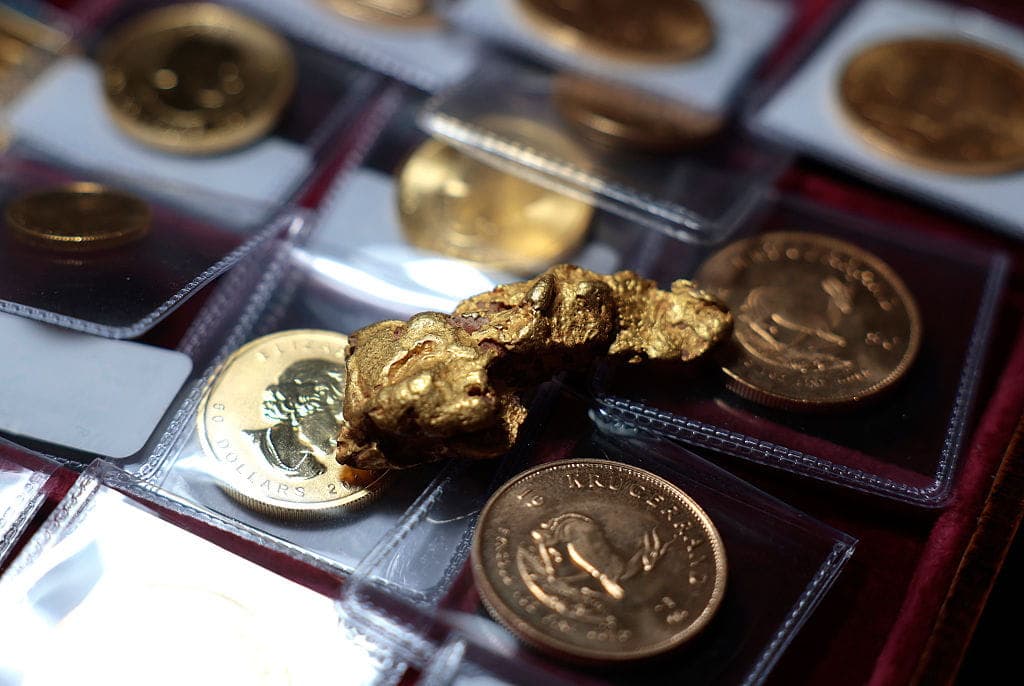

Nineteenth-century Italian astronomer Annibale de Gasparis discovered 16 Psyche, an asteroid located between Mars and Jupiter. What makes this space rock special is that it is metal-rich, with some experts estimating it could be worth up to $10 quintillion in iron, nickel, platinum, and gold. If people could safely extract all of its materials and distribute them on Earth, the price of these metals would crater, making Grandpa Jimmy's gold coins and bars worthless.
Well, humanity does not need to latch onto an asteroid to get gold. Instead, a San Francisco laboratory is turning mercury into the metal.
Alchemists Get Their Gold
Marathon Fusion announced in an Oct. 21 X post that it transformed mercury into what it says is “real, stable gold.” The company said it did this by firing neutrons from fusion reactions at mercury, turning it into an unstable isotope that decays into gold. It also claims it surpassed CERN’s 2015-2018 record of about 29 trillionths of a gram.
Its claim of success has not been independently verified, meaning there are still more questions than answers. How much gold was produced? How much power was used? How much did it cost?
For now, it was enough to spook the goldbugs during the Oct. 22 trading session. On the COMEX division of the New York Mercantile Exchange, gold prices fell 3%, despite favorable conditions for the metals market: plummeting interest rates, a tepid dollar, a market selloff, and ongoing inflation fears. The yellow metal now trades around $4,000, well below this year’s record high just north of $5,500.
So, if global financial markets remain in the dark about the technology’s potential, why the selloff? Look no further than diamonds.
Where Are Zee Diamonds?
Scientists killed diamonds, and the free market dismantled De Beers' diamond monopoly.
Free with the Daily Briefing
85EssaysUnravel the Constitution
Hamilton, Madison & Jay’s complete case for America, free and searchable in the Publius Reader.
Free with the Daily Briefing. Unsubscribe anytime.
The Diamond Standard Index, a real-time tracker of investment-grade diamonds, has been in freefall since early 2022. It has cratered 50% over the last four years to an all-time low. The average price for a one-carat diamond, which represents about 12% of the overall market, is just under $2,500.
Blame lab-grown diamonds, an industry that has been financially backed by Academy Award-winning actor Leonardo DiCaprio. These gems mirror the chemical and physical properties of natural diamonds and are produced by applying heat and pressure to small diamond “seeds” in a carbon source. Alternatively, the small diamond seed can be placed in a vacuum chamber filled with a carbon-rich gas and heated, requiring much less pressure. Either way, despite being grown in a laboratory, they look and feel the same as the diamonds formed deep within the ground.
The main difference is the price: Man-made diamonds typically cost under $1,000.
Gold’s Glitter Gone?
Generally speaking, gold’s price depends on its rarity. If a couple of people in white coats could transform mercury into gold and eventually create vast quantities of bullion, the price of gold could follow the same path as diamonds.
Does this mean the gold standard revival campaign is dead? Should seniors liquidate the gold coins buried in the backyard? Is it time to short mining stocks? It is easy to see why some would turn bearish. But a chorus of experts has crunched some of the numbers, including the Rand Group, which wrote:
“A one gigawatt plant, on the optimistic models, makes 2 to 5 tonnes of gold a year. Global mines pull out 3,500 to 4,000 tonnes. One plant moves annual supply by about a tenth of a percent.
“The feedstock is enriched mercury. About $15,000 per milligram. Gold trades near $135 per gram. You are loading the reactor with something 100,000x more expensive than what comes out of it.
“And what comes out is radioactive. The bars sit in storage for 14 to 18 years before anyone can legally sell them. A plant switched on today delivers its first sellable ounce in the 2040s.”
Perhaps in the near future, we will be writing gold’s obituary after 6,000 years. If so, that was quite a run, and after all, isn’t it all about the memories we gathered and the economic papers we penned along the way?