


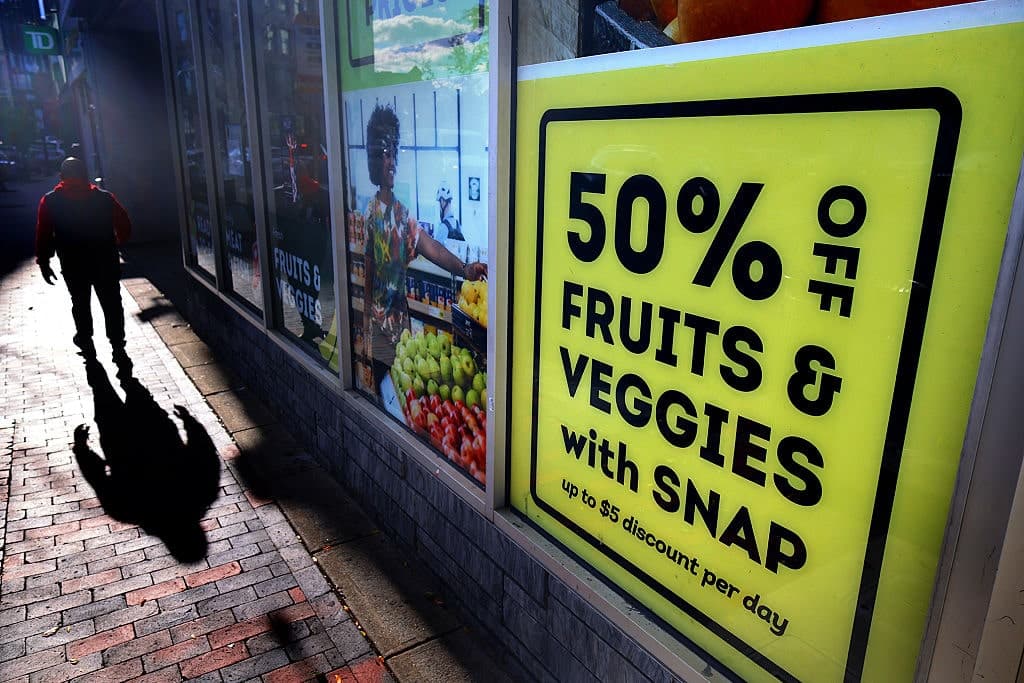

Agriculture Secretary Brooke Rollins announced this week that all recipients of the Supplemental Nutrition Assistance Program (SNAP) will have to reapply to prove their households are still eligible to receive benefits. “Business as usual is over,” said Rollins during an interview on Fox News’ Morning Maria. “The status quo is no more.” The Trump administration is on a mission to weed out and prevent fraud in the nation’s largest food assistance program. Rollins has already spotted significant misuse within the program despite some states withholding SNAP data. But there’s more to this than just catching fraud and saving taxpayers’ money. It’s a multifaceted issue that could have massive political implications, depending on which way the wind blows.
SNAP Reset
Upon taking office in February, Rollins ordered every state to share data on SNAP recipients, but only 29 have complied so far, mostly Republican-led states. That so many blue states have yet to comply with her order raises some questions, especially considering how many months have passed since she requested the data. Though the matter is apparently being challenged in court by some, one can’t help but wonder whether the Democratic-led states are trying to hide something.
With the limited information Rollins obtained from the cooperative states, she discovered 186,000 deceased people receiving SNAP aid, and around 500,000 getting benefits in more than one state, meaning they were registered twice – possibly double-dipping. Earlier this month, Rollins said her team found “thousands and thousands of illegal uses of the electronic benefits transfer (EBT) card.” She also said the White House has removed roughly 700,000 people from the rolls and made 118 arrests.
The Department of Agriculture (USDA) found that stolen benefits cost the government some $102 million in the first quarter of fiscal year 2025, a jump of nearly $33 million from the previous quarter. More than 220,000 fraudulent claims were approved, along with more than 690,000 fraudulent transactions.
In light of all this, forcing recipients to reapply doesn’t sound like such a bad idea. It also might weed out some beneficiaries. Participants already have to recertify every 6 months or so, depending on the state, to update any changes to their status. Reapplying, on the other hand, is like starting from scratch: Applicants have to submit proof of citizenship and identity, among other documents, and then appear at an eligibility interview and wait for verification and approval, which can take around 30 days. It’s more intense and time-consuming than recertification, so some people could decide they can get along fine without it just to skip the hassle. And, if the re-enrollment is on a different database, anybody who tries to register more than once might raise a red flag. If the states maintain the current systems, however, they will likely face the same issues in the future. But fraud is not the only problem.
A Crisis of Dependency
A large number of recipients are elderly, disabled, or children, people who undoubtedly need the assistance. But when looking at the numbers, it is hard not to wonder how so many people are dependent on the government to eat. Nearly 42 million Americans rely on SNAP benefits, about 12% of the population, more than double the number enrolled in fiscal year 2001, according to the Economic Policy Innovation Center (EPIC). Last year, the government spent almost $100 billion of taxpayers’ money on SNAP.

EPIC reported in 2024 that “Benefit levels have increased faster than inflation, in part due to President Biden’s unilateral 21 percent increase in the allotment calculation.” It also found that the duration of dependency had lengthened, with nearly half of the recipients staying enrolled for 20 months or longer. Much longer, in some cases. A few weeks into the recent government shutdown, the KOAT7 News team in New Mexico interviewed a seemingly mobile woman who said, “I have depended on those benefits since the 1990s, and it is detrimental to my life if I don’t get them.”
Most people can probably agree that 42 million people getting their food on the taxpayers’ dime is outrageous. If that many Americans truly need the assistance, perhaps the government is asking the wrong questions. Then again, maybe this has become a “crisis of passive and demoralized dependency,” explained independent journalist Chris Bray in his Substack newsletter. “[T]he costs of learned helplessness have to be faced. We’re not harming people by limiting food aid, with the exception of people who are too old or too disabled to work. … Rather, we’re harming people by not limiting food aid more carefully, and by teaching an enormous part of the population the premise that they’ll starve if the government doesn’t feed them.”
The “Big Beautiful Bill” that the president signed in the summer added new restrictions to SNAP, including expanding work requirements. Making people reapply seems like a reasonable next step to solving this dilemma. If the Trump administration can eliminate fraud and cut back the SNAP enrollments without disrupting assistance to those who absolutely need it, his efforts could save taxpayers money and, in turn, boost his support from the working class. Of course, if he's wrong and fraud isn’t as rampant as Rollins expects, or if the re-enrollment backfires, he could end up handing the Democrats a wedge issue heading into the 2026 midterms. Regardless of the political implications, somebody should probably find out why so many people are reliant on the government to eat and then act accordingly.
As Thomas Jefferson said in a letter to Thomas Cooper in 1802, “[I]f we can but prevent the government from wasting the labours of the people, under the pretence of taking care of them, they must become happy.”

.jpg&w=1920&q=75)

.jpg&w=1920&q=75)