
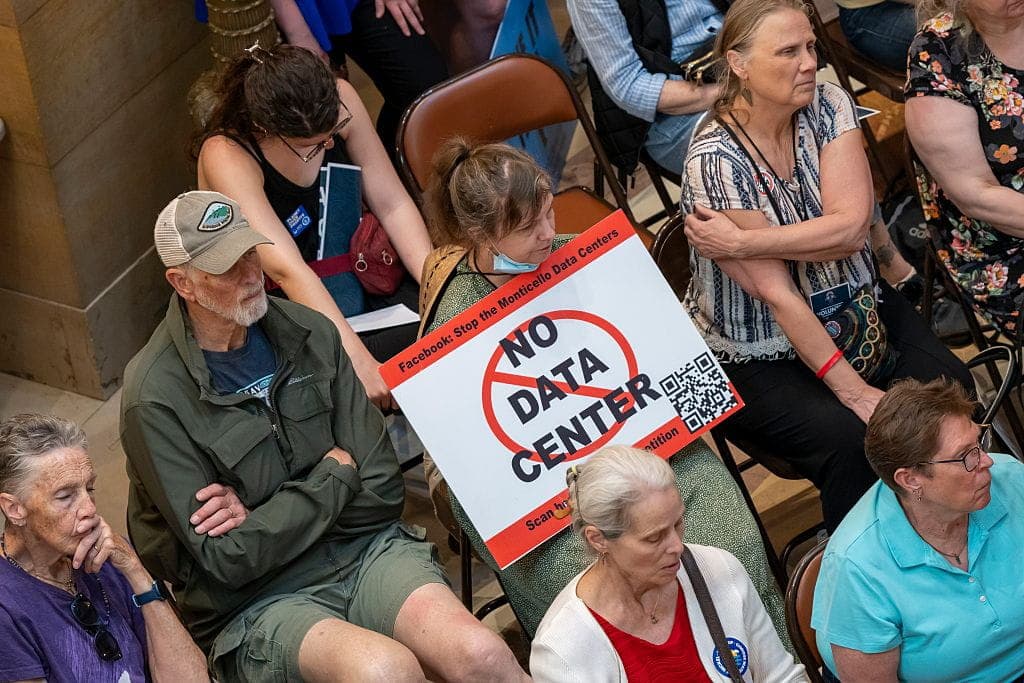

Communities across the United States are pushing back against data centers, citing the strain on natural resources and other local disruptions, as tech companies race to build digital infrastructure to support artificial intelligence projects. Data center development has become a household concern, and with the midterms on the horizon, voters are already taking action against politicians who back the computing facilities.
Opposition to Data Centers Abounds
Voters in Festus, a small town in Missouri, ousted four city council members for supporting a $6 billion data center. The council members lost their seats to candidates whose platforms stated that they were against it. “This data center fight has struck this community to the core and really, honestly ignited a community-driven effort here,” said Dan Moore, who defeated incumbent Bobby Benz. “People are awake now, and we're not going to let this continue on anymore.”
Festus City Administrator Greg Camp argued that the data center project was a rare opportunity for local governments to increase tax revenue, but residents argue the downsides outweigh the benefits – a sentiment shared by those in rural North Carolina. After commissioners in Edgecombe County approved a data center, an incumbent with four terms under his belt was unseated.
The concerns aren’t isolated to a few towns: A Consumer Reports survey conducted late last year found that “78 percent of Americans are somewhat or very concerned that the new data centers being built across the country will make their energy bills go up.”
Julie Bolthouse of the Piedmont Environmental Council warned that the centers will be a major issue in the upcoming midterms, adding, "It is becoming harder and harder for our elected officials to turn a blind eye.”
Footing the Bill
More than 3,000 data centers in the United States are already operational, and nearly 1,500 more are under construction or in the planning phase, according to Consumer Reports. Some of the facilities are considered “hyperscale,” meaning they can require thousands of acres and significant amounts of power to operate, similar to a small city.
All of that power costs money, and the average consumer is feeling the squeeze. A Bloomberg analysis found that “areas with high concentrations of data centers saw electricity prices jump 267 percent over the past five years.” One of the ways data centers drive up electricity bills is by essentially forcing local power companies to build new power plants and transmission lines. “Utilities are building infrastructure, and then we all pay for it because that’s how the utility business model has always worked,” explained Ari Peskoe, director of Harvard Law School’s Electricity Law Initiative.
The demand for water is also rising amid the AI boom. For cooling needs alone, one data center can gobble up 5 million gallons of water each day, which is roughly the equivalent of more than 16,000 average American homes. Millions of gallons of water are also required to generate the electricity needed to keep data centers operational.
Midterm Messaging
As opposition to data centers grows and the midterms approach, tech companies and politicians are considering new ways to win over frustrated communities, including what the Brookings Institution describes as a shift from a “community-benefit model” to a “shared-prosperity model.”
“Communities should become participants in real estate deals for data centers, and universities and states should participate in large and small funding rounds for AI startups,” Brookings argues. The AI boom is reminding Americans that their land, water, and electricity are vital, and they “may well soon come to believe those important AI resources should be shared only as part of grand bargains that deliver true, high-value economic development to the regions that provide them.”

.png&w=1920&q=75)