


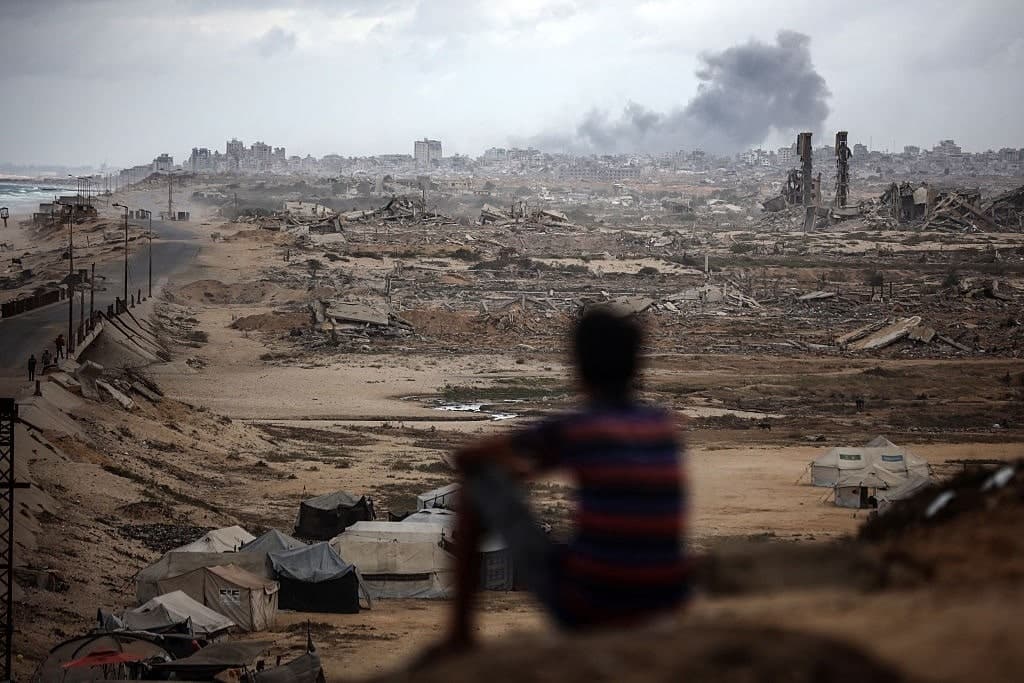

Conflict and strife have been the hallmark of the Middle East since Israel became a nation. Could that be coming to an end? Is the Middle East on the brink of peace? Recent diplomatic breakthroughs suggest that what was once inconceivable for decades could become a reality – a lasting peace. On October 8, President Donald Trump announced to an assembled press corps that Israel and Hamas had reached an agreement on the first phase of a ceasefire that could result in an end to the two-year-old Hamas-prolonged war.
Middle East Peace Begins With a Ceasefire in Gaza
Based on the Principles of Peace plan, Israel and Hamas have agreed to a phase one ceasefire whereby the fighting will stop and the Israel Defense Forces will pull back to a designated battle line. As Reuters explained, “Thousands of displaced Palestinians trekked over the wastelands of Gaza to return to the ruins of their abandoned homes on Friday, after a ceasefire took effect and Israeli troops began pulling back under the agreement to end the war.” In the meantime, Israeli families wait patiently for the 48 hostages to be returned. President Trump indicated that the hostages, living and deceased, would be repatriated on “Monday or Tuesday” (October 13 or 14). In return, Israel will release nearly 2,000 Palestinian prisoners, including 250 serving life sentences. Details of follow-on phases for the rebuilding of Gaza are in the planning stages, but they also portend the opportunity for rebuilding Gaza and a longer-lasting, more prosperous peace.

Since the massacre of innocent Jews on October 7, 2023, the conflict in Gaza has been the pivot point around which nearly all of the turmoil in the Middle East over the last two years has turned. However, looking forward to a more peaceful Middle East, Trump’s diplomatic olive branch to the new government in Syria has the potential for a tectonic shift toward a US alignment where Russia and Iran were once influential. Such a new Middle East geopolitical structure would ease tensions between Syria and Israel. During President Trump’s May visit to Saudi Arabia, he met with Syria’s interim President Amed al-Sharaa in Riyadh. “Trump met with al-Sharaa this week in a sign that Syria is growing closer to the United States after years of ostracization over concerns about its human rights, terrorism, and Iranian ties. The American President lifted sanctions against Syria as well,” Just the News observed.
Iranian proxy Hezbollah, so troublesome in the past as a source of terrorist attacks on Israel, has had its influence in the region reduced significantly. During the 2024 Israel-Hezbollah conflict that ended with the November ceasefire, Israel decimated Hezbollah leadership and destroyed much of the terrorist organization’s infrastructure. Estimates of Hezbollah losses are 5,000 fighters killed. As of October 2025, Israeli precision airstrikes have eliminated an additional 250 Hezbollah operatives. Additionally, a new pro-Western Lebanese government leadership elected in January has taken significant measures to constrain the influence and activities of Hezbollah. “Lebanon has intensified its efforts to prevent arms and financial smuggling to the organization: tightening airport inspections, halting flights from Iran since February, and strengthening border control over land crossings from Syria,” The Institute for National Security Studies (INSS) reported. Additionally, the Lebanese government took steps to make it more difficult for Hezbollah to carry out financial transactions. Again, from the INSS:
“On July 15, 2025, the Central Bank of Lebanon even banned all financial institutions from engaging with Hezbollah’s al-Qard al-Hasan network. Most far-reaching and exceptional, the new leadership has pushed, under American encouragement, to realize its vision of disarming Hezbollah…and stripping the organization of its status as an independent militia.”
The 12-day war the US and Israel fought against Iran left the Tehran government weak. Iran’s air defenses are in disarray, and its ballistic missile capability is significantly degraded. Nonetheless, Iran’s leadership continues its threatening rhetoric. “Iranian officials have threatened to close the Strait of Hormuz, likely to try to discourage the United States from enforcing sanctions that target Iranian oil exports,” the Institute for the Study of War reported. However, as the 12-day war demonstrated, Iran is not capable of taking on the US and would come out the worse should it attempt to attack shipping in the Strait of Hormuz. Despite Iran’s more modern anti-ship missiles, the consequences should give the leadership pause. All oil storage facilities, oil refineries, and the Iranian navy would be at risk.
The New York Times added some realism to Iran’s status, explaining: “Iran’s diminished regional standing is among the starkest shifts in regional dynamics since the war between Israel and Hamas began two years ago…Its ability to project power across the region has been vastly undercut through a series of setbacks over the past two years.” Iran’s reaction to the prospect of a ceasefire in Gaza and the potential a longer peace has been muted with a “tacit acceptance of the Palestinian militant group’s ceasefire deal with Israel,” according to the NYT.
Trump to Host Summit
Typical of his hands-on style, President Trump has requested and will host a high-level summit at the Red Sea resort town of Sharm el-Sheikh to discuss the details of the Gaza ceasefire and reconstruction while he is visiting Egypt to finalize the agreement between Israel and Hamas. Egyptian President Abdel Fattah el-Sisi has invited the foreign ministers from France, Germany, the UK, Italy, Saudi Arabia, Turkey, Jordan, and Qatar. The meeting agenda will surely focus on the details of the ceasefire, hostage releases, greatly increasing aid to the Gazans, and long-term reconstruction. There will no doubt be discussions on demilitarization and international oversight. Following the summit, Trump will travel to Israel, where Prime Minister Netanyahu has invited Trump to address the Israeli Knesset.
What is essential to the regional peace process is that the Trump peace initiative has the support of the major players among the Gulf States and countries around the world. Even a senior official from Hamas, Dr. Basem Naim, asserted that the “ceasefire would not have been possible without President Trump,” Sky News reported. Over 50 nations and organizations have expressed their support for the Trump peace plan, many lauding the ceasefire and the return of the hostages. Considering the change in the entire geopolitical dynamic, it’s safe to say that the Middle East is on the brink of peace. Will it be a lasting peace? That is the real question.
~
The views expressed are those of the author and not of any other affiliate.