

.jpg%20Canada&w=1920&q=75)

Former Prime Minister Justin Trudeau gave Canada a lost decade. A key contributor to the country’s stagnation was the Liberal government’s obsession with climate change and its ushering in of green energy policies that were disastrous for a nation rich in natural resources. To make Canada great again, Prime Minister Mark Carney is abandoning climate alarmism and embracing what made the country wealthy in the first place: crude oil.
Canada Loves Oil Again
On June 30, the prime minister published a 17-minute YouTube video, focused exclusively on his predecessor's climate agenda. He used words like "expensive" and "divisive" to describe Trudeau's environmental endeavors. Carney essentially admitted that Pierre Poilievre and the Conservatives were right.
For right-wing political pundits, this was a rare win for the incumbent. Indeed, in a bid to resuscitate the ailing Canadian economy, Carney is trying to make the country fall back in love with fossil fuels – and appease Alberta – despite years of climate doomerism.
Free with the Daily Briefing
85EssaysUnravel the Constitution
Hamilton, Madison & Jay’s complete case for America, free and searchable in the Publius Reader.
Free with the Daily Briefing. Unsubscribe anytime.
Ottawa announced earlier this month a new West Coast pipeline that will ship up to one million barrels of crude oil per day from Alberta to Asian markets. The federal government gave its blessing to a new west-east crude oil pipeline that will run from Alberta to Ontario. This comes as the Carney Liberals begin to expand liquefied natural gas exports, scrap the consumer carbon tax, and remove the cap on the oil and gas sector's pollution levels.
Carney already accepted that Canada's emissions will be higher in the coming years, a fact that was inevitable. Various models currently indicate that the Great White North has been missing its emissions targets, even before the current government's reforms. Canada lags behind other G7 countries in emissions reductions, and even the United States is outperforming its northern neighbor.
"The certainties of the world of 2015 are long gone. Our neighborhood hasn't been this hostile since Canada was founded," the prime minister said. "The world hasn't been this unstable geopolitically since the end of the Second World War."
Of course, skepticism is warranted because Carney has spent much of his tenure just talking with his elbows up. From housing to pipelines, it has been all talk and no action. Following Russia’s invasion of Ukraine, Germany surprisingly sprang into action and constructed Floating Storage and Regasification Units (FSRUs) to import seaborne liquefied natural gas in fewer than 200 days.
The prime minister has been in office for 15 months with nothing to show for it. Still, capital might be optimistic about Canadian energy moving forward, having been hesitant to invest in various projects across the country over the last 11 years.
What About America?
America's decision last week not to renew the USMCA could be a major blow to the Canadian economy. The post-NAFTA trade deal will now be subject to annual reviews as the United States raises grievances over production quotas, supply management, rules of origin, and other provisions.
Despite Ottawa's efforts to diversify its trade by importing more students from India and exporting more oil to Asia, the country still needs its southern neighbor. More than 90 percent of its energy is shipped to the United States, making it an extremely difficult market to replace, even if Canada desires to become an energy superpower.
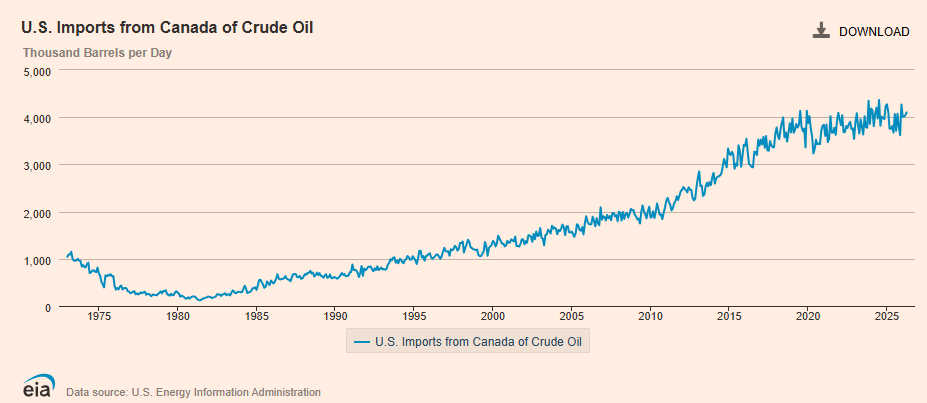
If the numbers are accurate, the United States has about 300 billion barrels of heavy crude sitting in its backyard (Venezuela). It also produces about 14 million barrels of oil per day. The current administration is a close ally of the United Arab Emirates, which withdrew from the Organization of the Petroleum Exporting Countries (OPEC) and is seeking to expand crude production. Add in control of the Strait of Malacca, and the United States is building upon its reputation as an energy superpower.
To be fair, Carney is situated between an igloo and Trumpism. He has to appease the White House (and appear tough to older Canadian voters who blame President Trump for everything) while also finding economic opportunities elsewhere. It is not an easy task.
Desperate Times, Desperate Measures
Trillions of dollars worldwide have been invested in green energy. And yet, every crisis over the last several years has proven these vanity projects to be entirely unreliable. Countries keep turning to crude oil, natural gas, coal, and nuclear power to meet their energy needs. The United States realized it. Europe is starting to come around. Asia always knew it. Canada was the last nation to finally understand that oil and gas are the answer, not a windmill.

.jpg&w=1920&q=75)