
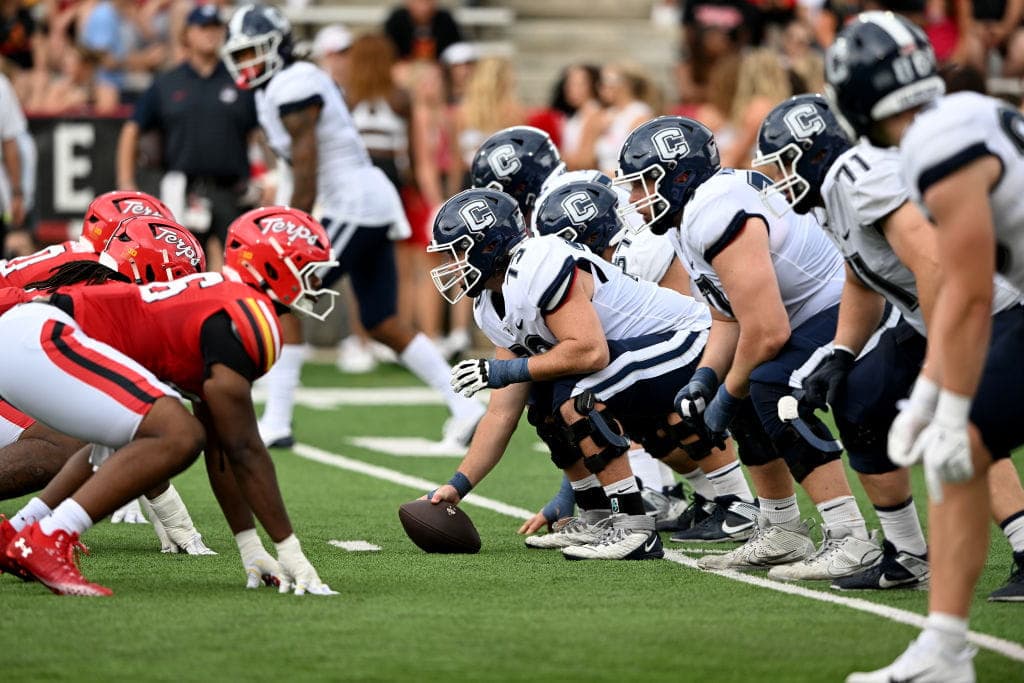

Viewed from the standpoint of profits and ratings, it would appear that college sports are healthier than ever. In 2025-26, college football generated the largest regular-season audience and largest championship game viewership (30 million) in a decade. And now, CBS and TNT Sports report that Monday’s basketball title game between Michigan and Connecticut attracted the largest audience (20 million) since 2019. Over 60% of adult Americans, including 55% of women, watched or attended college games in the last year, according to a recent survey by George Mason University.
And yet, as Marcellus observed in Shakespeare’s Hamlet, something is rotten in the state of Denmark.
The Myth of the “Student-Athlete”
Major universities from coast to coast have long claimed they are primarily concerned with the academic welfare of their talented “student-athletes” free-riding on scholarships. But that has long since become a laugh line, a smokescreen masking their thirst for raking in huge profits off the talents of players forbidden from receiving compensation in any form. Of course, this led to all manner of petty violations and major scandals, many perpetrated by shady coaches and powerful alumni booster clubs who shell out big contributions to their alma maters and expect a highly competitive team in return.
If, instead of calling their players student-athletes, they called them athlete-students, that would at least define them honestly as athletes who must be, in large part, shoe-horned into meeting the academic standards necessary for non-athletes to enter an institution of higher learning.
But college sports are now faced with a problem opposite from the one that plagued them for decades. A landmark Supreme Court decision in 2021 (NCAA v. Alston) and another by a district court in 2025 (House v. NCAA) opened the floodgates for formerly amateur athletes to be paid, turning them into quasi-professionals. This has entirely changed the face of college sports. Now, instead of the myth of “student-athletes” remaining pristine amateurs, the new environment has become little more than a cash grab for transient, mercenary athletes selling themselves to the highest bidder. On top of that, they are able to move through a so-called transfer portal from one school to another from year to year with few restraints.
Trump to the Rescue?
The National Collegiate Athletic Association (NCAA) bowed to the courts’ rulings that college athletes were entitled to compensation, introducing a concept called NIL, which stands for name, image, and likeness. The idea was that college athletes would get a piece of the action in profit-sharing with universities when their countenance, broadly speaking, is exploited for profit through commercials, ticket sales, TV contracts, and the like. Universities now act as open bidders for talent – same as in the pros – instead of doing so covertly for decades. And all of this is happening as online gambling explodes across the nation, drawing in college sports just as it does the pros.
From Liberty Nation
 News, Trivia, Facts, Check Us Out
Stay informed.
Today’s news, the Constitution and American history, written for young readers.
Visit GenerationLiberty.com
So, what’s the problem, you might ask? College athletes are finally being compensated, everyone is making money, TV ratings have swelled, so all should be right with the world. But it’s not. If it were, President Donald Trump would not have gone as far as issuing an executive order aimed at reining in the growing excesses of the college free-for-all bazaar that has cracked the bond between schools and their fans.
News, Trivia, Facts, Check Us Out
Stay informed.
Today’s news, the Constitution and American history, written for young readers.
Visit GenerationLiberty.com
So, what’s the problem, you might ask? College athletes are finally being compensated, everyone is making money, TV ratings have swelled, so all should be right with the world. But it’s not. If it were, President Donald Trump would not have gone as far as issuing an executive order aimed at reining in the growing excesses of the college free-for-all bazaar that has cracked the bond between schools and their fans.
Apparently responding to calls from athletes, universities, and fans across the country, Trump’s order protects college sports by employing “federal authority to support enforcement of clear, consistent, and fair rules on eligibility, transfers, and compensation, while promoting sustainable revenue-sharing and stronger protections for student-athletes.” It could well be that the president’s action is designed to prompt Congress, after years of discussion without action, to pass legislation that would cement such significant reforms into law.
Lesser of Two Evils in College Sports
So, which is worse, the old model based on the amateur student-athlete myth, or the new model that turns college sports into a virtual auction house? In the old days, most players would attend a university for four years, creating a bond between players and fans. But the stars got wise and started leaving for the pros after one or two years for contracts worth millions of dollars. That was the start of a sea change from the long-since dismissed premise that college sports are, and should be, entirely distinct from the professional ranks.
Like it or not, the character of college sports has fundamentally changed, never to return to its previous place in the popular culture. No proclamation or legislation can roll back the hands of time to the age of Knute Rockne and John Wooden, but it could restore some measure of stability to an American institution. In the end, viewers displeased with the changing face of college sports can either learn to live with it, as tens of millions continue to do, or, like a growing number in this ever more mercenary environment, simply stop watching.

.jpg&w=1920&q=75)