

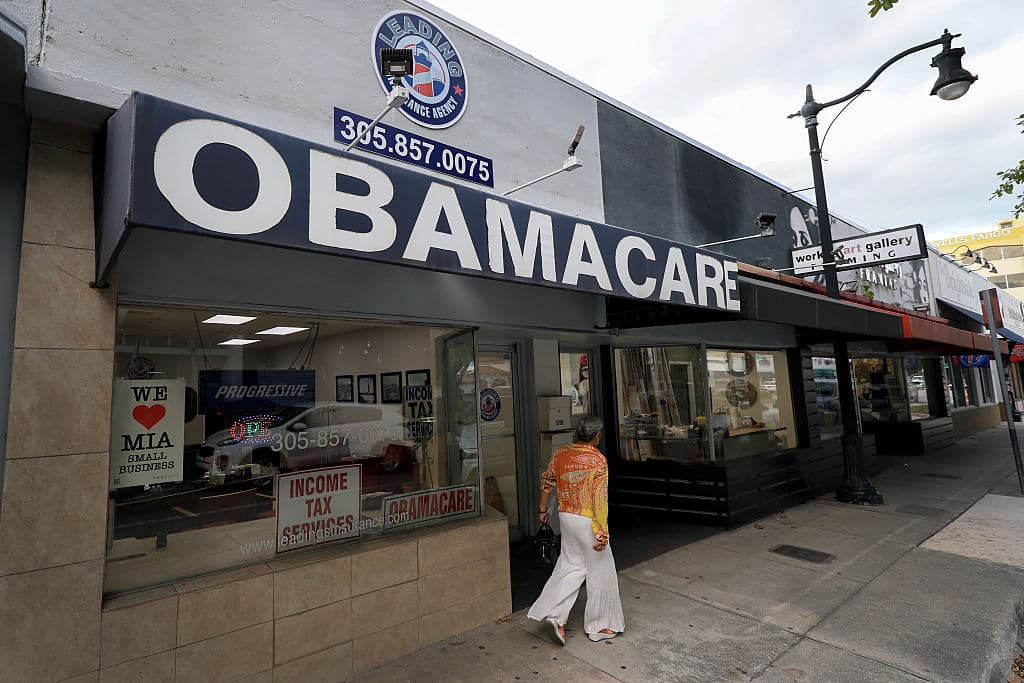

While the common perception of the six-week-long government shutdown is that Republicans won and Democrats lost, the Dems did manage to squeeze one notable concession from the GOP. In return for the votes of eight Democratic Senators to reopen the government, Senate Majority Leader John Thune (R-SD) promised to bring the reauthorization of COVID-era Obamacare insurance subsidies to a vote in December. And while Republicans have no appetite to further bankroll a program they have unanimously opposed for the last decade and a half, both parties stand to gain something from the vote. But the difference is that the Democrats, shut out of power, can only engage in pure partisan politics, while President Trump and Republicans will be presented with a monumental historic opportunity if they choose to carpe diem (seize the day).
Can Obamacare Finally Be Replaced?
When the GOP likely refuses to renew the subsidies that kept the Affordable Care Act (ACA) afloat without substantial increases in premiums during the pandemic, Democrats will certainly follow their usual script and call Trump and his allies cruel and heartless for allowing costs to rise on the more than 20 million Americans enrolled in Obamacare. But if Republicans respond by just discussing how the program is and always has been unsustainable, they would miss their first opportunity in years to fix it once and for all.
As the president and Sen. Bill Cassidy (R-LA) have proposed, those subsidies ticketed for insurance companies could instead be redirected to the beneficiaries with no middleman. Every Obamacare enrollee would receive a check from the federal government to spend on health care as they see fit through Health Savings Accounts (HSAs).

And that could be the start of something big – really big. “Instead of going to the insurance companies, I want the money to go into an account for people where the people buy their own health insurance,” Trump told Fox News, calling his plan “Trumpcare.”
“The insurance will be better. It will cost less. Everybody is going to be happy. They’re going to feel like entrepreneurs. They’re actually able to go out and negotiate their own health insurance.”
The problems with health care have long been the sometimes-perverse incentives built into the system. Insurance companies charge premiums and decide what they will or will not cover. Given ever-rising costs, doctors who prescribe drugs or procedures are met by the inevitable question from patients: Is it covered by my insurance? If it is, then they will consent to it – whether it is truly necessary or not. Doctors are motivated to overprescribe in order to protect their flank and assure they will not be accused of malpractice, for which insurance costs are astronomical. It’s called defensive medicine, and it is a major factor in the soaring costs of health care.
At the same time, according to Psychology Today, “doctors often feel pressure from patients to provide antibiotics, and they identify this pressure as a major reason why they frequently prescribe them for illnesses that do not respond to antibiotics.” Various studies also suggest that doctors who receive money from drugmakers for a specific drug, a common practice, will prescribe that drug more heavily.
Barack Obama and Democrats kicked the can down the road by frontloading Obamacare benefits and backloading much of the massive funding required to keep the ACA afloat over time. But in the 14 years since the passage of the ACA, Republicans have failed to present a viable substitute for the quasi-nationalization of health care. The problem is not that they’ve come up with no alternatives, but that they have come up with too many, and have thus failed to reach anything approaching a consensus. They came close to gutting the ACA in 2017, but the late Sen. John McCain broke from his Republican colleagues and – driven by his personal animus towards Trump – cast the deciding vote against repeal. The other ripe opportunity to replace Obamacare was deep-sixed in 2012 by Supreme Court Chief Justice John Roberts, who refused to go along with the four other conservative justices at the time, leaving the program in place. In 2020, the Court again refused to budge.
Go Big or Go Home
ACA deductibles of up to $10,000 annually make the plan virtually useless for low-income individuals unless they are the victim of a serious medical emergency. The alternative would be a dramatic expansion of HSAs combined with low-cost, high-deductible catastrophic insurance plans, allowing patients to control their own health care while reversing the incentives for doctors to overprescribe, thus lowering costs.
A majority of Americans originally were opposed to the Affordable Care Act, but like any government entitlement program, people get attached to it. As Ronald Reagan once famously said, the closest thing to eternal life on earth is a government program. Such has been the case with Obamacare, which Democrats originally had to work around the clock to pass by a single vote, and which they now defend to the death despite its clear lack of sustainability absent huge government subsidies.
The time is finally ripe for President Trump and the GOP to advance a long-awaited free-market Republican alternative to the ACA. And specific legislation on how to achieve it is in the offing. Rick Scott, Republican senator from Florida and a former health-care executive, says he is “writing the bill right now.” Presented with an opportunity to finally break the Obamacare fever and do more than just complain and obstruct, Republicans would do well to follow the well-worn expression, go big or go home.

.jpg&w=1920&q=75)

.jpg&w=1920&q=75)