

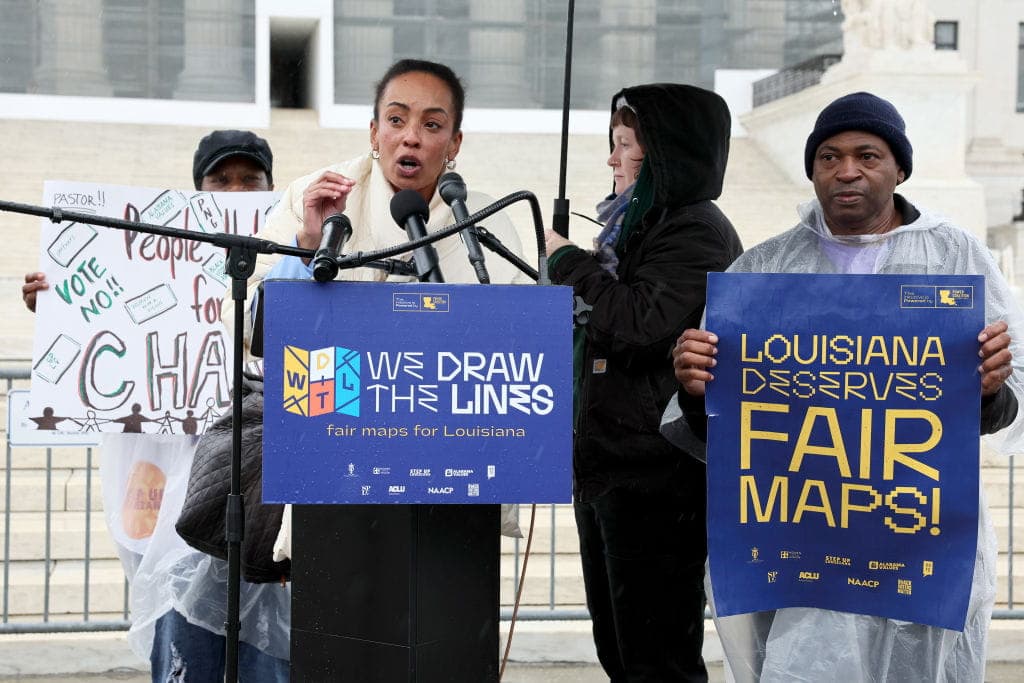

Was it the most consequential Supreme Court decision in recent history? Considering the potential repercussions, it was. On April 29, the nation’s highest court issued a ruling that may well profoundly impact the congressional district maps in several states. The case was Louisiana v. Callais, in which a group of “non-African American” Louisiana voters challenged the redistricting of the state after the 2020 Census. In a 6-3 decision, the Court ruled that the state used race “in creating SB8, and that map is an unconstitutional racial gerrymander.” SB8 refers to the redrawn map, which created a new majority-black congressional district. Previously, Louisiana had one such district.
Racial Redistricting Rejected
The Voting Rights Act, the 14th Amendment’s “equal protection clause,” and the 15th Amendment’s “prohibition on intentional racial discrimination” all came into play in this case. Previously, a three-judge panel from the US District Court for the Western District of Louisiana held that the new map violated the equal protection clause. The Supreme Court’s majority opinion, written by Justice Samuel Alito, concurred with that lower court decision. Louisiana then appealed to the Supreme Court.
Political gerrymandering – the practice of drawing congressional districts to the benefit of one political party over another – may seem unfair, but it is not unconstitutional. Racial gerrymandering is another matter. The Voting Rights Act neither demands nor permits the intentional creation of legislative districts that favor any one racial group – so-called majority-minority districts. In fact, that law expressly forbids it, as a reaction to previous practices that discriminated against black voters.
Justice Alito lamented in his decision that lower courts have not always interpreted it in that way.
“Section 2 of the Voting Rights Act of 1965, 52 U. S. C. §10301 et seq., was designed to enforce the Constitution — not collide with it,” Alito wrote. “Unfortunately, lower courts have sometimes applied this Court’s §2 precedents in a way that forces States to engage in the very race-based discrimination that the Constitution forbids.”
The 15th Amendment (1870) states that the “right of citizens of the United States to vote shall not be denied or abridged by the United States or by any State on account of race, color, or previous condition of servitude.” But the amendment also gave Congress the right to enforce its protections through legislation. Thus, after decades of various schemes in certain states to suppress the black vote, Congress in 1965 came up with the Voting Rights Act. But that act forbids discriminatory redistricting along racial lines. It does not specifically favor any one racial group.
The Supreme Court has now affirmed that political and racial motivations should not be intertwined, even though most blacks have for decades voted Democrat and still do. If a state’s “predominant motivation” in redistricting is racial – that is, if the state set out not to create a majority-Democrat congressional district but a predominantly black district, that violates the Constitution.
Democrat Districts on the Line
To say this Supreme Court decision caused a stir would be putting it mildly. Independent journalist Nick Sortor wrote on X that Democrats were “melting down,” adding, “Some estimates show they could IMMINENTLY lose up to 19 DEMOCRAT SEATS in districts that were drawn specifically for black voters.”
NAACP President Derrick Johnson said in a statement, "Today's decision is a devastating blow to what remains of the Voting Rights Act, and a license for corrupt politicians who want to rig the system by silencing entire communities.” Johnson accused the Supreme Court of betraying black voters, America, and democracy.
President Donald Trump wrote on Truth Social that the decision was a "BIG WIN for Equal Protection under the Law," and White House spokeswoman Abigail Jackson said in a statement:
"The color of one's skin should not dictate which congressional district you belong in. We commend the court for putting an end to the unconstitutional abuse of the Voting Rights Act and protecting civil rights."
The additional majority-black district in Louisiana snakes awkwardly across the state for some 200 miles from the southeast to the northwest and has no logical boundaries. When it’s redistricting time, Democrats have used similar tactics to carve out majority-black districts that favor them in several mostly Southern states. All those districts could now be in jeopardy. Politically, this is no doubt a win for Republicans.
For Democrats, this means not just the prospect of losing possibly multiple seats in the House of Representatives but also, going forward, the loss of a favorite strategy for creating safe districts in otherwise largely unfriendly states.
Dig Deeper Into the Themes Discussed in This Article!
Liberty Vault: The Constitution of the United States