


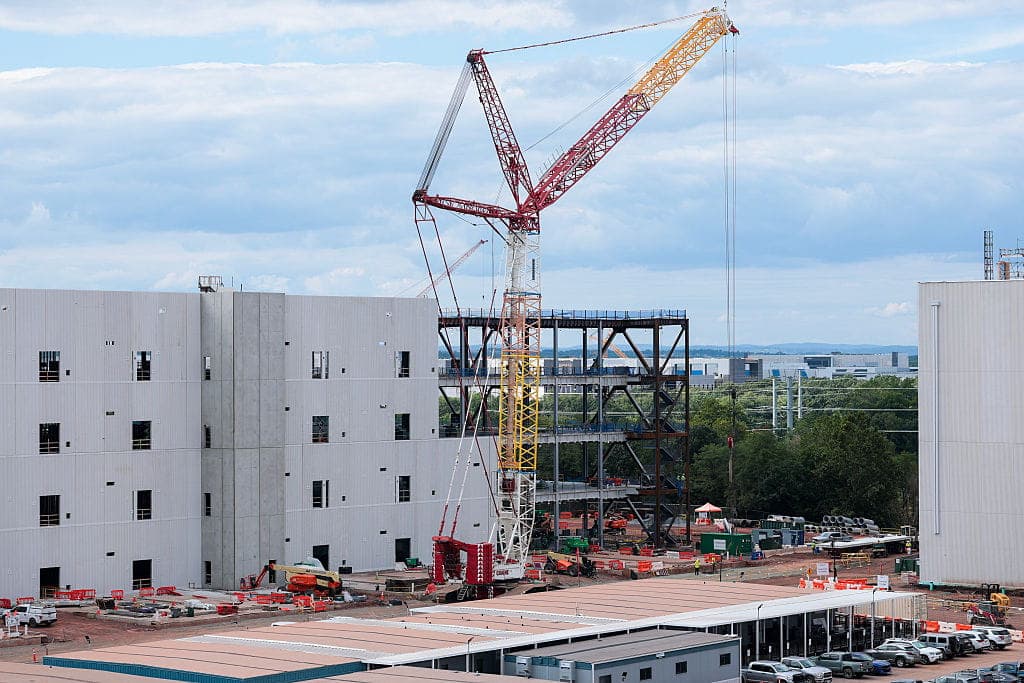

As opposition to data-center development intensifies nationwide, officials in West Virginia think they have a plan that could assuage concerns: using AI-infrastructure revenue to eliminate state income tax.
While zero income tax is undoubtedly appealing, governments hoping to capitalize on the AI boom face an uphill battle. Earlier this year, a Gallup poll found 70% of Americans “oppose constructing data centers for artificial intelligence in their local area, including nearly half, 48%, who are strongly opposed.” Less than one-quarter were in favor of the developments, with a mere 7% expressing strong support.
West Virginia’s Plan
The West Virginia Department of Commerce recently released a Responsible Data Center Development Plan, which claims that the success of the state’s economy, both present and future, relies heavily on data centers. As such, the state government developed a 20-year plan for data-center development, including the promise that “All West Virginians will benefit from Data Center Revenue.”
Under the state’s “High Impact Data Center (HIDC) Designation” – a formal process established last year to determine whether a proposed data center meets certain standards – the financial benefits from these major tech developments must be directed back to the people of West Virginia. At least 50% of the revenue from these facilities must be used to reduce and eventually eliminate the state income tax.
State law also protects local governments from being “negatively impacted by a data center project,” the plan explains, and at least 30% of data-center revenue must be allocated to the county in which the development is located. Half of the remaining 20% will go to all counties statewide, and the other half will be used to improve water, electrical, and wastewater projects.
Gov. Patrick Morrisey shared his outlook in a statement obtained by Fox News Digital:
"This shared framework gives us the exact blueprint we need to attract billions in private investment, create thousands of high-paying construction and technology jobs, lower taxes for our citizens, and revitalize economically distressed regions, all while preserving the wild and wonderful state we call home."
West Virginia is taking a noticeably softer and more persuasive approach to the data center issue than other government officials, including President Donald Trump, who wrote on Truth Social: “The only reason that communities throughout the U.S.A. should not want Data Centers is if they want to end up being backwards and poor. If they want to be successful and rich, with far lower taxes and jobs all over the place, let Data Reign.”
Can Data Centers Eliminate Income Tax?
Let’s look at the numbers for Loudoun County, VA, home to more than 200 of these facilities. Through just a tax on the computer equipment inside data centers, the county will likely generate around $1.3 billion in 2027 – which is roughly 40% of the locale’s total tax revenue, according to The New York Times. The county has already used data-center money to cut property taxes.

Back in West Virginia, the state collected just over $2 billion in personal income tax in 2025, according to Metro News. If West Virginia implements similar tax policies to Loudoun County, it certainly seems possible that the state could eliminate the income tax through data-center development – but it may take hundreds of facilities to do so.
Ultimately, it really comes down to trust. Will West Virginia’s government keep its word and use the money to eliminate the state income tax, or will the “golden goose,” as Trump calls it, be too much to resist as an additional revenue stream?