

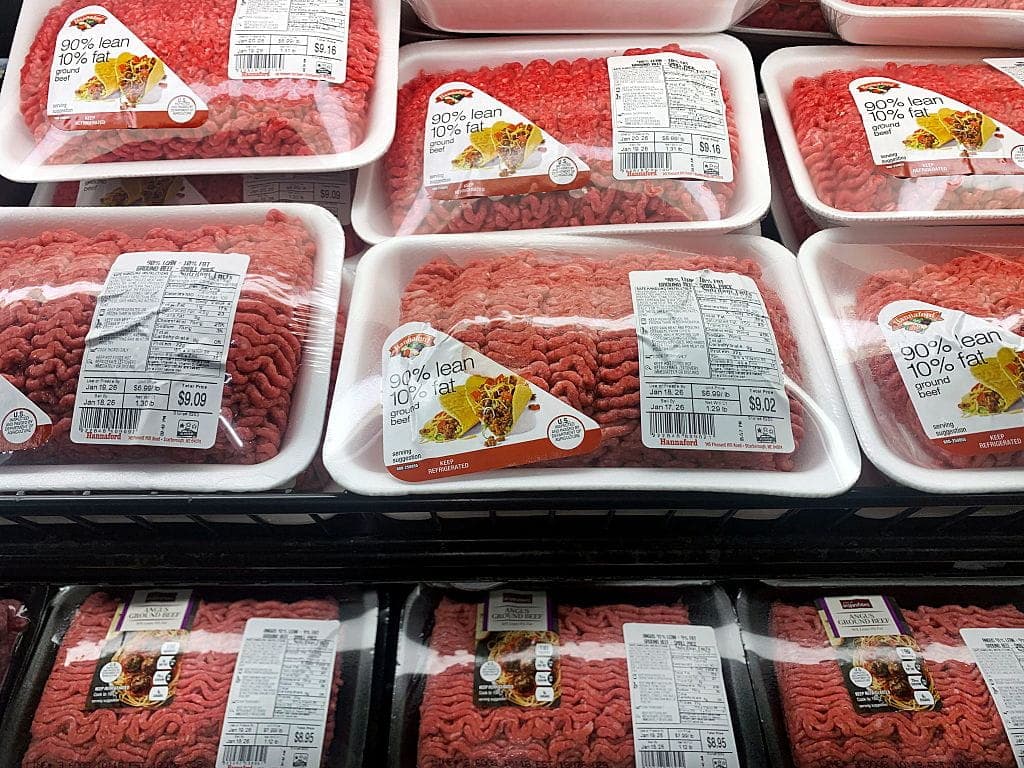

President Donald Trump recently signed an executive order aimed at tackling record-high beef prices after ground beef soared to an average of $6.69 per pound in December 2025, according to Bureau of Labor Statistics (BLS) data. While the president’s plan might help bring down prices, it could come at the expense of already struggling American farmers.
Importing More Beef
President Trump’s executive order authorizes the importation of an additional 80,000 metric tons of lean beef trimmings – which are used to make ground beef – from Argentina in calendar year 2026. Trump said this increase in supply for consumers should “ensure that hard-working Americans can afford to feed themselves and their families.”
Kent Bacus from the National Cattlemen’s Beef Association (NCBA) challenged the Trump administration’s plan, saying the group “fundamentally disagree[s] with the premise that increased imports can lower beef prices.”
In a prepared statement, Bacus noted that the "NCBA is encouraged to see the Trump administration take necessary steps to address longstanding market-access challenges for U.S. beef in Argentina," but he called for improved safety measures to avoid “Argentina’s issues with foreign animal diseases.” He went on to say that the “NCBA remains concerned that expanding imports from Argentina without increased inspection protocols and up-to-date audits could place American consumers and our cattle herd at unnecessary risk."
Bacus wasn’t the only one to push back on Trump’s new order. Food economist and Michigan State University Professor David Ortega told CBS News that the import increase would not be enough to bring down prices.
"We're talking about less than 1% of supply. And so, I wouldn't expect this to have much of an impact on these prices,” Ortega said. “Now, it doesn't hurt, but we're not talking about any major quantities that we are importing that would immediately suppress prices."
Why Prices Soared
Just five years ago, a pound of ground beef could be purchased for under $4. So, what caused the jump in price? Over the last several years, severe drought and devastating wildfires have hurt livestock producers, hitting such major beef-producing states as Texas, Oklahoma, Missouri, Nebraska, South Dakota, and Kansas.

To make matters worse, the Department of Agriculture Animal Plant and Health Inspection Service, along with US Customs and Border Protection (CBP), “restricted the importation of live animal commodities” from or through Mexico after the New World screwworm was detected in the Latin American nation in May 2025.
“These factors have combined to result in the United States cattle herd contracting to record lows. As of July 2025, the United States cattle inventory totaled 94.2 million head, including 28.7 million beef cows. This is one percent lower than the United States cattle inventory surveyed in July 2023, continuing the downward trend of cattle inventory in the United States,” Trump’s order states.
Will Trump’s Plan Hurt Farmers?
Liberty Nation News National Correspondent John Klar, who raises grass-fed organic beef in Vermont, acknowledged the complex relationship between grocery store prices and farmers’ profits, as well as the difficult position in which the Trump administration finds itself:
“The Trump administration is trying to navigate an unenviable Scylla and Charybdis of consumer demands for lower prices and farmer demands for higher market returns. This situation is the product of decades of favoring industrial food production with federal subsidies while small farms were consolidated … Beef is persistently rising in price because Americans are willing to pay a premium for healthy foods (especially young people) ... The short-term move of the EO may help consumers as the midterms loom, but it is counterproductive in the longer term for America's beef farmers.”
While it is unclear whether Trump’s plan will succeed in lowering beef prices, one thing is certain: Americans aren’t ready to give up their cheeseburgers just yet. Last year, consumers purchased more than 6.2 billion pounds of beef, spending upward of $45 billion, according to Beef Research, noted Fox News.