
The annual Munich Security Conference held a lot of potential for globalists to attack the US for its America First foreign policy doctrine. This year, the backdrop to the conference agenda was an anti-Trump hatchet job masquerading as a serious report. The Munich Security Report (MSR) 2026 is titled “Under Destruction” and embraces as its major premise that there is a “…growing backlash against core principles of the post-1945 order, evident not only in the United States but in many parts of the world.” The report identifies the culprit, explaining: “The most powerful of those who take the axe to existing rules and institutions is US President Donald Trump.” A presentation by Secretary of State Marco Rubio at the Munich Security Conference, however, reduced any tension that might have been stirred by the MSR 2026.
Trump Hasn’t Abandoned Europe
The Trump administration’s change of US foreign policy and national security strategy (NSS) direction to one of emphasis on America’s own neighborhood – the Western Hemisphere – and the problems that attend that region is not “wrecking-ball politics,” as MSR 2026 characterizes it. Trump’s policies didn’t abandon NATO and Europe. The NSS puts NATO, European nations, and the Indo-Pacific in a proper geopolitical context based on the threats the US faces. It is simply a commonsense, realistic foreign affairs sea state adjustment that addresses the near-to-home challenges as they are, not the way the allies and partners wish they were.

Nonetheless, the MSR 2026 points out: “Washington’s bulldozer politics promises to break institutional inertia and compel problem-solving on challenges marked by gridlock. The breakthroughs on NATO defense spending targets and on a ceasefire between Israel and Hamas are cases in point.” Yet the report does not believe such successes justify the means by which they were achieved. President Trump does have a way of pushing policies and initiatives based on a single alternative: his. With the absence of viable options from the Europeans, Trump’s approach is often not just a “single” alternative among many; it is the only alternative on the table.
MSR 2026 laments that “The US administration’s renunciation of core elements of the existing international order is impacting different regions of the world and disrupting various policy domains.” Maybe those policy domains need to be disrupted. The notion that there is a mutually agreed-upon and adhered-to rules-based order to geopolitics is a fiction. It doesn’t exist, as if it ever did. However, that mythology is held sacrosanct by the globalist elites, particularly in Europe. But look around. Try to identify where the international order of things transcends individual state transactions and achieves some higher goal. Those moments are few, if any. The report admits that “governments have long relied on and hugely benefitted from ‘Pax Americana.’” As it has played out in the past, Pax Americana has meant that allies, friends, and partners enjoy the “pax” part, while Americans disproportionately pay for it through tax dollars to sustain a formidable US military presence.
When the MSR 2026 was revealed to an audience attending the Munich Security Conference opening briefing, it didn’t go unchallenged. The Ukrainian English-language newspaper, Lviv Herald, explained:
“The American response, delivered with unusual public force by the US Ambassador to NATO, Matthew Whitaker, shows why the report has struck such a nerve. In remarks reported from an MSC ‘kick-off’ briefing, Whitaker said that he ‘completely rejects everything I just heard’ in response to the report’s implied claim that the United States is undermining NATO or the wider order.”
Rubio Presentation Relieved Tensions
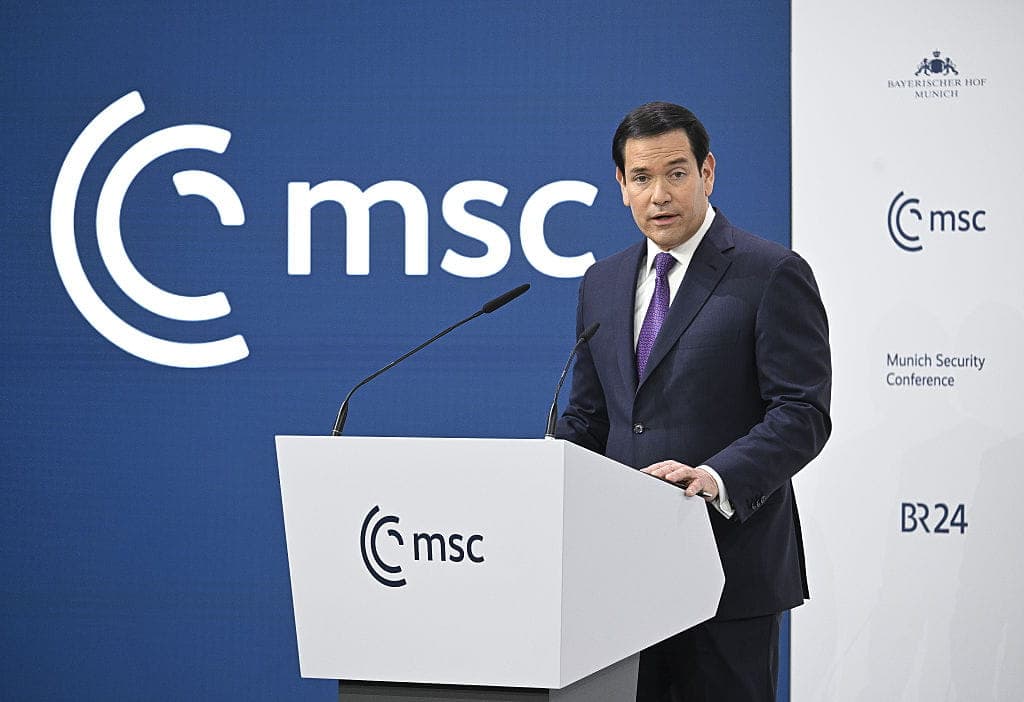
Secretary of State Marco Rubio arrived in Germany on Friday, February 13. His appearance at the Munich Security Conference provided a down-to-earth readout on US foreign policy as a partner in the future of Europe and America. It was a powerful and reassuring speech that was interrupted by applause and even garnered a standing ovation. But the address did not gloss over the idea of a failed “global order.” Rubio explained: “We can no longer place the so-called global order above the vital interests of our people and our nations.” He went on to call the United Nations to account as an example of a global institution in need of reform. “…[W]e cannot ignore that today on the most pressing matters before us, it [UN] has no answers and has played virtually no role.” He called “foolish” the globalist concept “that the rules-based global order, an overused term, would now replace the national interest.”
Basically, Rubio’s words were a complete and compelling repudiation of the MSR 2026, with a fundamental message that the US remained a steadfast partner to Europe, having a common history and a shared future. For those in the audience who believed that the US was pursuing a policy of isolation and withdrawal from the international community, during the question-and-answer period, Rubio made it clear that the US is deeply committed to ending the war in Ukraine. Additionally, when it comes to China: “On areas in which our interests are aligned, I think we can work together to make a positive impact on the world. And we seek opportunities to do that with them.” Rubio pointed out that where China’s interests and US interests are not in alignment, “…[W] e owe it to the world to try to manage those as best we can, obviously avoiding conflict, both economic and worse.”
The Munich Security Conference is an important international forum. Though the backdrop to the conference was one of tension between the US and Europe over a variety of issues, Secretary of State Rubio put to rest many of the fears MSR 2026 attempted to foster. In closing the Rubio session, the moderator, Munich Security Conference Chairman Wolfgang Ischinger, said: “Mr. Secretary of State, thank you for this message of reassurance. I think this is much appreciated here in the hall.”
~
The views expressed are those of the author and not of any other affiliate.