




Apple upset iPhone, iPad, and MacBook lovers everywhere when it announced across-the-board price hikes for its suite of products. CEO Tim Cook said the increases were unavoidable due to the “RAMpocalypse” or “chipflation” wreaking havoc on the global marketplace. Rep. Alexandria Ocasio-Cortez (D-NY) might have missed the memo. It turns out AOC thinks breaking up Apple will prevent higher consumer costs.
AOC Takes a Bite of the Apple
In a June 28 Fox News interview, AOC proposed that the government intervene and begin shattering the iPhone maker into tiny pieces to protect its customers.
“The problem that we have is that these big companies, they think they are governments, they want to be governments, they want to have totally unchecked power,” the New York lawmaker said. “I believe that we need to pursue antitrust, and we also need to give some more protections for consumers.”
She also placed the blame squarely on data centers because these facilities are “sucking up” much of the nation’s industrial supply. Indeed, demand for memory chips has been shifting from everyday consumer goods to artificial intelligence (AI) hyperscalers. A single AI server rack requires thousands of packaged semiconductors, while the typical smartphone needs as many as 30 chips.
This is why the AI-driven stock market rally is now centered on Advanced Micro Devices (AMD), Intel, Micron Technology, Nvidia, and SanDisk rather than Alphabet, Amazon, Meta, and Oracle. The world is hungry for RAM (random access memory) and chips, and this could lead to higher costs for personal computers, laptops, tablets, and smartphones as companies compete for a finite supply and bid up prices.
But what does AOC aim to achieve by breaking up Apple? How would this reverse the “RAMageddon”? Would different companies produce iPhones and iPads? How would smashing Apple into tiny pieces lower memory chip prices? If not Apple, then do Micron or Intel need to be broken up, too?
The world needs more details to figure out how one congresswoman would handle a $2 trillion tech juggernaut and a multi-trillion-dollar market.
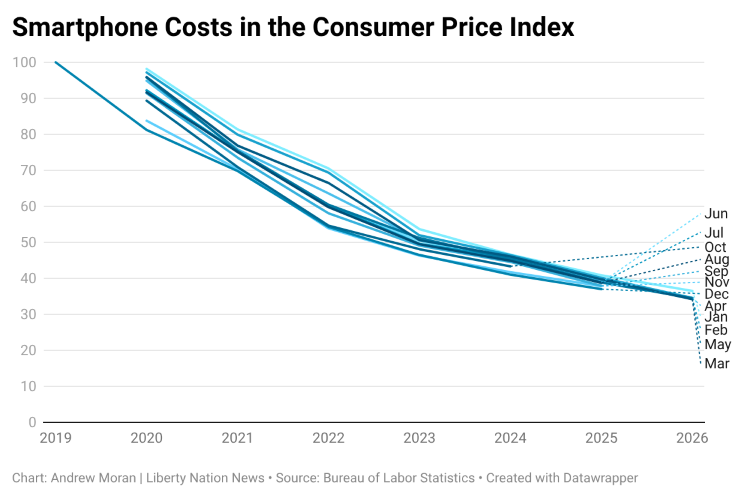
That said, considering President Donald Trump’s sweeping global tariffs, the Iranian conflict, and renewed inflationary pressures, Apple has done a good job of containing its costs. In fact, smartphone prices have trended lower over the last several years, indicating how these makers have navigated through all the turbulence.
It is an example of how efficient the private sector is – televisions, smartphones, computers, etc. – and how the government cannot keep costs down for the subjects it manages, such as education and health care.
The War on Data Centers
Data centers are the new scapegoat for everything, whether power consumption or water use. A chorus of left-leaning lawmakers in Washington, including AOC and Sen. Bernie Sanders (I-VT), wants to install a moratorium on the construction of these facilities.


Free with the Daily Briefing
85EssaysUnravel the Constitution
Hamilton, Madison & Jay’s complete case for America, free and searchable in the Publius Reader.
Free with the Daily Briefing. Unsubscribe anytime.
“A moratorium will give us time – time to understand the risks, time to protect working families, time to defend our democracy and time to ensure that this technology works for all of us, not just the few,” Sanders said at a press conference this past spring.
First, a data center is being built for the general population, not for Jeff Bezos or Elon Musk. The purpose of these expansive and expensive facilities is to accelerate computing power and ensure everyone has access to AI technology.
Second, when Sanders refers to risk, he is likely discussing environmental issues. It is a common misconception that data centers consume massive amounts of water. However, alfalfa, almonds, and golf courses use far more water than data centers. Is anyone proposing a moratorium on almonds?
Finally, data centers – at least their construction – are delivering for working families because building them requires blue-collar work. Moving forward, maintenance and inevitable expansion will keep more people employed, creating new job opportunities.
Betcha Can’t Eat Just One Memory Chip
The global economy will grapple with chipflation. While the long-term expectation is that AI will be disinflationary, the near-term effects could ignite price pressures for businesses and consumers. The consensus is that the “RAMpocalypse” will not ease up until late next year or early 2028 as the world acclimates. Until then, businesses will either have to pass costs on to their customers or sacrifice margin, and consumers will either have to pay up or wait.



.jpg%20Midterms&w=1920&q=75)