
On Sunday, Oct. 4, President Donald Trump announced the formation of the Super Intelligence Force (SIF). As envisioned, the SIF will be a White House task force charged with coordinating the federal government’s efforts to promote what the administration now calls super intelligence (SI), formerly artificial intelligence."
The president intends to maintain the US lead in SI by organizing and promoting advances, while addressing the possible dangers of an unregulated technology.
Bringing Super Intelligence Under Control
The US military has experienced how artificial intelligence has been weaponized against its forces, so it’s time the White House took steps to harness the technology and use it in a way that maximizes its benefits while reducing the risks of it getting out of control and becoming a menace. President Trump wrote:
“The Super Intelligence Force is tasked with coordinating the effort of the Federal Government to ensure that America continues to lead the World in Super Intelligence, which many say is bigger than the Industrial Revolution, and the Internet, and will protect the interests, and improve the lives, of all Americans. The Super Intelligence Force will coordinate the Federal Government's engagement with Consumers, Public Interest Groups, Religious Organizations, Critical Infrastructure Providers, and Super Intelligence Companies.”
Using his authority to direct Cabinet and agency heads, Trump named Director of National Intelligence Jay Clayton to lead the SIF, with Federal Trade Commission Chairman Andrew Ferguson, Under Secretary of War for Research and Engineering and Chief Technology Officer Emil Michael, and Office of Personnel Management Director Scott Kupor as vice chairs. The SIF will report directly to President Trump and White House Chief of Staff Susie Wiles.
The Wall Street Journal reported that, according to Jay Clayton - the new task force will have 120 days to report on the risks and opportunities of artificial intelligence, and determine the federal government's responsibility. The charter that establishes the operating policies and principles the task force uses as guidance states that it will “develop plans for responding to SI-enabled threats to our society, while preventing overregulation and regulatory capture that would stifle innovation and competition.”
Free with the Daily Briefing
85EssaysUnravel the Constitution
Hamilton, Madison & Jay’s complete case for America, free and searchable in the Publius Reader.
Free with the Daily Briefing. Unsubscribe anytime.
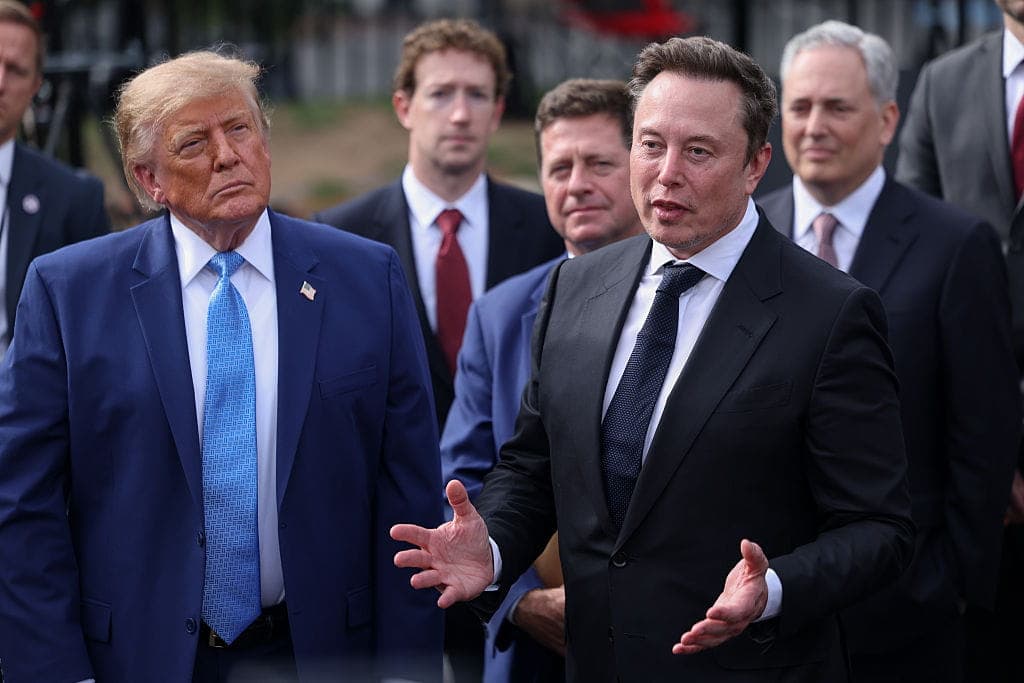
Six of the SI industry’s leading executives signed the White House Accord on Super Intelligence along with President Trump. The pact is a voluntary statement vowing to apply safeguards to limit the dangers that might develop from the unregulated application of SI. While lacking legal force, Trump called the agreement "morally binding."
Mark Zuckerberg, CEO of Meta Platforms and one of the signers of the accord, posted on X, “I think it’s a significant positive step that the leaders of every major American lab have committed to implementing robust internal controls and multiple layers of audits and reviews. This should give people more confidence that the technology each lab is building will work as intended.” These sentiments were no doubt music to President Trump’s ears, who has opposed formal regulations and guardrails, believing such efforts stifle the innovation and creativity that have put the United States first in the application of SI.
Not All Players Are Happy With the Technology
There are naysayers, however. Whenever something new or innovative is introduced, the Chicken Littles emerge with doomsday predictions. Typical of the sky-is-falling crowd, Sen. Bernie Sanders (I-VT), who has introduced legislation to ban superintelligence and pause advanced AI development, told the Associated Press, “It doesn’t take a genius to say, ‘slow it down.’ Do we really want to develop a super intelligence that, when it becomes smarter than human beings, could act independently of human control? I don’t think we do.” The implicit assumption in Sanders’ logic is that the humans who invented and developed SI are incapable of self-regulation. However, the SI industry has an interest in ensuring the technology is controlled.
From Liberty Nation News, Trivia, Facts, Check Us Out
Stay informed.
Today’s news, the Constitution and American history, written for young readers.
Visit GenerationLiberty.com
News, Trivia, Facts, Check Us Out
Stay informed.
Today’s news, the Constitution and American history, written for young readers.
Visit GenerationLiberty.com
Growth in SI capabilities and applications is inevitable. It is a clear case of the United States retaining and improving its lead or ceding the technology primacy to others who have no reservations about increasing their adoption of SI. “The risk of not being first is high. Not being first increases the identified and unidentified risks, particularly from our adversaries. Being first will better enable us to address those risks on behalf of the American people,” Clayton told The Wall Street Journal. China, Russia, and other adversaries would be thrilled if the United States stalled its research and development into SI applications.
~
The views expressed are those of the author and not of any other affiliate.

.png&w=1920&q=75)