


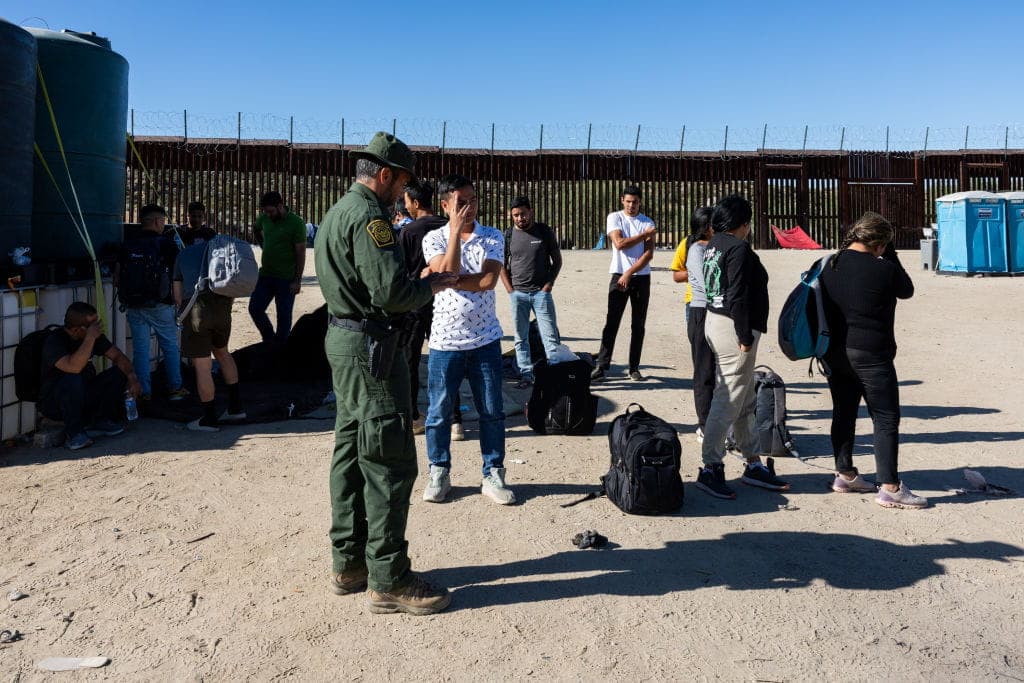

The Supreme Court just delivered two wins for the Trump administration’s crackdown on immigration. In the first, the Court ruled 6-3 that the Trump administration can move forward with ending Temporary Protected Status (TPS) for nationals of Haiti and Syria. In the second, it settled a dispute over asylum seekers, determining where they can officially request protected status.
Temporary Protected Status
TPS is a program created by Congress in 1990. It allows people from various countries who are experiencing hardships such as war, natural disasters, or other extraordinary circumstances to live and work in the US temporarily. It does not, however, provide permanent legal status or a direct path to citizenship.
The question was not whether Haiti or Syria is a safe country. Instead, the justices considered in Mullin v. Doe whether federal courts have the authority to block the Department of Homeland Security’s decision to end the TPS designations. Justice Samuel Alito, who wrote for the majority, said the law clearly states that the decision to terminate a country’s TPS designation is generally not subject to judicial review. Because of that, lower federal courts should not have issued orders that prevented the administration from ending the program. This ruling will make it much harder to challenge future TPS terminations.
This affects more than 350,000 Haitians and about 6,000 Syrians. The three liberal justices dissented, arguing that the administration may not have properly followed procedures and warned that the decision leaves migrants with little opportunity for judicial review before losing their legal protections.
The ruling is important because it gives the Trump administration more authority over immigration policy. It not only allows TPS to end for Haiti and Syria, but it also says courts cannot interfere when the executive branch decides to end TPS in general.
Asylum Seekers
Immigration laws can be tricky and complex, so the Supreme Court focused on one particular question in Mullin v. Al Otro Lado: When does someone legally "arrive" in the United States for purposes of requesting asylum? Immigrants used to be able to seek asylum at the border, before ever stepping into the country, but the new ruling changes that.

With another 6-3 vote, the Court determined that a person must first physically enter the US. Someone who is stopped on the Mexican side of the border or at the boundary line has not yet “arrived.” Federal law states that a noncitizen who arrives in the United States or is already present in the country may then apply for asylum. As Justice Samuel Alito wrote, “In ordinary speech, no one would say that a person ‘arrives in’ a place - for example, a house, a city, or a country - before the person enters that place.”
The Court held that federal immigration law does not require border officials to process asylum claims from people who have not yet entered the US, meaning they can be turned away at the border. The new ruling overturned lower court decisions that had found the policy unlawful. Those courts found that migrants who reached an official port of entry should be allowed to request asylum even if border officials prevented them from entering the country. The Supreme Court disagreed, reinstating the government’s authority to use the border “turnback” or “metering” policy.
Justice Sonia Sotomayor wrote the principal dissent, arguing that Congress had intended asylum protections to apply to those presenting themselves at the border. She warned that the current interpretation could leave people fleeing persecution without an avenue to seek protection in the US.
While this ruling means the federal government can again limit or refuse entry to asylum seekers without processing their asylum claims, it does not eliminate asylum as a form of legal protection.
Immigration – Asylum Seekers by the Numbers
According to the Migration Policy Institute, as of September 2025, more than 3.9 million asylum applications were pending – about 2.4 million before immigration courts and around 1.5 million with USCIS. The average asylum case takes about four years just to get an initial hearing, even longer for a final decision.
At the end of May 2026, 2,319,449 immigrants had already filed formal asylum applications and were awaiting hearings or decisions in immigration court, according to a report by Transactional Records Access Clearinghouse (TRAC), a nonprofit organization specializing in data gathering and analysis. As of that reporting, the total immigration court backlog stood at 3,241,899 cases.
From Liberty Nation News, Trivia, Facts, Check Us Out
Stay informed.
Today’s news, the Constitution and American history, written for young readers.
Visit GenerationLiberty.com
News, Trivia, Facts, Check Us Out
Stay informed.
Today’s news, the Constitution and American history, written for young readers.
Visit GenerationLiberty.com
In May, the Department of Homeland Security announced a new plan to crack down on those who fraudulently apply for asylum status. The plan is to impose civil fines on attorneys who file bogus or frivolous protection applications on behalf of their illegal immigrant clients.
The current asylum requirements make it difficult to prove fraud because applicants don’t have a huge burden of proof to provide. In fact, just their testimony on their experiences can be enough and doesn’t even require proof or collaboration.
The State Department used to help before Barack Obama took up residence in the Oval Office. Consular officers looked over applications and provided their opinions and assessments. “Back then, asylum applications were far more limited, with a backlog of about 106,000 in 2012,” the New York Post explained. “It’s been over a decade since the State Department provided such comments, and in the interim, the backlog — nearly 2.36 million asylum applications in the nation’s 73 immigration courts alone — has grown so large our consular officers abroad would be powerless to respond to more than a sample.”
Another issue is that many applicants never complete the process after filing for asylum and then remain in the country illegally. “In the first six months of FY 2026 alone,” explained The Post, “more than 48,000 aliens who had already filed applications were ordered removed in absentia when they simply stopped going to immigration court.”
For supporters of stronger border security, the rulings represent a significant victory by reaffirming the executive branch's authority to enforce immigration law as written. As the administration continues to address record backlogs and tighten enforcement, these decisions could become defining precedents for future immigration policy.



.jpg&w=1920&q=75)