

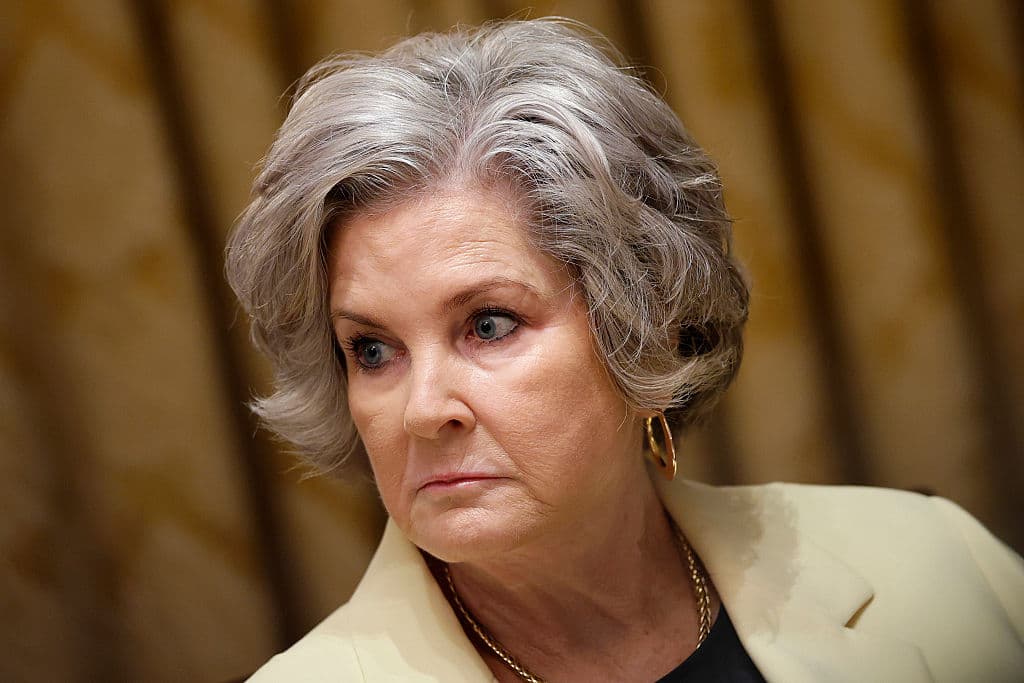

The fatal flaw of the first Trump administration has reared its ugly head once again with the hullabaloo over White House Chief of Staff Susie Wiles and her series of interviews with a writer for Vanity Fair magazine. A president explicitly elected as a rebuke to an ossified and deeply unpopular status quo still counts among his closest advisors people who long to be patted on the head by this very same establishment.
Chris Whipple is the author of what Wiles is now labeling a “hit piece” that was grossly taken out of context. Some of the damaging quotes attributed to her are that Trump has an “alcoholic’s personality,” and Vice President JD Vance has been a “conspiracy theorist for a decade.” Wiles also is said to have criticized Trump’s tariff policies and described the administration’s efforts to cut off funding to the United States Agency for International Development (USAID) – a move enthusiastically endorsed by Trump supporters – as something that left her “aghast.”
Trump, Vance, and other administration figures have strongly backed Wiles in the immediate blowback to the interview, but the question remains: Why was she sitting down with Vanity Fair in the first place?
‘Impose Some Discipline on Trump’s Disorder’
Whipple is “a documentary filmmaker, New York Times best-selling author, and acute observer of American power,” his personal website touts. He spent the entire four years of Trump’s first term trashing the outsider president as a dire threat to American political norms. But that didn’t stop Wiles from deciding it was a good idea to sit down for 11 sessions with him, even though a cursory background search would have instantly revealed that he has an axe to grind.
An examination of how Whipple operates provides clues as to how he was able to set a trap for Wiles.
“She’s an absolutely fascinating character. And you pointed out one thing about her that’s really intriguing,” Whipple gushed of Wiles to PBS’ Amanpour & Co. program on January 29, just nine days into Trump’s second term. “And I think it’s going to be fascinating to watch. But she is someone who has this uncanny ability to impose at least some discipline on Trump’s disorder. Nobody’s ever been able to do that before.”
This is the heart of the matter. Whipple’s entire schtick is to paint White House chiefs of staff as the real powers behind the throne. He focuses on “the historical significance” of the position to launch his political assault on the president it serves.
What likely attracted Wiles to Whipple was a belief that his core thesis, that Trump needed a strong chief of staff to direct him, could be framed in a positive way.
“She would be the first to tell you that she doesn’t manage Trump. Trump is unmanageable. But she’s figured out some sort of modus vivendi. She chooses her fights carefully. And she has lasted a long time,” Whipple told PBS in January. “He trusts her. She has charm and abundance. And she’ll need every bit of it to succeed. Temperament is an underrated quality among White House chiefs, but it’s very important. [Ex-Ronald Reagan and George Bush Sr. Chief of Staff] James Baker had it. Leon Panetta [under Bill Clinton] had it. Susie Wiles has it.”
That sounds laudatory enough, but beneath it is the obvious slam: Trump needs to be controlled. This is a message Whipple has spent a copious amount of time delivering on Trump-bashing media outlets such as MS NOW (formerly MSNBC) over the years.
‘The Chief Should Be More Empowered, Not Less’
“It’s existed since [Dwight] Eisenhower, and has been essential from [Richard] Nixon onwards. Yet, the role of White House chief of staff is being ‘defined out of existence’ by President Trump, according to journalist and author Chris Whipple,” a blurb to a 2019 YouTube post of a HuffPost interview with Whipple reads.
Here’s all you need to know about where Whipple is coming from:

“Donald Trump has seemed to have learned all the wrong lessons from the first two years of his presidency,” Whipple told HuffPost's Caroline Modarressy-Tehrani in 2019. “He still thinks he’s the smartest guy in the room, who knows how to govern, and if everyone would just get out of his way, everything would be fine. The truth is the opposite.”
In June 2018, Whipple once again served as the go-to guy for the establishment press on the topic, chiming in on John Kelly’s departure as Trump’s White House chief of staff. “They’re 0 for 2,” Whipple told Politico. “They had two chiefs who were ineffective [Kelly and predecessor Reince Priebus], and a White House that still has no idea how to govern.”
Whipple used the occasion to stress his continual theme – that Trump should leave the actual running of the White House to the professionals. “The lesson of Priebus and Kelly is that the chief should be more empowered, not less, and most importantly tell the president what he does not want to hear,” he stated.
Susie Wiles Dreaming of Being the Next Ken Duberstein?
The more one reads of Whipple, the more it becomes clear that he values a political careerist chief of staff as a safeguard to Trump’s iconoclasm. “Almost everybody would agree that James Baker was the gold standard. I would put Leon Panetta in the same league, and [Ken] Duberstein [during Reagan's second term] was very effective. Erskine Bowles [under Clinton], Dick Cheney [under Gerald Ford] was a terrific chief of staff,” Whipple told freelance writer Deborah Kalb in an October 2017 interview.

It’s all so pre-2016. Is there one American in ten million today who even knows who Ken Duberstein is? How many times in a day does the name Erskine Bowles pop into your head?
Is this the hallowed company Susie Wiles yearns to join? There probably isn’t a single Trump backer who cares one bit about what historical verdict somebody like Chris Whipple has to pass on the administration and its inner workings.
Wiles may see her role as the Horse Whisperer, and not the overt controller. Either way, it points to a perception that Trump needs to be carefully managed. And that is precisely the problem in the eyes of Trump supporters, who likely abhor the notion that career professionals – the “adults in the room” – are driving the MAGA mobile while the wrecking ball of a president they intentionally put into the Oval Office placidly waves at them from the back seat.


.jpg&w=1920&q=75)