


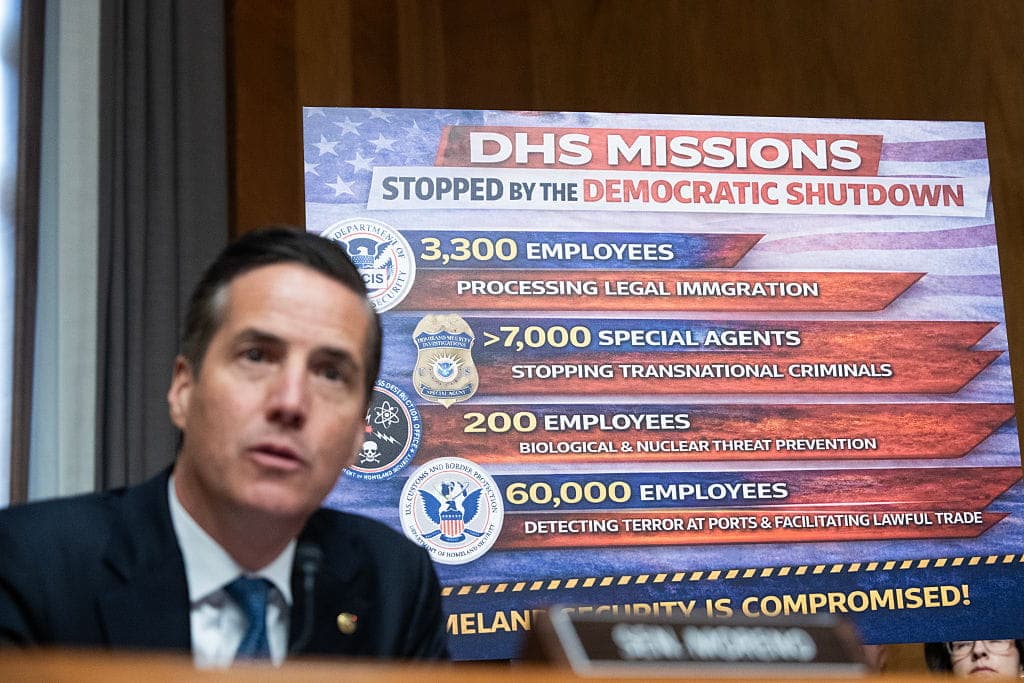

The White House revealed on Tuesday a letter sent to Senate Republicans detailing the Trump administration’s new plan to “improve” operations at the Department of Homeland Security (DHS). The letter, sent to Senators Katie Britt (R-AL) and Susan Collins (R-ME), was the administration’s latest attempt to strike a deal with Senate Democrats, whose refusal to fund the DHS over immigration enforcement methods triggered a partial government shutdown in mid-February. But on Wednesday, Democrats rejected the White House’s offer, arguing it failed to address their concerns.
More Bodycams for DHS
The letter outlined five areas in which the Trump administration is willing to codify improved operational guidelines for the department, including:
Expand the use of body-worn cameras by DHS personnel involved in immigration enforcement, excluding those working undercover.
Limit civil immigration enforcement at “certain sensitive locations,” with an exception made for national security, flight risks, or public safety.
Increase oversight by “creating mandatory review and compliance reporting from the Inspector General of DHS.”
Enforce the use of “visible officer identification for DHS law enforcement carrying out immigration enforcement activities.”
Adhere to existing law prohibiting the deportation of any US citizen, and codify the current standard of “not knowingly detaining a US citizen” unless the individual is subject to arrest under state or federal law.
The call for expanded bodycam usage touches on an issue that has been politically charged for more than a decade. In 2014, after Michael Brown was killed by a police officer in Ferguson, Missouri, law enforcement agencies across the US started embracing the technology.
"A lot of departments purchased cameras so they wouldn't be the next Ferguson. There was a lot of emphasis on transparency, on demonstrating to your community that you're willing to be open and to have some accountability,” said former deputy sheriff Michael White, who is also a professor for the School of Criminology and Criminal Justice at Arizona State University.

While many on the left expected body cameras to expose rampant abuse among police, the technology has often had the opposite effect, proving that many use-of-force incidents were justified. Take the recent case involving Will McNeil Jr., a black man who posted a video online showing a white police officer smashing his car window and punching him in the face before dragging him out of his vehicle. The video quickly went viral on social media, sparking widespread outrage. The officer was clearly racist, observers insisted – that is, until the officer’s bodycam footage was released.
The video from the Jacksonville Sheriff’s Office showed McNeil had locked his car door while refusing commands to exit his vehicle during a traffic stop. After verbally ordering McNeil to cooperate, the officers broke his window and forcibly removed him from the car. Thanks to the police bodycam footage, most of the racism accusations vanished, and the officers were cleared of any wrongdoing by the state attorney’s office.
The left was largely convinced that police body cameras would uncover countless racist officers in the ranks, but instead, they often show law enforcement exercising restraint and escalating only when suspects refused to comply. While the attention has shifted to immigration enforcement, the accusations are largely the same: DHS officers are racist thugs who are unnecessarily violent during operations. If history is any indication, expanded bodycam use in DHS will tell a different story.
DHS Needs a New Leader
President Donald Trump’s new pick to lead the Department of Homeland Security, Sen. Markwayne Mullin, took heat from both sides of the political aisle during his confirmation hearing on Wednesday.
Mullin’s fellow Republican, Sen. Rand Paul from Kentucky, slammed the Oklahoma lawmaker for saying he understood why Paul was attacked by his neighbor in 2017. “Tell me to my face why you think I deserved it,” Paul told Mullin in the fiery hearing. “And while you’re at it, explain to the American public why they should trust a man with anger issues to set the proper example for ICE and border patrol agents.”

“I just wonder if someone who applauds violence against their political opponents is the right person to lead an agency that has struggled to accept limits to the proper use of force,” Paul added before Democrat Senator Gary Peters of Michigan questioned Mullin over “classified” travel he took while serving as a representative in the US House.
Mullin reiterated that the travel “is classified,” but explained that he was “asked to train with a very small contingency and go to a certain area, which was scheduled for 2016.” “I have spoken in general about my experiences, but I’ve never spoken specifically on details, on dates or on the mission,” he added.
Paul said the committee will vote today (Thursday, March 19) to decide if Mullin’s nomination should be sent to the full Senate. The Kentucky senator said he plans to vote no, and without his support, Mullin will need at least one Democrat to move forward.
Mullin, who could replace recently ousted DHS Secretary Kristi Noem, said he wants to “restore” the public’s view of the Department of Homeland Security. “I hope people have confidence in our agency again. And I’m going to work every day to restore that,” Mullin said. Whether he gets the chance may depend as much on Washington’s dysfunction as on his own confirmation.



.jpg%20Redistricting&w=1920&q=75)