
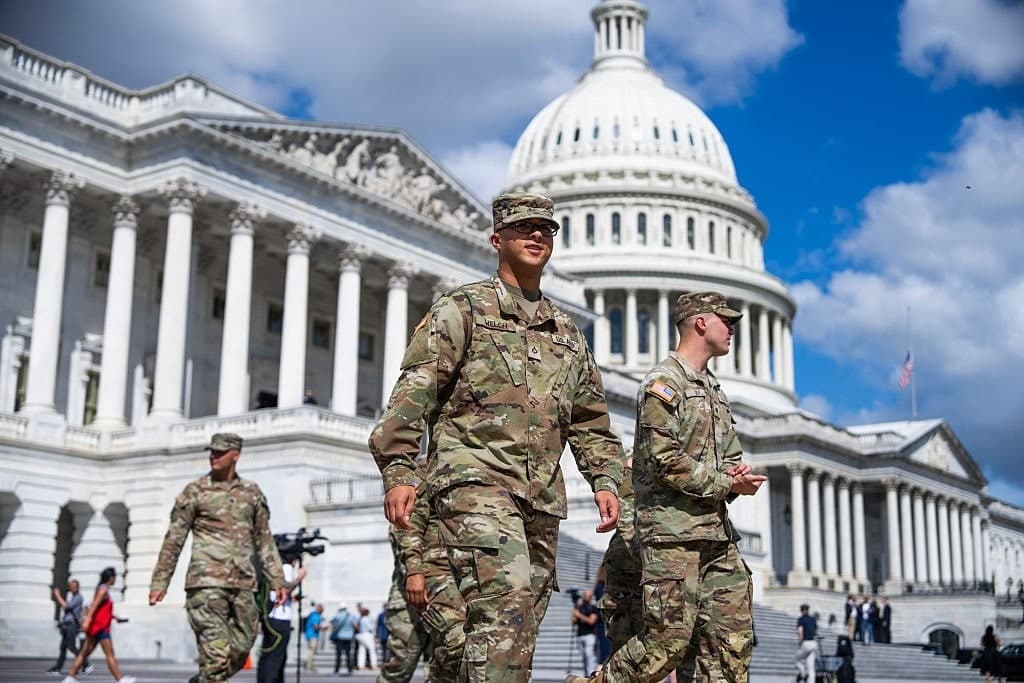

At President Donald Trump’s directive, Oregon National Guard troops could be deployed to Portland on Oct. 2. However, on Sept. 29, Oregon Attorney General Dan Rayfield filed a Motion for a Temporary Restraining Order to block Secretary of War Pete Hegseth from sending 200 members of the Oregon National Guard there for 60 days. The lawsuit argues, among other points, that local law enforcement has the situation under control, the ICE protests don’t constitute a rebellion, and the state and city “will suffer irreparable harm” if the guard appears.
Trump announced on Truth Social that he would crack down on “war-ravaged Portland,” where US Immigration and Customs Enforcement (ICE) facilities face violent protesters. This set off a firestorm of complaints from leftist leaders, who have responded by showing cherry-picked peaceful-looking photographs, voicing selective storytelling, and defending the 24/7 protests. Their hyperbolic language, such as “abuse of power” and “authoritarian,” could be described as incendiary.
Newly elected Portland Mayor Keith Wilson said, “We have a long and proud track record of being at the forefront of positive social change." Yet, the next day, several hundred protesters gathered outside the ICE facility in Portland again, reportedly shutting down bus service through the area.
History of Violence in Portland
So does this qualify as “positive social change” or negative social resistance? One does not have to go back very far to understand the need for federal assistance to protect law enforcement agents in Portland. On Nov. 10, 2016, a riot broke out during a large protest that opposed Trump’s election, causing damage to local businesses. From May to October 2020, Portland’s downtown district was ravaged by crowds angry about the death of George Floyd, resulting in rampant arson and vandalism. When federal law enforcement was employed to protect federal buildings during that time, the demonstrations grew more intense.

In June this year, protests erupted again, this time outside Portland’s ICE Detention Facility. Antifascist activists have reportedly been among the protesters, who have thrown rocks and set off fireworks at ICE agents. As Fox News reported, the ICE building has been vandalized with anti-ICE graffiti. In August, a violent protest showed demonstrators bringing out a guillotine, setting fires, and fighting with law enforcement.
ICE has reported a more than 1,000% increase in assaults against its officers. On Sept. 26, more than 200 rioters blocked access to a gate at the ICE facility in Broadview, IL, while 30 others swarmed another, trying to force their way in. These rioters reportedly arrived with fireworks, gas masks, eye, knee, and elbow protection, and large quantities of food and water. More chilling were their chants: “Arrest ICE, shoot ICE.”
This came just two days after a deadly shooting attack on an ICE facility in Dallas, where alleged sniper Joshua Jahn shot three illegal aliens, murdering one before killing himself. “Anti-ICE” was engraved on the shell casings he used. And these are just a couple of the recent incidents that had intensified over the summer.
Search for Solutions
Trump’s deployment of National Guard troops to Washington, DC, resulted in a 45% drop in violent crime, as Mayor Muriel Bowser reported. But the situation in Portland may be more complicated. The president is facing a perfect storm: a sanctuary city with a history of disorder, accelerated violence toward ICE agents, and an increase in left-wing mayhem.
The Portland City Council officially declared Portland a sanctuary city in 2017. By its own policy, it will not cooperate with ICE agents but does acknowledge the federal government’s jurisdiction to operate lawfully in Portland. When ICE agents are under siege, will the city police protect the very agents they are not allowed to cooperate with pursuant to the sanctuary city designation? We are about to find out.

.jpg%20FISA&w=1920&q=75)
.jpg%20Starmer&w=1920&q=75)