

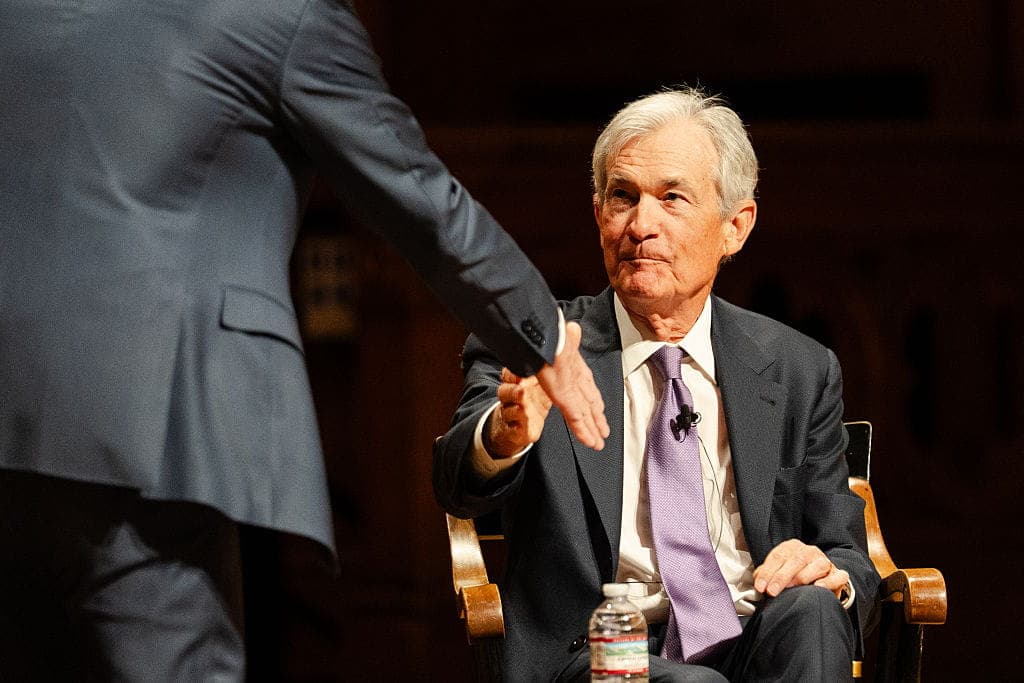

Even his worst critics have to feel bad for him. A trade war, a once-in-a-century pandemic, 40-year-high inflation, bank failures, the highest tariffs since the Great Depression, and more. Suffice it to say, whatever could go wrong did go wrong since he arrived at the 113-year-old US central bank in 2018. This was what Federal Reserve Chair Jerome Powell endured in his eight years at the helm. With one final meeting to go in the Powell era, it was not an easy tenure.
Jerome Powell Says Goodbye
The Department of Justice ended its investigation of the central bank chief, clearing a key hurdle for the confirmation of Kevin Warsh, President Donald Trump’s pick to head the Fed. Sen. Thom Tillis (R-NC) confirmed he will no longer serve as a roadblock, meaning the path to chairman is all but set in stone for Warshonomics.
This also means that Powell will lead the two-day April Federal Open Market Committee (FOMC) policy meeting for the final time as his term expires on May 15. The meeting will not be consequential, as the futures market is pricing in no interest rate cut (again!). What Powell does next, however, will be vital, as observers speculate on whether he will remain in his seat on the Board of Governors until 2028.
Until then, it is only fitting to comb through his track record in the world’s most powerful entity.
When he received the keys to the Eccles Building, Powell lowered interest rates three times to give the economy a jolt amid a trade-related slowdown, partly reversing some of the tightening by his predecessor, Janet Yellen. This turned out to be a mistake as the United States rang in a new decade by wrestling with a global health crisis. So, while the benchmark federal funds rate was already low at below 2%, the Fed slashed it to 0%, expanding the money supply at a historic pace and manufacturing the Everything Bubble.
Despite much of the US economy returning to normal several months later, the Fed did not start raising interest rates until March 2022. By the time it tightened policy, it was too late as the inflation genie had already left the bottle. The annual inflation rate topped 9% in June of that year, and it has yet to return to the central bank’s 2% target, whether measured by the consumer price index (CPI) or the personal consumption expenditures (PCE) price index.
The balance sheet has also accelerated. Despite falling by more than $2 trillion to around $7 trillion, it is far higher than the roughly $2 trillion registered during the global financial crisis.
While Powell has insisted that politics and elections do not play a role in the Fed’s decision-making – the central bank chief sports a purple tie – skeptics have their doubts, given the timing, which has been suspicious. One week, Powell suggests officials are not even considering lowering interest rates. A week later, then-President Joe Biden says inflation is tame enough to support rate cuts. Shortly after, out of the clear blue sky, Powell says policymakers can begin entertaining easier monetary conditions. Prior to the 2024 election, the Fed kicked off its easing cycle with a super-sized half-point rate cut.
The Federal Reserve has a long history of playing politics, whether in the early FDR days of Marriner Eccles or the Nixonian era of Arthur Burns. So, after 100 years, the suspicion is warranted.
Powell was one of 12 FOMC colleagues to vote on policy, but the lack of divergent views over the years is a subject for scrutiny. And this is where his successor could shake things up at the Fed.
World War Warsh
Like Powell, Kevin Warsh will be only one voice. The way the mainstream media and Democratic lawmakers oppose the former Fed governor, it is as if Warsh shares Henry Fonda’s ability to convince 11 other people in 12 Angry Men. Still, as Fed chair, Warsh could usher in change.
During his Senate Banking Committee confirmation hearing last week, Warsh officially outlined what he would like to see or at least teased what reforms could be made over the next four years: trimmed inflation averages, fewer press conferences, abolition of the Summary of Economic Projections, removal of forward guidance, and a shrinking of the balance sheet.
Put simply, the art of Warsh consists of the Federal Reserve lurking in the background rather than standing in the spotlight. Positive or negative? Economists will undoubtedly debate. Less communication? Well, what do you have to hide? More talking? Well, you are swaying markets!
Nevertheless, given the few changes to the Fed over its history, perhaps a facelift would do it some good. Will the institution look more like those botched plastic surgeries, or skinny people taking Ozempic? Ultimately, everyone will have to Warsh and see until the June policy meeting, the first two-day gathering of the husband of the lady who is heir to the Estee Lauder cosmetics fortune.
A Jerome Powell Memoir
Let’s hope that Powell pens a memoir so we can learn what occurred behind closed doors, from his interview with President Trump in 2018 to the pandemic-driven fear in 2020 and his thoughts on the barrage of White House criticisms. Good night, and good luck, Mr. Powell. Enjoy your free time playing guitar and listening to the Grateful Dead.
.jpg&w=1920&q=75)
.jpg&w=1920&q=75)