


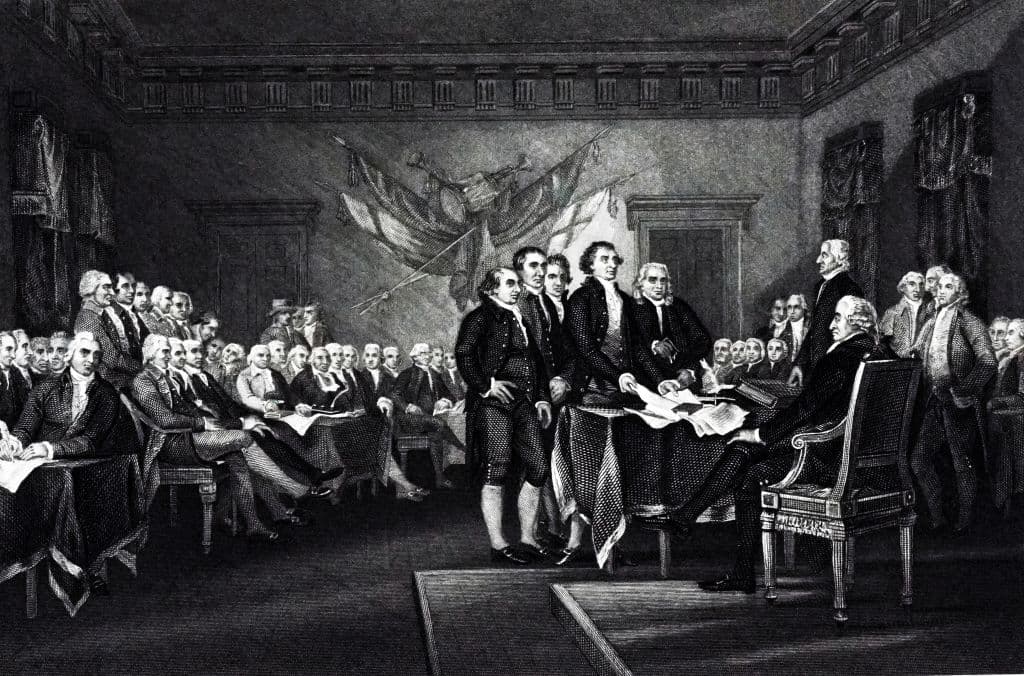

After the handshakes, pats on the back, and celebration of the final approval of the Declaration of Independence, July 4 turned into July 5. Now what? Now that the barking dog has caught the car, what does it do with the rolling tire? A relatively small group of signers, 56 in all, put their lives on the line. They knew full well that acknowledging their willingness to sever ties with England would be seen as treason. These courageous men signed a declaration that could serve as their death warrant should the colonists fail to break free.
The Declaration of Independence Signaled a New Chapter
July 5 did not mark the end of an armed struggle in the Colonies; rather, it signaled a new, practical chapter in an ongoing conflict. The Revolutionary War had been raging for 15 months since April 1775. Other major battles predated the signing of the Declaration of Independence. These included the Battles of Lexington and Concord on April 19, 1775; the Capture of Fort Ticonderoga on May 10, 1775; the Battle of Bunker Hill on June 17, 1775; and the Siege of Boston from April 1775 to March 1776, which ended with the British evacuating the city.
So, as July 5 dawned, the signers of the Declaration were under no illusions as to the significance of the document. Any hope of reconciliation with England was all but dashed. Now came the time to get the last of the signatures. Not all of the eventual signers put their names to parchment on July 4. In fact, the only document available on July 4 was a draft with the signatures of just John Hancock as President of the Continental Congress and Charles Thomson as Secretary. They signed what was known as a “fair copy” or working manuscript draft on July 4 and provided it to John Dunlap, the official printer to the Continental Congress. History.com explained Dunlap worked through the night to produce 200 broadsides (large single-sheet documents printed on only one side). According to Harvard University’s description:
“The engrossed parchment is what most people think of as ‘the’ Declaration of Independence: the document on display in the National Archives, alongside the United States Constitution and Bill of Rights. It is a parchment sheet measuring 29 3/4 inches high by 24 1/4 inches wide. Unlike paper, parchment was a sturdier, longer-lasting material, and was also used for the Articles of Confederation, United States Constitution, and Bill of Rights.”
Getting all the signatures was a long, drawn-out process. Most of the remaining names, besides Hancock’s and Thomson’s, appearing in the main body of the document were added on August 2, 1776. Some of the signatures were added even later. For example, Matthew Thornton from New Hampshire signed in November 1776, and Thomas McKean of Delaware signed after January 1777. Delaware may have been the first of the Colonies to ratify the US Constitution, but it appears to be the last to approve the Declaration. It is believed that a small number of the signers were not present when the Declaration's wording was adopted but were still sufficiently committed to the cause to add their names.
Word Spread Quickly
Couriers spread copies of the Declaration of Independence across the colonies. As History.com explains, the broadsides were “Sent to printers across the former colonies so they could reproduce the words in local newspapers. Couriers on horseback brought other broadsides to committees, assemblies, and commanders of the Continental Army across the new states.” In many towns, the Declaration was read to the townspeople. Because most adult men could not read, public readings became essential for communicating the official break with England. Surprisingly, news traveled fast. Once local newspapers got hold of the Dunlap broadsides, news of the thirteen colonies' independence from British rule spread quickly.

Free with the Daily Briefing
85EssaysUnravel the Constitution
Hamilton, Madison & Jay’s complete case for America, free and searchable in the Publius Reader.
Free with the Daily Briefing. Unsubscribe anytime.
General George Washington’s soldiers heard the news during a reading in New York City. The reaction was such that troops and civilians alike paraded to Bowling Green and tore down a large statue of King George III on horseback and melted the lead into musket shot.
Reports attest that a handwritten copy of the Declaration reached London on August 10. When King George III finally realized what the Declaration of Independence meant, he addressed Parliament on October 31, 1776, asserting: “So daring and desperate is the spirit of those leaders, whose object has always been dominion and power, that they have now openly renounced all allegiance to the crown, and all political connection with this country,” according to History.com.
What might have been patriotic exuberance on July 4 became, on July 5, a commitment the signers of the Declaration of Independence could not walk away from. Each had invested his livelihood and indeed his very life. Most were men of means who risked it all. The average age of those who penned their names to the parchment was 44. Benjamin Franklin, representing Pennsylvania, was the oldest at 70, and Edward Rutledge from South Carolina, 24, was the youngest. The day after July 4, the 56 patriots started a movement that would build a new country – one that would last 250 years, so far.
Dig Deeper Into the Themes Discussed in This Article!
Liberty Vault: Declaration of Independence
~
The views expressed are those of the author and not of any other affiliate.



.jpg&w=1920&q=75)