

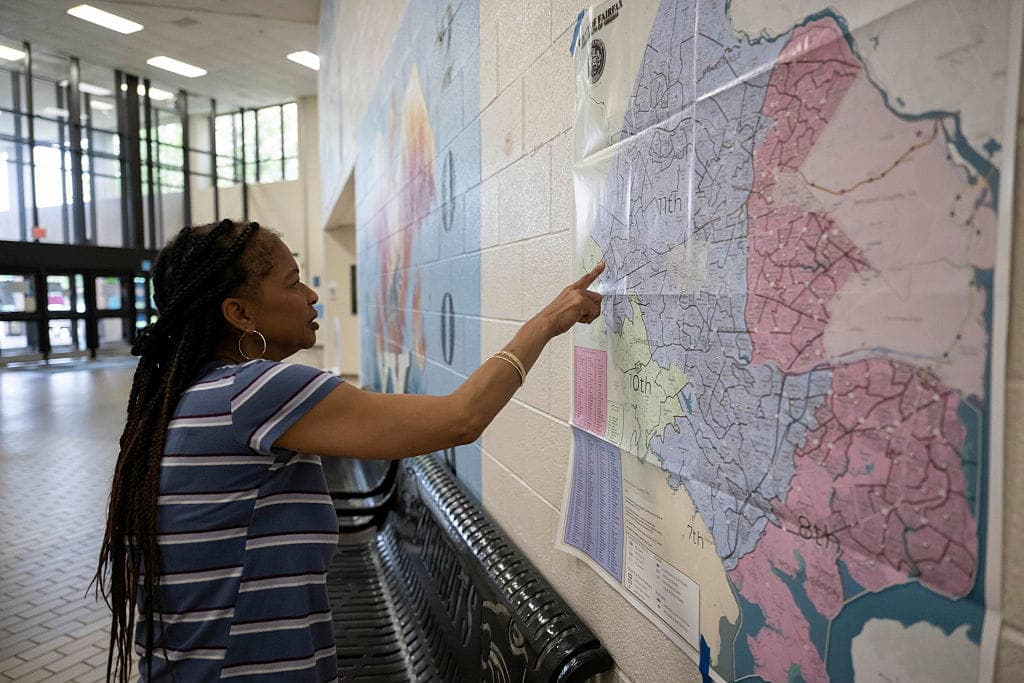

One of these days, the nation will awaken to a dramatically altered congressional map. Safe seats will suddenly be in play, contested seats will no longer be up for grabs, as dozens of districts are realigned across the land. The balance of power will shift, perhaps dramatically. The only question is whether that will come to pass as early as 2026 or as late as 2032.
Gutting the Congressional Map
Two recent court rulings and the prospects for the next national census have combined to portend a dramatic shift in the balance of power on Capitol Hill. A new congressional map in Virginia that would have landed as many as four new House seats for the Democrats this year was nullified by the Virginia Supreme Court. The US Supreme Court dropped its own bombshell, ruling that a racially gerrymandered congressional district in Louisiana is unconstitutional, a decision with far-reaching consequences. And if that wasn’t distressing enough, the Dems will almost certainly lose a significant number of seats after the 2030 census.
With the court decision in Virginia, the gerrymandering scoreboard now favors the Republicans decisively. The GOP stands to gain as many as 13 House seats through mid-decade redistricting in Texas, Florida, Missouri, North Carolina, and Ohio. The Democrats can pick up six seats, five in California if voters approve a referendum, and one in Utah. That is a net gain of seven seats for the GOP. It seems President Donald Trump’s gerrymandering gambit is paying off.
But that is just the proverbial tip of the iceberg that's dead ahead for the Democrats. As of early 2026, 13 states have had a congressional map challenged over a reliance on racial demographics. There are a total of 148 majority-minority districts across the land, roughly a third of the 435 total in the House. While only a fraction of them are likely violative of unconstitutional racial gerrymandering, even if, say, 20% of those districts fall under the Supreme Court ruling in Louisiana v. Callais, that would mean around 30 districts would be forcibly removed from congressional maps, which would then be redrawn by state legislatures. Needless to say, Democrats are terrified of the raging battle ahead to uphold an extremely significant Supreme Court decision.
This decision by the high court is yet another staggering blow to Democrats, who already feel victimized by the structure of the Senate, complaining that California, with a population of some 40 million, has the same number of senators as Wyoming and its fewer than 600,000 residents. Losing their grip on the lower chamber will be nothing less than disastrous. And if the party persists in glorifying socialism, the outlook could become worse. Most importantly, by sliding into relative powerlessness in the House, they will not only lose control of the federal budget but also a Republican president will be able to have his way with the House, while a Democratic president will be held completely in check.
Democrats’ Census of Defeat
Of course, a constitutionally mandated census must be conducted by the federal government at the turn of every decade. And while this nationwide counting of heads usually results in a few districts becoming more favorable to one party or the other, the 2030 census will likely deliver at least 12 new seats to red states, courtesy of the blue states that have driven people out with high taxes and regulations. California and New York’s losses will be Florida and Texas’ gains. And since the census counts persons, not citizens, the outflow of at least 2.5 million illegal aliens who have left the country since Trump returned to the White House will cut even deeper into the flesh. Coming on the heels of gerrymandering disasters on two fronts, the 2030 census stands to be the final nail in the blue coffin.
Indeed, by the time 2032 rolls around and all the dust has settled, the Republicans could conceivably have secured dozens of new seats in the House of Representatives. The magnitude of such a transformation cannot be overstated. A perfect storm of politics, race, and population shift will turn a long-held Republican fantasy into reality. A so-called “permanent” Republican majority, inconceivable for decades on end, is now possible if not probable for at least a generation. The Democrats, already at their lowest ebb in decades and endlessly infuriated by the election and re-election of Trump, will be left spinning even further into a downward spiral, stripped of legislative power in the people’s house for as far as the eye can see.



.jpg&w=1920&q=75)
.jpg&w=1920&q=75)