
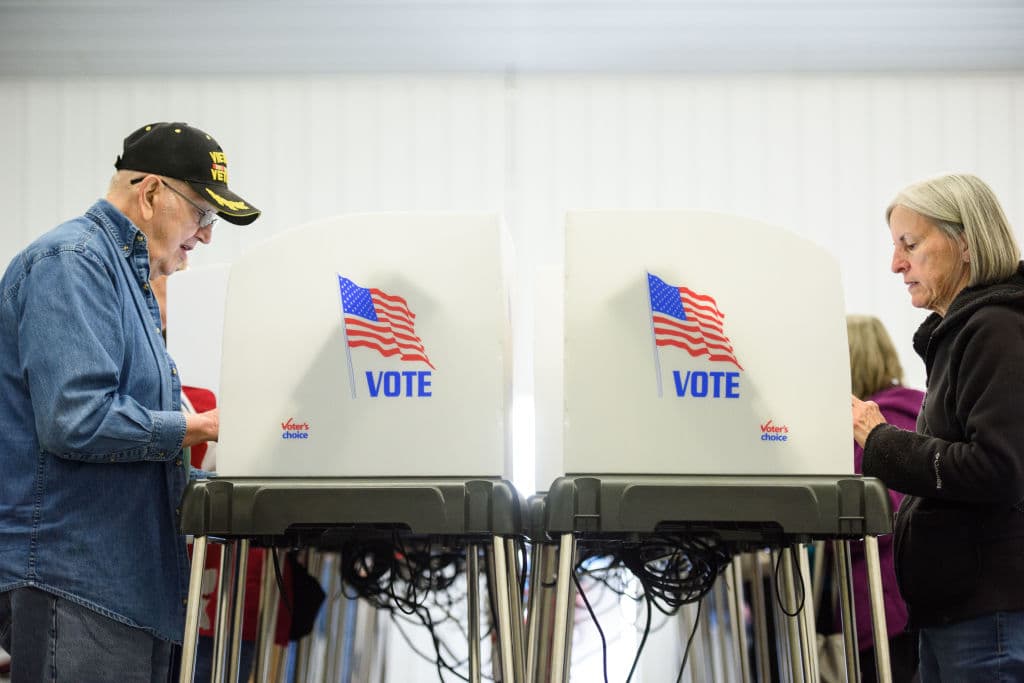

The midterm elections are less than a month away, and national attention has mostly focused on the balance of power in Washington, where Democrats could gain a majority in one or both chambers next year. But state governments, which the GOP has largely dominated since 2010, could also change dramatically. As of 2026, Republicans have 23 state trifectas, seven more than Democrats have. This election cycle, several battles for unified control of state governments are unfolding, and their outcomes could change more than who works in statehouses.
Chasing Trifectas
A party holds a trifecta when it controls the governorship and both chambers of a state legislature. This election season, either party could gain unified control of state governments in Arizona, Michigan, Minnesota, Nevada, Pennsylvania, Vermont, and Wisconsin, according to Ballotpedia, while Republicans have additional pickup opportunities in Alaska and Kansas. Democrats’ best chances of gaining new trifectas might be in Minnesota, Michigan, and Pennsylvania. They hold a narrow majority in Minnesota’s state Senate and are tied in the lower chamber. A win by US Sen. Amy Klobuchar, a favorite to defeat Republican state Rep. Lisa Demuth in the gubernatorial race, could give Democrats unified control in Minnesota if they can come out on top in the legislative races, all of which are on the ballot this year. Pennsylvania, however, might be a larger challenge.
Free with the Daily Briefing
85EssaysUnravel the Constitution
Hamilton, Madison & Jay’s complete case for America, free and searchable in the Publius Reader.
Free with the Daily Briefing. Unsubscribe anytime.
The GOP has controlled the Keystone State’s upper chamber for more than three decades, but Democrats have a shot to take control of it this year if they can defend their slim state House majority, net at least three Senate seats, and reelect Gov. Josh Shapiro, who is heavily favored to win a second term. Only half of the upper chamber’s seats are up for election in 2026, though, which could benefit the GOP. In Michigan, Democrats could capture a new trifecta if Secretary of State Jocelyn Benson (D) can defeat US Rep. John James (R) in the governor’s race and the party holds its slim majority in the state Senate. Right now, Republicans narrowly control the state House.
Another trifecta opportunity for Democrats is in Nevada, where Attorney General Aaron Ford (D) faces incumbent Gov. Joe Lombardo (R) in a competitive gubernatorial race. Nevada Democrats have held both legislative chambers since 2016, but if Republicans can oust three Democratic incumbents, they could flip control of the state Senate and block a Democratic trifecta.
In Wisconsin and Arizona, either party could win unified control. With new legislative maps in Wisconsin, however, Democrats may have the edge, and Liberty Nation’s polling aggregator shows Democrat David Crowley with a four-point lead over Republican Tom Tiffany in the state’s governor race, though Cook Political Report rates it as a toss-up. In Arizona, Democratic Gov. Katie Hobbs looks set to win re-election and has led in every poll since May. In an effort to flip both chambers in the Grand Canyon State, the Democratic Legislative Campaign Committee (DLCC) has invested in several races, hoping to help Democrats win a trifecta for the first time since the 1960s.
One of Republicans’ best chances to gain unified control of a state government is in Kansas, where Republican state Sen. Ty Masterson faces Democratic state Sen. Cindy Holscher in a race to replace Democratic Gov. Laura Kelly. Because the GOP already holds majorities in the Kansas legislature, a win for Masterson would give Republicans full control of the state government.
Republicans have held more state legislative seats than Democrats since 2010, and more than 6,000 are up for election across 46 states this year. How these races pan out, along with the gubernatorial contests, could change the daily lives of many Americans because of the vast difference between a Democratic and a Republican trifecta. Unified control makes it easier for a party to enact its agenda. But one side apparently has more in mind than just writing new policies.
Drawing New Lines
For Democrats, gaining new trifectas is seemingly part of a broader plan. In June, Time got an exclusive look at an internal strategy memo that showed Democrats were “setting the stage to pursue redistricting efforts in as many as 13 states before 2028, redrawing congressional lines to secure potentially dozens of additional House seats.”
From Liberty Nation News, Trivia, Facts, Check Us Out
Stay informed.
Today’s news, the Constitution and American history, written for young readers.
Visit GenerationLiberty.com
News, Trivia, Facts, Check Us Out
Stay informed.
Today’s news, the Constitution and American history, written for young readers.
Visit GenerationLiberty.com
In the memo, Heather Williams, the president of the DLCC, listed 19 races the committee was targeting to help deliver a Democratic trifecta in four states. Democrats are also looking at Colorado, Maryland, New York, and New Jersey, where, if they keep their majorities, “they may try to amend the state constitution or push a voter referendum to allow them to redraw maps in their favor before the next presidential election cycle,” explained Time.
“Redistricting is no longer a once-in-a-decade conversation,” Williams wrote in the memo to donors. “If you care about federal power, state legislatures matter now and they matter in every single election.”
The stakes for state legislative elections seem to be rising. Candidates are pitching better tomorrows to voters now, while strategists are plotting the 2028 maps. But if those plans kick off another tit-for-tat map battle, whom will the lines really serve: the people drawing them or the ones living inside them?

.jpg&w=1920&q=75)
.png&w=1920&q=75)