

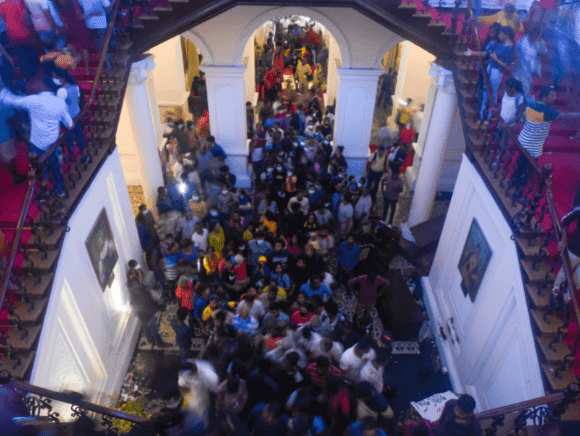

Sri Lanka’s economy collapses and President Gotabaya Rajapaksa announces that he will be stepping down after thousands of protesters stormed his official residence. Parliament Speaker Mahinda Yapa Abeywardena confirmed in a televised announcement that the president will officially resign Wednesday to facilitate "a peaceful transition." Prime Minister Ranil Wickremesinghe also informed the public on Twitter that he, too, will resign from his position. When this happens, according to the nation's constitution, the parliamentary speaker will assume power for one month.
Rajapaksa was taken to an undisclosed location, and some experts speculate that he was relocated to a naval ship. Whatever the case, thousands have invaded the palace, prompting some of the demonstrators to take a swim in his pool after weeks of taking to the streets.
So, what has been happening in Sri Lanka? It has been a month of a financial crisis, social unrest, and mass misery. Last month, the government ran out of money to pay for food and fuel and defaulted on its $51 billion debt. As a result, the South Asian country has been unable to import critical products, including milk, gasoline, and paper. In recent weeks, leaders have been seeking assistance from the International Monetary Fund (IMF) and its neighbors, including China and India.
Until then, the population is facing a myriad of challenges amid shortages of essential items. Reports suggest that households are skipping meals and waiting in long lines to obtain any scraps of food remaining in stores. It is unclear if Colombo will get out of this mess, with officials noting that they only possess about $25 million in usable foreign reserves and are already purchasing deeply discounted oil from Russia.
Although Sri Lanka had made some modest economic gains prior to the COVID-19 public health crisis, the country's financial calamity has been years in the making. The biggest component of the collapse had been fiscal mismanagement, taking on a substantial number of obligations from multiple parties, including the Asian Development Bank, the World Bank, Beijing, Tokyo, and other markets. In addition, the inflation rate had been spiraling out of control while the nation relied entirely on imports.
Has the Recession Been Canceled?
Well, that was one incredible June jobs report. As everyone on Wall Street had penciled in a headline reading below 300,000, the US economy stunned observers and produced 372,000 positions. In addition, the unemployment rate held steady at 3.6%, average hourly earnings rose at a better-than-expected pace of 5.1% year-over-year last month, and average weekly hours stayed the same at 34.5. Overall, it was an impressive look at the sizzling labor market.
Does this mean the recession has been called off? Many headlines in the business media suggested so, writing that an economic downturn had been postponed or put into a corner because of the top-notch numbers. But while the employment figures were exceptional, pockets of the economy are still slumping.
(Photo by Michael M. Santiago/Getty Images)
On the labor front, job openings and quit rates eased, and cuts swelled. The four-week initial jobless claims average has risen every week since the beginning of April. Real wage growth is still deep in negative territory amid soaring price inflation.
For the rest of the economy, the data have been disappointing. The Institute for Supply Management's (ISM) non-manufacturing purchasing managers' index (PMI) eased to 55.3 in June, wholesale inventories rose at a smaller-than-expected pace of 1.8%, consumer sentiment has cratered, housing demand dropped, and regional manufacturing surveys have been atrocious.
To put this into perspective, even after a terrific June jobs report, the Federal Reserve Bank of Atlanta's GDPNow estimate was revised upward to -1.2% in the second quarter, up from -1.9%. Should the labor market remain strong this year, the other aspects of the economy are bleak enough that they may send the United States into a recession.
A Critical Week for the Biden Economy
The coming week could make or break the US economy in the second half of 2022, as a flurry of data will confirm if the country is in a recession or not.
The much-anticipated consumer price index (CPI) for June will be published. Economists are penciling in an annual inflation rate of 8.8%, up from 8.6% in May. They expect the core inflation measurement, which strips the volatile food and energy sectors from the inflation gauge, of 5.8%. The producer price index (PPI) will also be released, with experts forecasting 10.7% year-over-year.
June retail sales are projected to advance 0.8%. Industrial production is forecast to edge up 0.1% while manufacturing output is believed to have been flat. Analysts think that the capacity utilization rate slipped to 80.4%. Import prices are expected to have increased 0.7%, and export prices are anticipated to have gone up 1.1%.
Moreover, in what might possibly set the stage for the second half, the University of Michigan's Consumer Sentiment Index for July could have slipped into subzero territory of 49.8. Consumer expectations may have worsened, while current economic conditions could have fallen even more.
As the great Bette Davis uttered in the superb 1950 motion picture, All About Eve, “Fasten your seatbelts. It’s going to be a bumpy night.” By the end of the week, the American people may also repeat the famous line from another Davis film, 1949’s Beyond the Forest: “What a dump.”



.jpg%20Senate&w=1920&q=75)
.jpg%20Deep%20State&w=1920&q=75)