
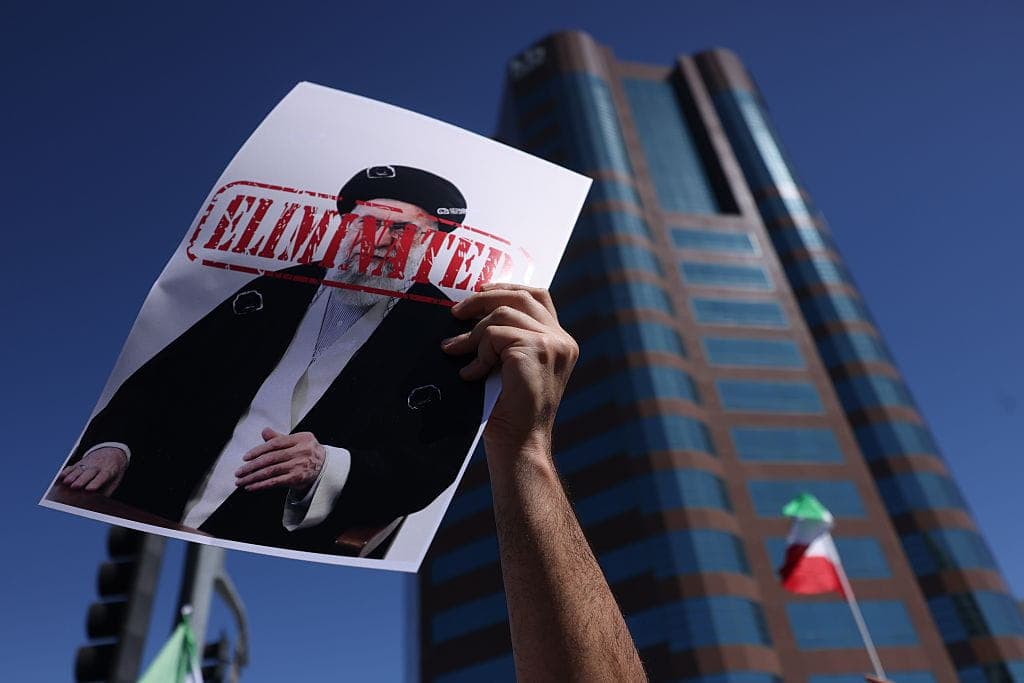

After the United States launched “major combat operations” dubbed Operation Epic Fury in Iran on Saturday, President Donald Trump made the US military’s purpose in the Middle Eastern nation clear: regime change.
"To the members of the Islamic Revolutionary Guard, the armed forces and all of the police, I say tonight that you must lay down your weapons and have complete immunity. Or in the alternative, face certain death. So, lay down your arms. You will be treated fairly with total immunity, or you will face certain death,” Trump said in a video statement. “Finally, to the great proud people of Iran, I say tonight that the hour of your freedom is at hand. Stay sheltered. Don’t leave your home. It’s very dangerous outside. Bombs will be dropping everywhere. When we are finished, take over your government. It will be yours to take. This will be probably your only chance for generations.”
But what will it actually take to achieve a successful regime change in Iran?
Regime Change
The US-Israeli strikes are one step forward on the path to a successful regime change in Iran – but what comes next is arguably more critical. The Islamic Republic’s air defenses, ballistic missile arsenal, and remaining nuclear sites must be devastated, but the most important targets for long-term success are the regime’s political and security institutions.

Once Iran’s military infrastructure is destroyed, and its political leaders and security forces fractured, the Iranian people will be able to “finish off the regime,” Behnam Ben Taleblu, director of the Iran program and a senior fellow at the Foundation for Defense of Democracies, wrote in Foreign Affairs.
“With the security forces out of their way or actively helping them, protesters could seize state television, radio, and other communications platforms and broadcast the end of the Islamic Republic,” Taleblu explained. He acknowledged critics’ concerns that another “strongman” leader would just take over, but insisted such an outcome was avoidable:
“Newly empowered protesters could use their new platforms to call for the country’s large civilian bureaucracy to keep working in order to maintain government functions. They might also bring in Iran’s exiled opposition leaders, who have been planning for and could help lead a transition.
“The real source of destabilization in and around Iran, after all, is not the prospect of regime change. It is the Islamic Republic itself.”
A Major Obstacle
President Trump confirmed Iranian Supreme Leader Ali Khamenei was killed in Saturday’s attack. Will it be enough to topple the government? According to Taleblu, not likely:
“The Islamic Republic may have once been a sultanistic state built on the personal cult of its founding supreme leader, Ayatollah Ruhollah Khomeini. But over the last three decades, Khamenei (Khomeini’s successor) has institutionalized his rule and his regime both by empowering loyalists throughout a considerably larger state bureaucracy and by supporting competing power centers. As a result, the Islamic Republic looks more like a series of pillars than it does a pyramid, with a powerful deep state made up of security officials with their own vested interests in maintaining the regime.”
Taleblu explained that Khamenei’s system is made up of partners rather than superiors and subordinates, meaning remaining officials would likely “close ranks” in the event of Khamenei’s death to “keep the system running and try to seek revenge.”
Iran’s foreign minister called regime change in the Islamic Republic “mission impossible.” “You cannot do regime change while millions of people are supporting the so-called regime,” Abbas Araghchi told NBC News just hours after the first US-Israel joint strikes. But do the Iranian people support the regime? Not according to the data. The Group for Analyzing and Measuring Attitudes in Iran, a Netherlands-based institute, found most Iranians reject the Islamic Republic and support regime change. The organization polled over 77,000 participants inside Iran, and just 20% said they’d prefer to keep the Islamic Republic in place.
Trump is bad news for that 20%, because he has shown no signs of slowing down despite the potentially bumpy road ahead, calling Khamenei’s death “the single greatest chance for the Iranian people to take back their Country.”
“We are hearing that many of their IRGC, Military, and other Security and Police Forces, no longer want to fight, and are looking for Immunity from us,” Trump wrote on Truth Social. “As I said last night, ‘Now they can have Immunity, later they only get Death!’ Hopefully, the IRGC and Police will peacefully merge with the Iranian Patriots, and work together as a unit to bring back the Country to the Greatness it deserves.”


.jpg%20Ukraine&w=1920&q=75)