


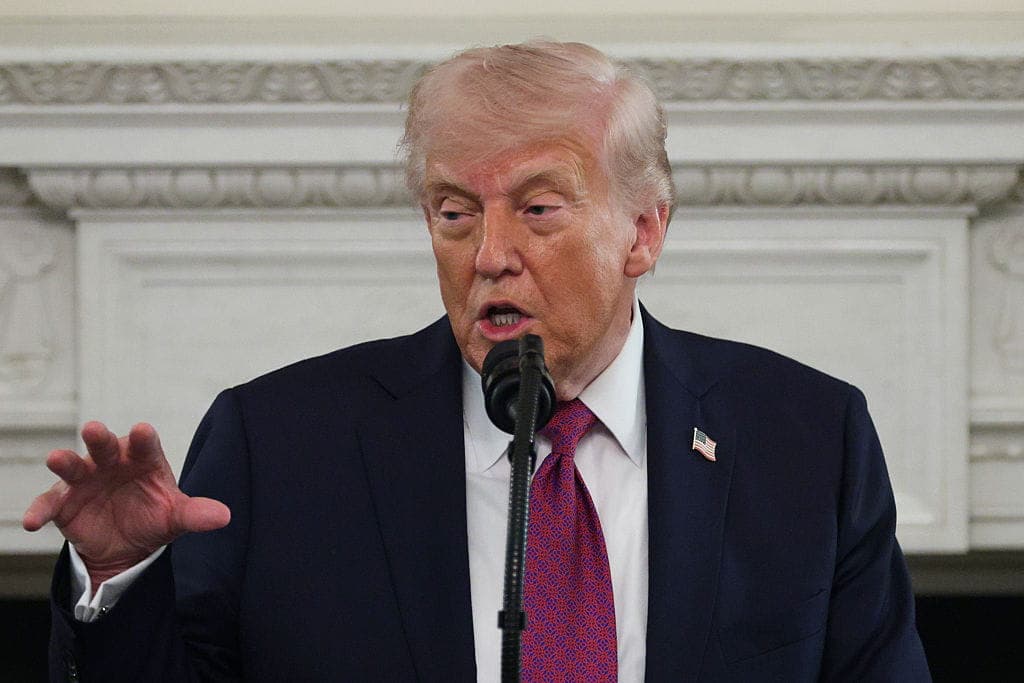

The bombing will resume until attitudes improve. That appeared to be the message coming out of the White House after scheduled peace talks between the United States and Iran were put on hold. Things changed quickly, though. Vice President JD Vance was about to go back to Islamabad, Pakistan, for talks with Iranian officials, but, as of April 21, he was still in Washington, DC. Meanwhile, in Tehran, the Iranian Revolutionary Guard Corps (IRGC) has reportedly sidelined Supreme Leader Mojtaba Khamenei and is now effectively overseeing the functions of the state.
Iranian President Masoud Pezeshkian is now facing a “complete political deadlock,” according to the Iran International website, as the IRGC blocks his ability to make any decisions.
Iran Peace Talks Stall
The word from the US administration was that the vice president will now go to Pakistan on April 22. President Donald Trump has signaled that he is unwilling to extend the current ceasefire, already breached by the Iranians. The temporary truce was set to expire “Wednesday evening Washington time," according to the president.
Asked during a radio interview with CNBC if he expects a deal to be reached, Trump said, "Well, I expect to be bombing, because I think that's a better attitude to go in with."
Then, late in the afternoon of April 21, Trump announced that he would, in fact, extend the ceasefire. Though the US naval blockade of Iranian ports would remain in effect, the president said the ceasefire would be extended “until such time as [Iran’s] proposal is submitted, and discussions are concluded, one way or the other.”
The most recent update – because to describe the situation as fluid would be like asserting that the Pacific Ocean is damp – is that peace talks are also on hold until Tehran delivers a “unified” peace proposal.
Iran International reports that the Iranian president has also been blocked from appointing government officials: “All proposed candidates, including Hossein Dehghan, were rejected. Ahmad Vahidi is said to have insisted that, given wartime conditions, all critical and sensitive leadership positions must be selected and managed directly by the IRGC until further notice.” Vahidi is the chief commander of the IRGC. The site also says the whereabouts of Supreme Leader Mojtaba Khamenei has been unclear “in recent weeks.”
Iran is reportedly demanding that the US lift its blockade of Iranian ports before any agreement can be approved. On April 21, Foreign Minister Seyed Abbas Araghchi asserted on X: “Blockading Iranian ports is an act of war and thus a violation of the ceasefire.” He added, “Iran knows how to neutralize restrictions, how to defend its interests, and how to resist bullying.”
The blockade of Iran’s ports was imposed after the country cut the vital oil supply route through the Strait of Hormuz. President Trump claimed that, after an initial round of talks in Pakistan, Iran had agreed to fully open the strait but quickly reversed its position.
Turmoil at the Top in Tehran
Behnam Ben Taleblu, the senior director of the Iran program at the Foundation for Defense of Democracies, told Fox News Digital, "It’s a mistake to assume this is some sort of coup. This has been the process in Iran for years now, as the regime has chosen conflict over cooperation and emboldened its security forces at every juncture."
Iran is now being governed by a “military council” of senior IRGC officers. Pezeshkian has never exercised much control in Iran. The supreme leader is the more powerful civilian role.
A power struggle now appears to be underway in Iran as regime insiders attempt to oust Ali Asghar Hejazi, a highly placed security official who opposed the naming of Khamenei. Hejazi argued that Khamenei’s appointment as his father’s successor would be tantamount to handing over complete control to the IRGC.
Analysts predict that this latest move by the IRGC signals an even harder line from Iran, making the prospects for peace with the United States fainter than ever.

.jpg&w=1920&q=75)